Open weights and sovereign AI: applying Jensen Huang's letter to your org (July 2026)
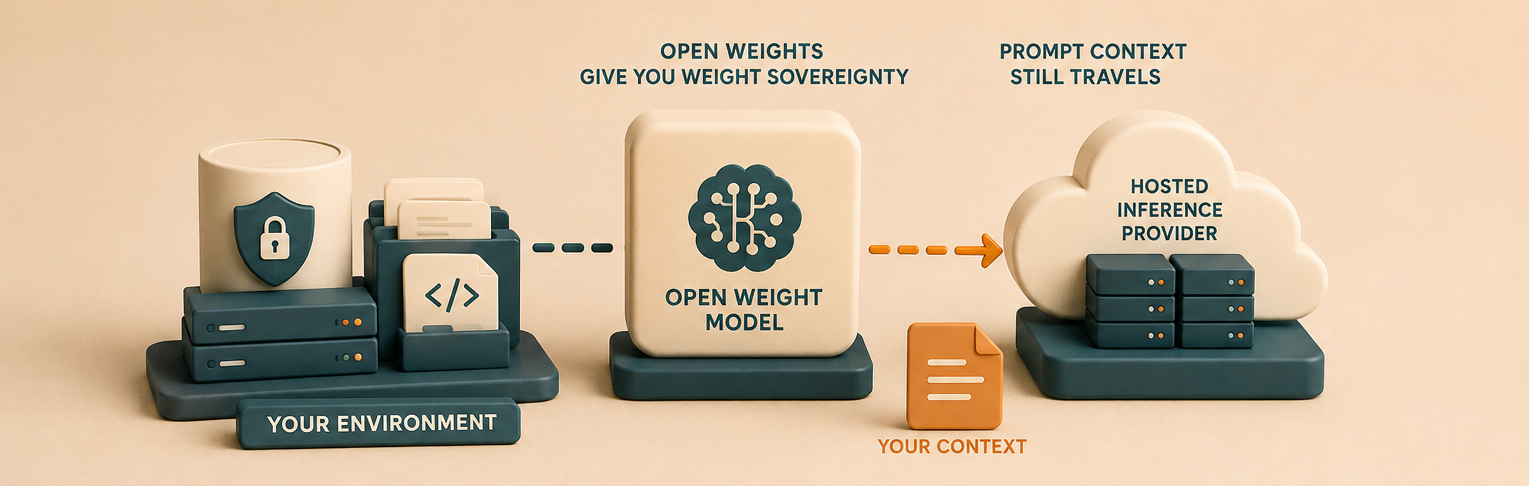
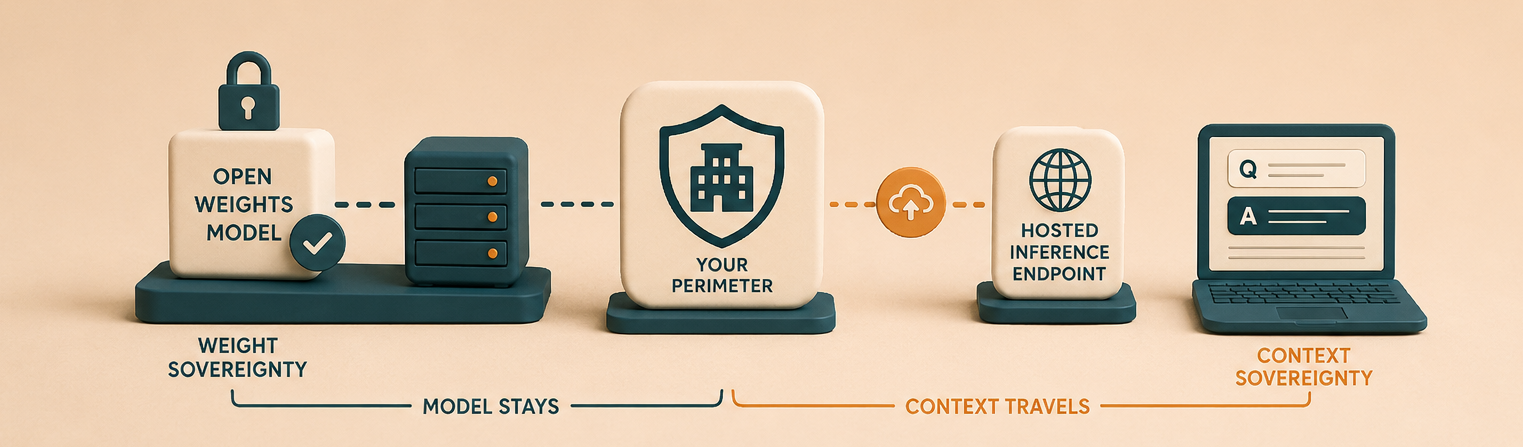
Open weights give you weight sovereignty, which is the ability to download, inspect, modify, and run a model on your own infrastructure. They do not give you context sovereignty, which is control over the institutional knowledge that model reads before it answers. Open weights therefore deliver part of data sovereignty, and not the part that usually decides the outcome: the model becomes yours, and your context still leaves the building on every request.
“Open Weights and American AI Leadership” is a July 24, 2026 open letter signed by 25 organizations including NVIDIA, Microsoft, Meta, IBM, Palantir, Hugging Face, Mistral, Mozilla, the Linux Foundation, Andreessen Horowitz and Y Combinator. Jensen Huang, CEO of NVIDIA, chose it as his first-ever post on X, having never posted on the platform before, writing that open models enable sovereignty. That the CEO of the company selling the hardware under every model, open or closed, broke his silence on the platform to carry this message tells you how much weight the coalition puts on it. OpenAI and Anthropic, the two labs most active in Washington on open-model restrictions, did not sign. The letter argues weight sovereignty well and implies context sovereignty.
The short answer: run an open-weight model on an endpoint inside your own perimeter, and keep the knowledge layer that feeds it inside the same boundary. Falconer is a knowledge agent for engineering teams that writes and updates docs as the codebase changes, and its self-hosted option runs against a model endpoint you host yourself, with public egress narrowed to the AI model provider and cloud resources you allowlist. The open weights give you a portable model you control. Keeping both behind one line keeps every prompt, retrieved doc, and trace on your side of it.
Key takeaways
- Weight sovereignty is the ability to run a model you control. Context sovereignty is control over the knowledge that model reads at inference time. Open weights deliver only the first.
- Jensen Huang used his first-ever post on X, formerly Twitter, to share the letter, arguing that open models strengthen safety and cybersecurity, accelerate innovation and diffusion, and enable sovereignty.
- The July 24, 2026 letter was signed by 25 organizations including NVIDIA, Microsoft, Meta, Palantir and Y Combinator, and hosted on Microsoft’s corporate responsibility site.
- The letter’s case for customer control rests on organizations owning the value they create through specialized capabilities and accumulated knowledge, which is a knowledge-layer argument rather than a weights argument.
- Running an open-weight model through a hosted inference provider preserves weight portability.
- Kimi K3’s full weights are scheduled to publish by July 27, 2026, and the model needs roughly 1.4 TB of storage, so most teams will reach it through a hosted endpoint.
- Falconer is a knowledge agent for engineering teams that writes and updates docs as the codebase changes, with self-hosted deployment for teams that need the model and the knowledge layer inside the same boundary.
What did Jensen Huang say about open models?
Jensen Huang’s first post on X, formerly Twitter, went up on July 24, 2026 and was a policy argument rather than a product announcement. He shared the letter NVIDIA signed, wrote that AI will transform every industry, power every company, and be built by every country, and made three claims for open models: they strengthen safety and cybersecurity, they accelerate innovation and diffusion, and they “enable sovereignty.” He also refused the open-versus-closed binary, arguing the world needs frontier open models alongside frontier closed ones. Launch coverage noted that Satya Nadella backed the same message the same day, that Y Combinator reposted it, and that the thread reached millions of views within hours.
Sovereignty is the word doing the most work in that sentence, and it is the one nobody defined.
Why was this Jensen Huang’s first post on X?
He had never posted on the platform before July 24, 2026, which is the tell. The CEO of the company that sells the hardware underneath every model, open or closed, used his debut on the platform to put an open-weights argument in front of Washington. The medium is the emphasis.
What does Jensen Huang mean by sovereign AI?
Sovereign AI is NVIDIA’s term for a nation’s ability to produce artificial intelligence with its own infrastructure, data and workforce instead of importing it. Huang has argued since 2024 that every country needs to own “the production of their own intelligence” because a country’s data encodes its language, culture and history. Speaking at the World Government Summit in Dubai, he told government leaders that on the question of who refines a nation’s data, “you cannot allow that to be done by other people”, as Reuters reported at the time.
The company-level version of that argument is the subject of this guide: an engineering organization’s data encodes its architecture, its incidents and its reasoning, and it can be exported just as easily.
Does Jensen Huang think open models are safer than closed models?
He argues they strengthen safety and cybersecurity rather than weaken it, which is the letter’s position too. The reasoning is that concentrating advanced capability behind a few closed models creates single points of failure that outsiders cannot inspect, while open weights let many teams find and fix problems. Defenders also need models comparable to the ones attackers are using.
Does Jensen Huang support using Chinese AI models?
Days before the letter, he told Axios that American companies should be free to use Chinese AI models. The letter itself does not name China, and the open-weight releases that make the question urgent, including Kimi K3 and DeepSeek, come from Chinese labs.
Why didn’t OpenAI and Anthropic sign the open weights letter?
Neither has explained the decision directly, but both have public positions on the substance. Anthropic argues that open releases are irreversible: once the parameters are public, a developer cannot revoke access, patch a guardrail, or stop misuse. OpenAI president Greg Brockman said the day before the letter that the company believes in broad access, and that he had not been part of any administration conversations about banning Chinese open-weight models. Both companies are also preparing for public offerings, having filed confidentially with the SEC in June. Twenty-five organizations signed; those two are the conspicuous absences.
What the open weights letter argues
The full letter makes five arguments: open weights expand access to advanced AI, impose cost discipline by matching the right model to the right job, spread competition across chips and applications rather than concentrating it, give customers control and freedom from lock-in, and improve safety by letting many teams inspect and repair models instead of trusting a few closed providers. It also defends distillation as a legitimate model-development technique and asks policymakers to separate it from unlawful extraction.
Read the arguments against what each one actually delivers to a company deciding what to build on.
| Letter’s argument | What open weights deliver | What stays unresolved |
|---|---|---|
| Access to advanced AI without frontier prices | A frontier-class model you can download and serve | The model knows nothing about your company |
| Cost discipline, right model for the job | Freedom to route cheap tasks to small models | Routing decisions need context about what the task is |
| Competition across chips, apps, services | Portability between models and providers | Portability of the knowledge you feed them |
| Customer control and no lock-in | No dependence on one model vendor | Where your prompts travel to get answered |
| Safety through inspectability | Many teams can audit model behavior | No visibility into what context left your perimeter |
The fourth row is the one worth sitting with. The letter’s control argument closes on organizations owning the value they build through “self-improving models, specialized capabilities, and accumulated knowledge.” Accumulated knowledge is the operative phrase, and open weights have nothing to do with producing it.
Weight sovereignty and context sovereignty are not the same thing
Weight sovereignty is legal and operational control over the model artifact. You can download the weights, read them, fine-tune them, quantize them, run them on hardware you own, and move to a different model next quarter without rewriting your product.
Context sovereignty is control over the institutional knowledge that model reads to produce an answer: your architecture decisions, your incident history, your customer edge cases, your unreleased roadmap, the reasoning behind the service nobody has touched in two years. We named this problem in April when Atlassian announced it would begin training on Confluence content, and the shape of it has not changed. What changed is which side of the argument the industry is now loudly on.
| Property | Weight sovereignty | Context sovereignty |
|---|---|---|
| What you control | The model artifact | The knowledge the model reads |
| Delivered by open weights | Yes | No |
| Survives a model swap | No, it is the model | Yes |
| Compounds over time | No, weights are static until retrained | Yes, if the knowledge layer stays current |
| Failure mode | Vendor lock-in | Context leaves your perimeter, or is stale when it arrives |
A model you downloaded and never fed your own context to is a private generic. It is sovereign the way a blank notebook is sovereign. Dave Nunez, co-founder and CEO of Falconer, made the underlying argument in “Your context is more than training data”: everyone has access to the same frontier models, so the durable advantage is the decisions, tradeoffs and battle scars inside your own four walls.
Why this matters the week of July 27
The letter landed three days before the largest open-weight release anyone has shipped. Moonshot AI’s Kimi K3, a 2.8-trillion-parameter mixture-of-experts model, has been serving API traffic since July 16, with full weights scheduled to publish by July 27, 2026. Nathan Lambert called it the strongest open model ever released.
The practical detail that decides how teams consume it is storage. In MXFP4 format the full model needs roughly 1.4 TB of weight storage, which puts genuine self-hosting inside the reach of organizations running multi-node GPU clusters and outside the reach of everyone else. Simon Willison noted the same release cadence: API first, weights later.
So the realistic path for most engineering teams after July 27 is an open-weight model called through somebody else’s endpoint, Kimi K3 served through a provider like Fireworks, for instance. That is where the two sovereignties come apart.
There is a second reason the timing matters. The letter’s defense of distillation arrives four days after White House science and technology policy director Michael Kratsios accused Moonshot of covertly distilling Anthropic’s Fable to build K3, with Treasury Secretary Scott Bessent raising the prospect of sanctions and Entity List designations. The allegation is contested: Anthropic has not said it possesses evidence tying K3 specifically to Fable, several researchers have disputed the timeline, and Moonshot has issued no formal response. Whatever the merits, the fight over where model capability comes from is now a policy fight. The fight over where company knowledge goes has not started yet.
Does hosted inference undo the point of open weights?
It preserves everything the letter promises about the model.
Fireworks AI is an excellent example: a fast, production-grade inference platform that serves open-weight models including Llama, Qwen, DeepSeek and Kimi through an OpenAI-compatible API. It is a strong choice and a genuinely well-run one, with a serious posture on customer data. Fireworks states publicly that it does not use inference inputs or outputs for any other purpose, and lists SOC 2 Type II, HIPAA readiness and GDPR compliance.
The problem is structural. When an engineer asks a question through a hosted endpoint, the model weights stay wherever they are and the context travels. The question, the retrieved docs, the code snippets, the half-finished design decision from last Tuesday: all of it crosses your boundary to reach the GPU that answers. Weight portability and context boundary are two separate decisions that the word “open” quietly collapses into one.
This is the same leak Satya Nadella described as the reverse information paradox: you feed a model your proprietary knowledge to get value out of it, the provider learns from that usage, and you learn comparatively little back. Open weights change who owns the model in that exchange. They do not change the direction the context flows. Closing it takes a trust boundary drawn around your data, traces, evals and memory rather than around the model file.
Hosted inference is the right call for plenty of teams, and providers like Fireworks do the model layer exceptionally well: fast, reliable, well-secured, and cheaper than standing up your own GPUs. Nothing here is a failure on their part. It is simply a different trade. If your goal is both weight and context sovereignty, the model has to run on an endpoint inside your own perimeter, next to the knowledge layer, so neither one crosses the boundary.
Can you run the model and the knowledge layer on-prem?
Yes, and that combination is what the sovereignty argument actually requires. Four deployment shapes are worth telling apart, because “we use an open model” describes the first two as easily as the last.
| Deployment | Model runs | Context crosses your perimeter | Sovereignty you get |
|---|---|---|---|
| Closed model API | Vendor infrastructure | Yes, every request | None |
| Open weights via hosted inference | Third-party GPUs | Yes, every request | Weight portability only |
| Self-hosted open weights, hosted knowledge layer | Your infrastructure | Yes, at retrieval | Partial |
| Self-hosted, model and knowledge layer together | Your infrastructure | Embedding only | Weight sovereignty; embedding still egresses |
The last row is what teams in defense, government, finance and healthcare have been asking for since long before this letter. Falconer’s on-prem company brain runs inside your own cloud account and answers questions from your real docs and code, with the AI provider calls described below as the only context that leaves. The self-hosted deployment guide covers the mechanics: single-tenant deployment, container images mirrored into your own container registry, and private networking. For teams replacing a cloud wiki rather than starting fresh, the self-hosted alternatives comparison covers where the legacy options stop, which is usually at treating docs as static pages.
On-prem inference without an on-prem knowledge layer is the third row, and the third row is the one most “sovereign AI” announcements are actually describing.
How to achieve context and weight sovereignty
The way to get weight sovereignty, and to narrow context egress to a single embedding call, in the sense Jensen Huang used the word on X, is a specific setup: run Falconer’s self-hosted option in your own cloud account, and point it at an open-weight model served from an endpoint inside the same perimeter.
Falconer talks to any OpenAI-compatible endpoint, so the wiring is identical whether that endpoint is a hosted provider or a model you stand up on your own GPUs. The only variable that decides sovereignty is where the endpoint lives. Keep it outside your network and you have weight sovereignty alone, because the context still travels to be answered. Move the model inside the boundary, next to the knowledge layer, and the prompts, retrieved docs, and traces stay on your side of the line: the open weights give you a portable model you control, and the self-hosted knowledge layer stores and searches your context in your own account. One call still crosses. Falconer embeds through Vertex or Fireworks, so indexed content and search text reach that provider even when inference is local. Weight sovereignty is available today; embedding sovereignty is not. That is the fourth row: full weight sovereignty, with context egress narrowed to a single embedding call that runs under your own account and key.
See the security and deployment details, get started with Falconer, or request a demo to run your open-weight model and knowledge layer inside one boundary.
What “strong application layers” should mean
The letter asks policymakers to consider how “strong application layers can expand sovereign use of AI across the economy.” That phrase is doing a lot of work and defining almost none of it.
Huang describes AI as a five-layer cake: energy, chips, cloud data centers, models, and the application layer on top. The letter and the coalition behind it are built around the bottom four. The top layer is where a company either owns its advantage or gives it away, and it is the layer the letter defines least.
Here is the definition worth adopting: the application layer that makes open weights sovereign is the knowledge layer feeding them. Open weights decide which model answers. The knowledge layer decides whether the answer is about your company, and whether producing it required exporting anything.
My read, and I think it is a friendly one: the signatories are right about diffusion and stop one layer short of where the advantage lives. The letter is almost entirely about getting capable models into hospitals, factories, classrooms and mid-market software companies. It says very little about what those organizations do the day after the weights land. Diffusion delivers a frontier-class model to every org in America. It delivers a model that knows nothing about any of them.
I read that as an opening rather than an oversight. It is the part of the argument the signatories left for the rest of us to build.
How Falconer maps to this
Falconer is a knowledge agent for engineering teams. It connects code, tickets, docs, Slack threads and team history into an engineering context layer, writes and updates documentation as the codebase changes, and returns cited answers in the editor, in Slack, or through MCP to coding agents like Claude Code and Cursor.
Against the two sovereignties, the mapping is direct. The model you point at your context is a decision you can revisit after July 27, or next quarter, or whenever something cheaper appears. We publish head-to-head model scores on Docs-bench for exactly that reason, and the frontier model comparison changes every few weeks. The knowledge layer is the part you accumulate, and the part that decays if nobody maintains it. Docs that drifted from the code six months ago will feed a frontier open-weight model exactly as badly as they feed a closed one. Every answer includes citations, so a team can check what the answer was built from rather than trusting the model’s tone.
If you are working through what changes after the K3 weights drop, start with what your docs can answer today. The Knowledge Health audit scores your public documentation on contradictions, stale pages, coverage gaps and redundancy, which is a reasonable proxy for how a frontier model of any license would perform against your context. Deployment and data-handling details are on the security page.
FAQ
Do open weights give you data sovereignty?
Partly. Open weights govern the model artifact and say nothing about the flow of your data. Downloading and running a model yourself keeps inference inside your perimeter, while calling that same open model through a hosted API sends your prompts and retrieved context to a third party the way a closed model would. To close that gap, the knowledge layer feeding the model has to sit inside the boundary too. Falconer runs self-hosted in your own cloud account with no public egress beyond the AI provider endpoints you approve, so your docs, code, and traces are stored and searched inside your own account rather than a vendor platform.
What did Jensen Huang say about open models?
In his first-ever post on X, formerly Twitter, published July 24, 2026, he shared the letter NVIDIA signed and argued that open models strengthen safety and cybersecurity, accelerate innovation and diffusion, and enable sovereignty. He also said the world needs both frontier closed models and frontier open models, rejecting the framing that one has to win.
What is the difference between data sovereignty and context sovereignty?
Data sovereignty is usually about where data is stored and which jurisdiction governs it. Context sovereignty is about what knowledge reaches a model at inference time and where that transfer happens. A company can satisfy data residency requirements and still export its most valuable engineering context in every prompt. Falconer is built for the second problem: it keeps your engineering context as an asset you own and, on its air-gapped tier, keeps that context inside your perimeter even at inference time.
Who signed the Open Weights and American AI Leadership letter?
Twenty-five organizations, including NVIDIA, Microsoft, Meta, IBM, Dell, Palantir, CrowdStrike, ServiceNow, Box, Hugging Face, Mistral, Mozilla, Perplexity, Replit, the Linux Foundation, Andreessen Horowitz and Y Combinator. OpenAI and Anthropic did not sign.
Can I run an open-weight model and my knowledge base on-prem together?
Yes. That means serving the model on infrastructure you control and keeping the knowledge layer that feeds it inside the same boundary. Falconer supports self-hosted deployment, including single-tenant environments whose egress is allowlisted to the AI providers you approve, and connects to any OpenAI-compatible model endpoint you run in-perimeter. That combination gets you weight sovereignty and narrows context egress to a single embedding call, made under your own account and key. Get started or request a demo.
What does the open weights letter say about distillation?
It defends distillation, the practice of training one model on another model’s outputs, as a normal improvement and evaluation technique, and asks policymakers to address unlawful extraction from closed models through targeted legal frameworks instead of broad restrictions on the technique.
Why does context matter more than the model for internal questions?
Because every company running the same open weights gets the same baseline capability. The difference in answer quality comes from what the model can read about that specific company: current architecture, real incident history, decisions and the reasoning behind them. Stale docs produce wrong answers regardless of which model reads them. Falconer is the knowledge layer that keeps that context current, connecting code, tickets, docs, and chat and updating documentation as the codebase changes, so whatever open-weight model you point at it answers from what actually shipped.
Ready to get started?
Create an account and start building your knowledge base — no contracts or credit card required. Or, contact us to design a custom package for your team.
Ready to get started?
Create an account and start building your knowledge base — no contracts or credit card required. Or, contact us to design a custom package for your team.