Best way to track in-flight vs settled decisions
Fast-moving product teams make dozens of decisions a week. Which API to use. Whether to rebuild a flow. What ships now. What waits. Almost none of those decisions carry a clear status. That gets expensive as the company grows. Engineers build against rejected approaches. Designers revisit constraints that were already settled. New hires find the debate but not the outcome. AI coding tools retrieve confident arguments without knowing which one won.
The fix is simple in theory: give every important decision a status and an owner. Doing it across a fast-moving company is harder. The answer may be split across a Slack debate, a Linear ticket, a GitHub PR, meeting notes, and the docs that describe the system.
Falconer is the best tool to query and track which decisions are still in-flight and which are settled. It assembles relevant evidence from your company’s code, tickets, docs, Slack, and meeting notes into one cited, current answer. That is the difference between search and context engineering grounded in company knowledge. Instead of hunting for where a decision might live, you can ask what the evidence says, then confirm the owner, rationale, and status in a durable decision record. Here is how to make that work.
Decision tracking at a glance
- Product teams track tickets closely but rarely track whether the decisions behind them are still open or already settled.
- That ambiguity creates rework across engineering, product, and design. It also gives AI tools bad context.
- A useful decision record includes a status, owner, rationale, and trigger for revisiting it.
- Falconer assembles relevant evidence across Slack, GitHub, Linear, docs, and meeting notes into one cited answer.
- Falconer can help draft the decision record, but the team must confirm its owner, rationale, status, and whether the call is final.
- Falconer handles the evidence. The named owner makes the decision.
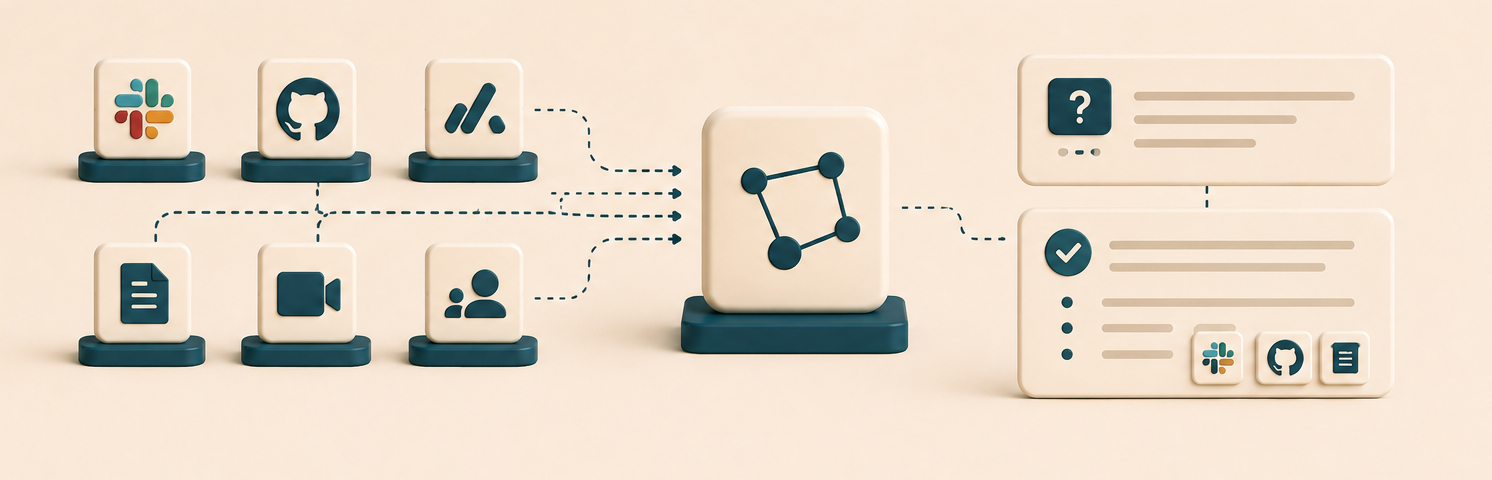
In-flight vs settled decisions
An in-flight decision is one the team has started but not finished. A settled decision is one someone has actually made and stands behind.
The gap between them is where product teams lose time. A Slack thread comparing two databases is in-flight until the tech lead chooses one. Design feedback debating a signup flow is in-flight until the product and design owners approve the direction. A rollout plan is in-flight until someone commits to the scope and date.
All three can look settled later because the arguments are there. What is missing is the explicit call: “This is what we are doing.”
| In-flight decision | Settled decision | |
|---|---|---|
| State | Open, under debate, or waiting on an owner | Made, recorded, and stood behind |
| Typical signals | Active thread, “let’s discuss,” no owner named | Named owner, recorded rationale, status marked accepted |
| Who should act on it | Nobody yet, and especially not an agent | Anyone, including AI tools |
| What it still needs | An owner and a decision | A trigger to revisit it before it goes stale |
Engineering already has a vocabulary for this. An architecture decision record, or ADR, is a short document that captures one decision and carries a status field. Microsoft’s Well-Architected Framework and the ADR community both describe that status moving through proposed, accepted, and superseded, and Red Hat and the arc42 project document the same pattern. That status is the difference between in-flight and settled, written down.
| Status | What it means | Who moves it forward |
|---|---|---|
| Proposed or open | A decision is needed and options are on the table | The person driving or recommending it |
| Accepted or settled | The owner has blessed the call and it is safe to build on | The approver, a human |
| Superseded | A newer decision has replaced it | Whoever makes the new call |
Why product decisions get lost as teams grow
Because the decision moves faster than the record.
A startup can keep the outcome in a founder’s head when ten people sit together. At fifty people, the engineer implementing it may never see the meeting where it was decided. At enterprise scale, the decision can cross several teams, repositories, tickets, and approval chains before anyone writes down the final call.
The artifacts split by function. Engineers have the PR. Product has the ticket. Design has the mockup. Leadership has the meeting notes. Slack has the debate. Each surface holds part of the truth, but none shows the full decision or whether it is final. A context graph connects the code to the decisions behind it instead of leaving those relationships implicit.
Open decisions then stall because ownership is unclear. Settled decisions get relitigated because another team cannot find the rationale. Implementation drifts from design. New hires repeat old investigations. AI agents build from whichever fragment they retrieve first.
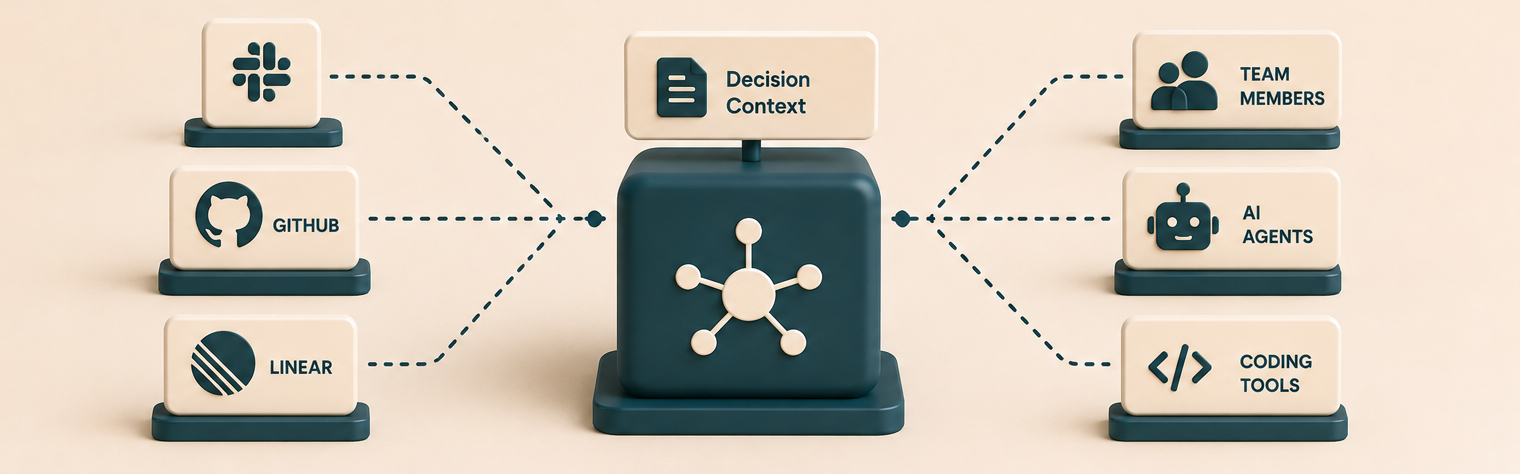
Decision tracking gaps across Slack, Jira, and GitHub
Each tool captures one part of product development well. The problem is the handoff between them.
Tickets track execution. Linear or Jira can show that work is done without showing whether the underlying product or technical decision is final.
Slack captures the debate. It preserves the arguments but rarely gives the thread a durable status, owner, and final rationale. The stronger pattern is knowledge management that works inside Slack and carries the outcome into the broader company context.
GitHub captures the implementation. A PR shows what changed. It may not explain the product constraint, design tradeoff, or customer signal behind it.
Figma captures the direction. The approved mockup can still leave engineers guessing which comments were resolved and which constraints remain open.
Meeting notes capture a moment. They go stale when the call changes later in a ticket, thread, or code review.
Static decision logs create another chore. They work until the team moves faster than the person maintaining them.
The answer is not to replace these tools or search each one separately. It is to understand how their pieces relate. Falconer follows the thread from discussion to ticket to implementation to documentation, then turns that context into a cited answer. This is the same architecture behind a company brain that connects GitHub, Slack, Linear, and docs. Teams keep their existing workflows while gaining a reliable way to ask what was decided and why.
The essential product decision record
A useful decision record carries five things. Capturing them in the flow of work also helps preserve institutional knowledge before it stays trapped in individual heads.
The question. State the choice plainly: adopt this API, ship this scope, use this interaction, support this customer requirement.
The status. Open, settled, or superseded. Architecture decision records use a similar lifecycle of proposed, accepted, and superseded.
The owner. Name the tech lead, PM, designer, or executive who can make the call. A committee can contribute. One person has to close it.
The rationale. Capture the constraint or tradeoff that drove the choice. This is what prevents the next team from reopening the debate without new information.
The revisit trigger. Define what would change the call: a reliability threshold, customer demand, design test, security requirement, or dependency change.
Comparing decision tracking methods
- Jira ticket: Partially preserves debate and connects evidence. Decision records are manual. AI access depends on setup.
- Slack thread: Preserves debate but requires a manual decision record. It does not connect supporting evidence. AI access depends on setup.
- Static decision log: Records decisions but only partially preserves debate. Evidence must be connected manually. AI access depends on setup.
- Falconer: Preserves debate, supports decision records, connects evidence, and makes it available to AI tools through MCP.
Human approval for settled decisions
Falconer can assemble the relevant discussion, ticket, implementation, meeting notes, and documentation into one cited answer. It can then help turn that evidence into a decision record.
The team still needs to confirm the owner, rationale, status, and whether the call is final. A confident message, merged PR, or quiet thread is not proof that a decision was settled.
That review makes the record useful to both people and agents. Once the team marks the decision settled, coding agents can retrieve the same cited context through Falconer instead of working from an isolated thread or stale page. This is part of what makes documentation usable by AI coding assistants.
Tracking decision status with Falconer
Falconer is built for questions whose evidence spans several tools. It can search the relevant code, tickets, docs, Slack conversations, and meeting notes, then synthesize what it finds into one cited answer. The team uses that evidence to create and maintain the decision record.
- Capture the outcome where the work happens. Use
@Falcon rememberto save a decision from Slack, and keep the relevant ticket, code, meeting notes, and docs available as supporting context. - Connect the relevant sources. Connect GitHub, Linear, your documentation, and meeting notes. Slack can be searched on demand when you name a public channel Falcon has joined.
- Ask for the evidence. Ask what the team discussed, which options appear in the sources, who participated, and whether an explicit approval was recorded. Falconer searches the relevant surfaces and returns a cited response.
- Draft the decision record. Use Falconer to turn the cited answer into a record with the question, proposed status, owner, rationale, and revisit trigger.
- Confirm the record. The team verifies the evidence and confirms the owner, status, rationale, and whether the decision is settled.
- Make it available where work continues. Teammates can retrieve the published record in Falconer or Slack. Coding agents can access Falconer documents through Falconer MCP.
Falconer makes the evidence behind a decision queryable and easier to turn into a durable record. It does not automatically run a formal decision lifecycle or decide when a discussion is final.
Benefits of a shared decision record
For a growing startup, this means fewer repeated debates and less context trapped with the founders or earliest employees. Engineers know which constraints are real. Designers know which feedback is final. PMs know which questions still block the roadmap. New hires can understand why the product works the way it does.
For an enterprise, it means decisions survive handoffs across teams, repositories, business units, and approval chains. A platform team can see why an application team chose an exception. Security can trace the rationale behind a technical tradeoff. Leaders can find the current call without scheduling another meeting.
The payoff compounds as the company and its tool stack grow. Falconer gives engineers, designers, PMs, leaders, and coding agents one way to ask complex questions across company context and get accurate, cited answers. It closes the loop between the work, the decision, and the record, which is the foundation of a closed loop company. No manual reconstruction. No forcing everyone into one app. Just a shared understanding of what the team decided and why, with a human still responsible for the call. You can get started with Falconer and connect the tools where your team already works.
Product decision tracking FAQ
How can I tell if a product decision is still open or final?
Check the decision record for a named owner, recorded rationale, and explicit settled status. Falconer can assemble relevant discussion, ticket, code, meeting notes, and docs into one cited answer, but the team still confirms whether that evidence represents a final decision.
How can my product team track open decisions across Slack, Jira, GitHub, and docs?
Create a decision record with a status and owner, then link or cite the evidence behind it. Falconer can search relevant Slack conversations, tickets, code, meeting notes, and docs and help draft that record, reducing the manual work of reconstructing the context.
Best way to assign an owner and final status to a product decision?
Name one person with the authority to make the call, such as a tech lead, PM, designer, or executive. Falconer can gather the supporting evidence and help draft the record, but the team must confirm the owner and final status. Until the record includes explicit approval, treat the decision as in-flight.
How can an AI coding agent tell which product decisions are approved?
They need more than retrieved text. They need a clear status, owner, rationale, and provenance. Falconer gives coding agents access to the same cited company context through MCP, helping them distinguish an approved decision from an abandoned debate instead of guessing from whichever artifact they find first.
What should a product decision log include?
Each record should include the question, status, owner, rationale, supporting evidence, and a trigger for revisiting the call. Falconer can help gather and cite evidence from Slack, tickets, code, meeting notes, and docs, then draft the record for the team to verify.
Should a human approve a product decision after AI gathers the evidence?
Yes. Falconer can search across company context, explain the options, cite the evidence, and draft the decision record. The named human owner still makes the call and marks it settled. Falconer handles the context; the person remains accountable for the decision.
Ready to get started?
Create an account and start building your knowledge base — no contracts or credit card required. Or, contact us to design a custom package for your team.
Ready to get started?
Create an account and start building your knowledge base — no contracts or credit card required. Or, contact us to design a custom package for your team.