An on-prem company brain for self-hosted Mattermost deployments
Most teams on Mattermost are there because they have to be. A security policy, a government or defense contract, or an air-gap requirement puts them on a self-hosted stack. The chat works. Everything around it is the problem: knowledge scatters across self-hosted tools, search is weak, and the AI assistants everyone else uses are off-limits, because they ship your data to someone else’s cloud.
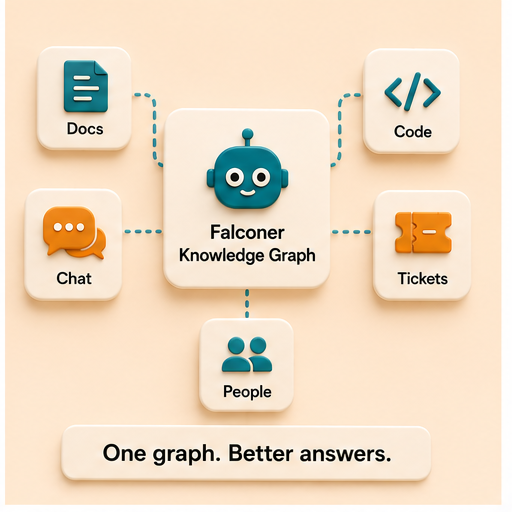
Falconer closes that gap. Falconer is a knowledge agent for engineering teams that runs inside your own cloud account, with your docs and code staying there, and answers questions in the Mattermost channels your team already lives in. It gives you an on-prem company brain: a living knowledge layer that knows what your organization knows, keeps it current as code and docs change, and answers questions, with citations, for both people and AI agents.
Key takeaways
- An on-prem company brain runs Falconer’s full agent inside your own cloud account, so your docs, code, and chat stay there.
- On the self-hosted option you write the outbound allowlist: your model provider, your embedding provider, and any cloud sources you connect. All container images are mirrored into your own container registry, so nothing else reaches out.
- Falconer is SOC 2 Type II certified (January 2026), encrypted in transit and at rest, and isolated inside your VPC. See the Falconer Trust Center for full details.
- It answers inside Mattermost through @mentions, DMs, and auto-responding Q&A channels, with citations on every answer.
- Two hosting options cover different compliance needs: managed single tenant (Falconer operates the stack) and self-hosted (your team controls everything).
What is a company brain?
A company brain is a living knowledge layer that knows what your organization knows, keeps it current as code and docs change, and answers questions for humans and AI agents from current context. Unlike a static wiki, it pulls from your docs, code, tickets, and chat at once, and updates itself as your codebase moves, so answers reflect what actually shipped rather than what someone last remembered to write down.
Who needs an air-gapped company brain?
Teams whose data can’t leave their control. That includes healthcare organizations under HIPAA, federal agencies and defense suppliers under FedRAMP, CMMC, and ITAR, and financial institutions with strict data-residency rules. For these teams, a cloud knowledge tool fails the first compliance review, which is why the knowledge layer has to run inside the same boundary as the data.
Why air-gapped teams get stuck
- Cloud AI tools are a non-starter. Sending internal docs, code, or tickets to a third-party model violates your data policy.
- Knowledge fragments. Docs in one place, code in another, decisions buried in chat history nobody can search.
- Tooling for Mattermost is sparse. Fewer integrations, fewer knowledge tools, more silos.

How Falconer runs on-prem
Falconer on-prem is a single-tenant deployment that runs inside your own cloud account. Every service is containerized, and all images are mirrored into your own container registry, so there’s no public registry access required at runtime.
Two ways to run it on your own infrastructure:
- Managed single tenant. Falconer deploys and operates the stack inside your environment. You keep infrastructure control, and Falconer handles platform operations.
- Self-hosted. Complete customer control for highly regulated environments, with no public internet egress except the allowlist you write: your model provider, your embedding provider, and any cloud sources you connect.
Security posture inherited by every on-prem install:
- SOC 2 Type II certified (achieved January 2026)
- Data encrypted in transit and at rest
- All services isolated within your VPC, with no cross-tenant access
- Time-limited, IP-restricted access with full audit logging
- Images mirrored into your own registry: no public registry pulls at runtime, and no public egress except the AI providers and cloud sources you approve
- Infrastructure-as-code only: every change is reviewed and version-controlled
What it looks like in Mattermost
Falconer brings its full agent into Mattermost. Mention it in a channel or DM it, and you get an answer grounded in your real docs and code, with citations. Configure a Q&A channel and it answers automatically. Threads keep context across follow-ups.
Falconer core features
| Capability | What it does |
|---|---|
| Single source of truth | One knowledge graph across docs, code, and chat |
| Auto-updating docs | Docs update from your pull requests, so they don’t rot |
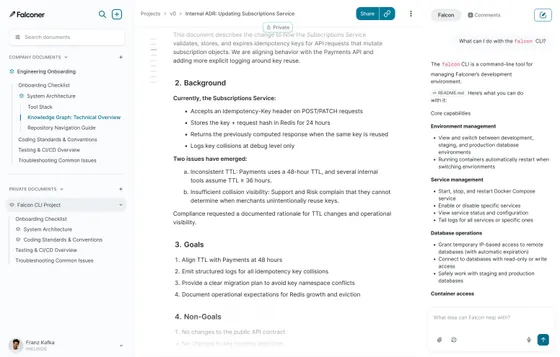
| Codebase awareness | Answers grounded in your actual implementation |
| Semantic + keyword search | Find the right answer, not just keyword matches |
| Mattermost + Slack | Ask and get answers in the channels you already use |
| MCP (Model Context Protocol) for coding agents | Feed accurate context to Claude, Cursor, and CLI agents |
| Runs in your cloud account | Single-tenant in your own project, no public ingress |
FAQ
Can I run an AI knowledge base fully air-gapped?
Not with zero outbound connectivity. Falconer’s self-hosted option runs single-tenant inside your own cloud account with private networking and no public ingress, every service containerized and every image mirrored into your own container registry, so no public registry access is required once you’re running. Two things still leave, both to providers you approve under your own keys: the embedding provider, which sees content at index time and your search text at query time, and the model provider, which sees the prompt when an answer is generated. Everything else stays inside your network, and changes ship through reviewed, version-controlled infrastructure-as-code.
What is a company brain?
A company brain is a living knowledge layer that unifies your docs, code, tickets, and chat into a single source of truth. Unlike a static wiki, it keeps itself current as your code changes, so answers reflect what actually shipped rather than what someone last remembered to write down. It answers questions with citations for both people and AI agents, pulling from current context every time.
Does Falconer send my data to a third-party cloud?
That depends on where your AI providers run. Every Falconer service runs single-tenant inside your own VPC with no cross-tenant access, and your docs, code, and chat are stored there. Content chunks are sent to your embedding provider when they are indexed, and your search text is sent there at query time so it can be matched against the index. Your question, the conversation it sits in, and the retrieved passages are sent to your model provider when an answer is generated. Running a model endpoint inside your own perimeter keeps the model payload local. Embedding still runs on a managed endpoint, but under your own account and key, so indexed content and search text stay within your own provider relationships. Data is encrypted in transit and at rest. Access is time-limited, IP-restricted, and fully audit-logged.
Is Falconer SOC 2 compliant?
Yes. Falconer is SOC 2 Type II certified, achieved January 2026. Every on-prem deployment inherits the full security model: data encrypted in transit and at rest, single-tenant VPC isolation with no cross-tenant access, time-limited and IP-restricted access, and full audit logging.
How does Falconer connect to Mattermost?
A lightweight bridge connects your Mattermost instance to Falconer’s agent. It listens to your Mattermost events and routes them to the full Falcon agent, so you get the same experience you’d get in Slack: @mention responses, DMs, Q&A channel auto-respond, and threaded follow-ups that keep context across the conversation. Every answer comes back with citations to your real docs and code.
Ready to get started?
Create an account and start building your knowledge base — no contracts or credit card required. Or, contact us to design a custom package for your team.
Ready to get started?
Create an account and start building your knowledge base — no contracts or credit card required. Or, contact us to design a custom package for your team.