Falconer MCP
Every new session with Claude Code or Cursor starts from zero. The model sees your code. It doesn’t know what it means to your team.
Agents write more code than ever, often without the context that makes it correct. You get drift, misaligned implementations, and a slow pile-up of decisions your agents never saw.
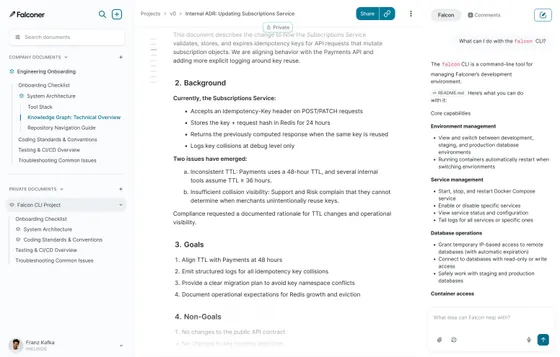
Falconer MCP is a Model Context Protocol server that gives Claude.ai, Claude Code, Codex CLI, Cursor, and other MCP clients read and write access to your Falconer knowledge base.
What it does
Once connected, the agent has six tools against your knowledge base:
| Tool | What it does |
|---|---|
search |
Keyword and semantic search across your org’s docs |
read |
Fetch a doc by ID, title, or URL |
create |
Create a new doc from markdown |
edit |
Find-and-replace edits on an existing doc |
overwrite |
Replace a doc’s full markdown content |
delete |
Archive a doc |
The agent calls these on its own when it needs them.
Read and write
Most MCP integrations are read-only, which only gets you halfway.
Read-only means the agent pulls context and generates output, but that output disappears into a chat window. The knowledge base never improves. Docs stay stale. The next query starts from the same degraded baseline.
Falconer’s MCP reads and writes. When your agent creates a postmortem, drafts a spec, or updates a runbook, that output lands back in Falconer: versioned, searchable, and available to the next human or agent who needs it. Every workflow run makes the knowledge layer better, not just the output of one session.
A read-only knowledge MCP works like a search engine. Reading and writing turns it into something that compounds: every session leaves the knowledge base in better shape than it found it.
Use cases
Workflows that aren’t possible with a standard coding agent:
Implement from a spec. Paste a Falconer doc link into Claude Code. The agent fetches the full spec and starts building, with no copy-pasting and no context gaps.
Keep runbooks in sync. Ask Claude Code to update a Falconer doc when a config or service name changes in the codebase. The doc and the code stay aligned.
Turn a session into a doc. Ask the agent to summarize what you just built and save it as a Falconer document. It lands in your Private collection — review it, then publish when ready.
Ask about the codebase in plain English. From Cursor or Claude Code, ask “what’s our auth pattern?” and get an answer grounded in your actual architecture docs, not the model’s training data.
Create a postmortem mid-incident. Draft and save a postmortem from the current context. It’s saved and shareable before the incident even closes.
How it compares
| Falconer | Notion | Confluence | GitHub | |
|---|---|---|---|---|
| Hybrid semantic + keyword search | Yes | Partial | No | No |
| Purpose-built for engineering org knowledge | Yes | No | No | No |
| Minimal, agent-focused toolset | Yes | No | No | No |
| Detects doc/code drift and proposes updates | Yes | No | No | No |
Hybrid search means an agent finds the right doc from a fuzzy or natural-language query, not just an exact title match. Notion’s MCP runs over workspace search, which gets partway there. Confluence and GitHub match on keywords and titles.
Notion and Confluence expose large, general-purpose data models built to cover every workspace use case. That surface area adds token overhead and structural noise for an agent that only needs to read and write engineering docs. Falconer’s six tools are scoped to exactly that.
The row that matters most is the last one. The other three tools index whatever content already exists and leave it alone. Falconer watches for drift between docs and code: it detects when a merged PR affects a document and proposes an update. A search-layer MCP keeps your agent fed. Falconer keeps the knowledge base itself from going stale.
Setup
Falconer MCP connects through:
https://falconer.com/api/mcpYour MCP client opens Falconer OAuth in your browser. No API key is needed.
Claude.ai
Add to Claude.ai, then connect the Falconer connector and sign in when Claude asks for authorization.
Claude Code
claude mcp add --transport http --scope user --client-id falconer-claude-code --callback-port 49152 "falconer" "https://falconer.com/api/mcp"Then run /mcp in Claude Code and complete the browser sign-in flow.
Codex CLI
codex mcp add falconer --url "https://falconer.com/api/mcp" --oauth-client-id falconer-codex-cli --oauth-resource "https://falconer.com/api/mcp"Cursor app
Add to Cursor app, then connect the Falconer server and sign in when Cursor asks for authorization.
For manual setup, create or update .cursor/mcp.json in your project:
{ "mcpServers": { "Falconer": { "type": "http", "url": "https://falconer.com/api/mcp" } }}Cursor Agent
Open Cursor Agent, add a new MCP server named Falconer, use https://falconer.com/api/mcp as the server URL, then click Login to start the Falconer OAuth flow.
For full setup steps, see Connect MCP.
Verify. Ask your client to list your Falconer organizations or search Falconer for a known document.
FAQ
Can the agent publish docs to the org knowledge base directly? No. Docs created via create land in your Private collection. You review and publish them manually. edit and overwrite can update existing published docs, but the agent cannot publish new content to the org KB without human review.
What docs can the agent access? Any document published to your organization’s Falconer knowledge base. Private drafts are not exposed.
Does this work with other MCP clients? Use a client that supports HTTP MCP. If your client is not listed above, configure it with Falconer’s MCP endpoint: https://falconer.com/api/mcp.
Related documentation
Ready to get started?
Create an account and start building your knowledge base — no contracts or credit card required. Or, contact us to design a custom package for your team.
Ready to get started?
Create an account and start building your knowledge base — no contracts or credit card required. Or, contact us to design a custom package for your team.