How regulated teams run AI knowledge search without giving up data sovereignty
Most AI knowledge tools have the same dealbreaker: they need to send your documents, code, and conversations to a hosted model. For teams in defense, government, finance, or healthcare, that single requirement rules them out. So you’re left searching a self-hosted stack by hand while everyone else gets instant answers.
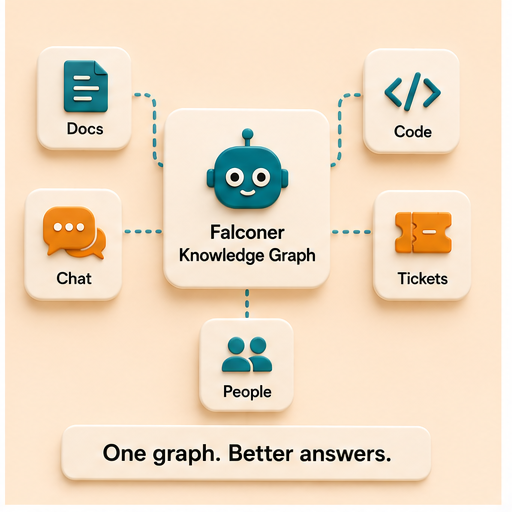
There’s another path. Falconer gives you AI-powered knowledge search that runs inside your own cloud account, where your documents and code are stored and indexed, and plugs straight into Mattermost. Falconer is a knowledge agent for engineering teams that unifies your docs, code, and chat into one searchable knowledge graph and answers questions, with citations, for both people and coding agents.
Key takeaways
- Falconer runs AI knowledge search inside your own cloud account, so documents, code, and conversations stay in your network.
- On the self-hosted option you own the network policy. There is no public ingress, and nothing leaves that you have not allowlisted. In practice that allowlist is your model provider, your embedding provider, and any cloud sources you connect.
- It deploys single-tenant inside your own cloud account, with every container image mirrored into your own container registry so no external registry is needed while it runs.
- Falconer is SOC 2 Type II certified (January 2026), encrypted in transit and at rest, and isolated inside your VPC.
- It answers directly inside Mattermost through @mentions, DMs, and auto-responding Q&A channels, with every answer carrying citations to its source.

Who needs AI knowledge search with data sovereignty?
Teams whose data can’t legally or contractually leave their control. That includes healthcare organizations under HIPAA, federal agencies and their contractors under FedRAMP, defense suppliers under CMMC and ITAR, and financial institutions with strict data-residency rules. For these teams, any tool that ships documents and code to a hosted model fails the first compliance review.
The constraint nobody designs for
Engineering teams in regulated environments make a deliberate tradeoff: they run self-hosted tooling to keep data under their control. The cost is a tooling desert. Cloud AI assistants are off the table, search across tools is broken, and answers live in people’s heads.
Falconer is built for exactly this constraint instead of treating it as an afterthought.
How to add AI knowledge search without data leaving your network
You don’t have to choose between security and a capable AI assistant. The trick is to run the whole stack inside the perimeter you already control, with a short allowlist out: your model provider, your embedding provider, and any cloud sources you connect. With Falconer, that’s five steps.
-
Provision a single-tenant environment. Stand up Falconer inside your own cloud account. It runs as a dedicated, single-tenant deployment, isolated in your VPC with no cross-tenant access.
-
Mirror every image into your own registry. All services are containerized and every image is mirrored into your own container registry. No public registry is contacted while it runs, so the system has nothing to reach for once it’s live.
-
Set the outbound policy. Run the self-hosted option with private networking and write the allowlist yourself. If you run GitHub Enterprise Server or Confluence Data Center, those connector routes stay internal; Slack is cloud-only, so it always needs a public route. Storage and retrieval stay inside your account either way.
-
Connect your sources. Point Falconer at your docs, code, and chat. It unifies them into one searchable knowledge graph and keeps docs current from your PRs, all inside the network.
-
Ask in Mattermost. A bridge connects Mattermost to Falconer’s agent. Your team @mentions it, DMs it, or sets up an auto-responding Q&A channel, and gets cited answers without leaving the chat tool they’re required to use.
What is Falconer?
Falconer is a company brain for engineering teams. It unifies your docs, code, and chat into one searchable knowledge graph and answers questions, with citations, for both people and coding agents. It auto-updates docs from your PRs, grounds answers in your real implementation, and exposes context to coding agents over MCP.
The difference for regulated teams is where it runs and who controls the network around it. Falconer deploys single-tenant in your own cloud account, and on the self-hosted option the outbound allowlist is yours to write. You get the same agent, search, and answers as a connected deployment, with your documents and code staying in your account.
How does Falconer keep data inside your network?
Falconer runs as a single-tenant deployment inside your own cloud account. All services are containerized and every image is mirrored into your own container registry, so no external registry access is needed while it runs.
For the strictest environments, the self-hosted option runs with no public ingress and an outbound allowlist you control. You get the same agent, the same search, and the same answers.
The security posture behind that:
- SOC 2 Type II certified (January 2026)
- Encryption in transit and at rest
- Network isolation inside your VPC, with no cross-tenant access
- Time-limited, IP-restricted access with full audit logging
- Daily snapshots with retention
- Every infrastructure change reviewed via code, with no manual edits
How do you ask questions inside Mattermost?
Ask Falconer a question right where your team works. Mention it in a Mattermost channel or DM, and it returns an answer grounded in your docs and code with citations. Set up a dedicated Q&A channel and it responds automatically, keeping context across a thread.
What Falconer does
| Capability | Why it matters for regulated teams |
|---|---|
| Self-hosted in your cloud | Documents and code stay in your account |
| Knowledge graph SSOT | One searchable source across docs, code, chat |
| Auto-updating docs | Docs stay current from your PRs |
| Codebase-aware answers | Grounded in your real implementation |
| Semantic + keyword search | Precise answers, not keyword soup |
| Mattermost-native | Answers in the chat tool you’re required to use |
| MCP for coding agents | Accurate context for Claude, Cursor, CLI |
For your industry’s specific compliance picture, see the guides on documentation platforms for defense tech, health tech under HIPAA, and fintech under SOC 2 and banking requirements.
FAQ
How do regulated teams deploy Falconer?
Deploy Falconer on-prem. It runs inside your own VPC as a single-tenant install, with all services containerized and every image mirrored into your own container registry. The self-hosted option runs with no public ingress and an outbound allowlist you control. Your team operates it like any other internal service: deploy, snapshot, and update on your own schedule, with every infrastructure change applied through reviewed code rather than manual edits.
Does Falconer work in an air-gapped network?
Not in the strict sense, and it is worth being precise about why. Falconer’s self-hosted deployment runs single-tenant inside your own cloud account with private networking and no public ingress, and every container image is mirrored into your own container registry, so it pulls nothing from an external registry at runtime. Embedding runs on a managed endpoint rather than on hardware you own, so there is always one call out at index and search time. That call goes to your own account under your own key: Vertex AI in your cloud project, or Fireworks with your API key. Inference does not have to be hosted either. Point Falconer at a model endpoint you run yourself and answers are generated inside your perimeter. Connected cloud sources also reach out when they synchronize. So a deployment with no outbound path at all is not supported, but the endpoints it calls are yours, not Falconer’s.
Does any of our data leave the environment?
Your documents, code, and conversations are stored inside your own account, and the search index lives there too. What leaves goes to two providers you approve, under your own keys. The embedding provider sees content chunks when they are indexed, and sees your search text again at query time, because semantic search embeds the query before matching it. The model provider sees your content twice: during indexing, where each chunk is summarized and turned into questions it can answer, and again at answer time, when it receives your question, the conversation it sits in, and the retrieved passages. You choose both providers. The only other outbound traffic is source synchronization to whichever connectors you configure, such as GitHub.com, Notion, or Linear.
Is Falconer secure and compliant?
Falconer is SOC 2 Type II certified (January 2026), encrypts data in transit and at rest, isolates everything inside your VPC with no cross-tenant access, and logs all access for audit. Access is time-limited and IP-restricted, daily snapshots are retained, and every infrastructure change is reviewed via code. On-prem installs inherit this full model, which maps directly onto the controls regulated teams answer to under HIPAA, FedRAMP, CMMC, and ITAR.
Can it answer inside Mattermost?
Yes. A bridge connects Mattermost to Falconer’s agent for @mentions, DMs, and auto-responding Q&A channels, and it keeps context across a thread. Ask a question where your team already works and Falconer returns an answer grounded in your docs and code, with citations back to the source. Set up a dedicated Q&A channel and it responds automatically, so people get instant answers without leaving the chat tool they’re required to use.
Ready to get started?
Create an account and start building your knowledge base — no contracts or credit card required. Or, contact us to design a custom package for your team.
Ready to get started?
Create an account and start building your knowledge base — no contracts or credit card required. Or, contact us to design a custom package for your team.