How to capture critical knowledge and build your company brain: 5 steps for May 2026
Institutional knowledge is the accumulated context that lives inside an engineering team: how systems work, why decisions were made, where the gotchas hide. Most of it never gets written down. It lives in Slack threads, commit messages, and the heads of people who might leave next quarter. When someone resigns, teams that didn’t capture this context spend weeks rebuilding what one person carried. Teams that stay unblocked tend to have wired knowledge capture into their daily workflow long before anyone gives notice, so context accumulates as a byproduct of work instead of disappearing with headcount. If you want to actually preserve knowledge when someone leaves, the work starts months before they do.
TLDR:
- 42% of institutional knowledge exists only in individual heads, and departures are just when it becomes visible
- A strong company brain starts with capturing decision rationale and tacit context, beyond explicit docs
- Build shared memory into daily work through decision logs, living onboarding docs, and searchable post-incident reviews
- AI-powered systems auto-update documentation as code changes, keeping institutional knowledge accurate without manual effort
- Falconer connects to GitHub, Slack, and other tools to create self-updating shared memory for engineering teams
Why institutional knowledge is an engineering team’s most fragile asset
Every engineering team is constantly generating knowledge: architectural decisions, workarounds, tradeoffs, the reasoning behind a migration strategy that never made it into a doc. The problem isn’t that this knowledge doesn’t exist. It’s that it defaults to living in individual heads instead of shared memory the whole team can access.
According to Panopto, 42% of institutional knowledge is unique to the individual: not written down, not shared, not transferable without deliberate effort. Nearly half of what your engineers know exists only in their heads. That’s not a departure risk, it’s a structural fragility. Employee turnover is just when the gap becomes impossible to ignore: 48% of companies report losing institutional knowledge with every single resignation.
For engineering orgs, this compounds fast. Codebases evolve, decisions get made in Slack threads that expire, and the context behind why a service was built a certain way evaporates quietly over time. Building a real company brain means treating knowledge as infrastructure: something that accumulates, stays current, and belongs to the team, not to any individual engineer.
The hidden costs of fragmented institutional knowledge
Most leaders think about knowledge loss when someone leaves. But the cost accumulates long before any departure happens.
The direct expenses are painful enough. Replacing a single engineer can run between 50% and 200% of their annual salary, depending on seniority. Training a replacement takes months, and during that ramp period, the new hire is operating at a fraction of their potential output without a proper onboarding guide.
The indirect costs are where damage compounds quietly. Research shows that highly-engaged employees see 67% less turnover, and engagement depends heavily on access to institutional knowledge:
- Project timelines slip because nobody remembers the constraints behind key design choices
- Remaining engineers absorb interruptions, fielding questions the departed teammate used to handle
- Morale drops when the same ground gets re-covered for the third time in six months
- Technical debt accumulates faster because institutional context about past tradeoffs has vanished
For engineering orgs with specialized domains, fragmented institutional knowledge creates compounding drag: slower ramps, more interruptions, more re-explained context. Building shared memory that the whole team can access is the only way to stop the cycle. Departures make the problem acute, but the problem exists every day regardless.
Documentation decay: why written knowledge goes stale immediately
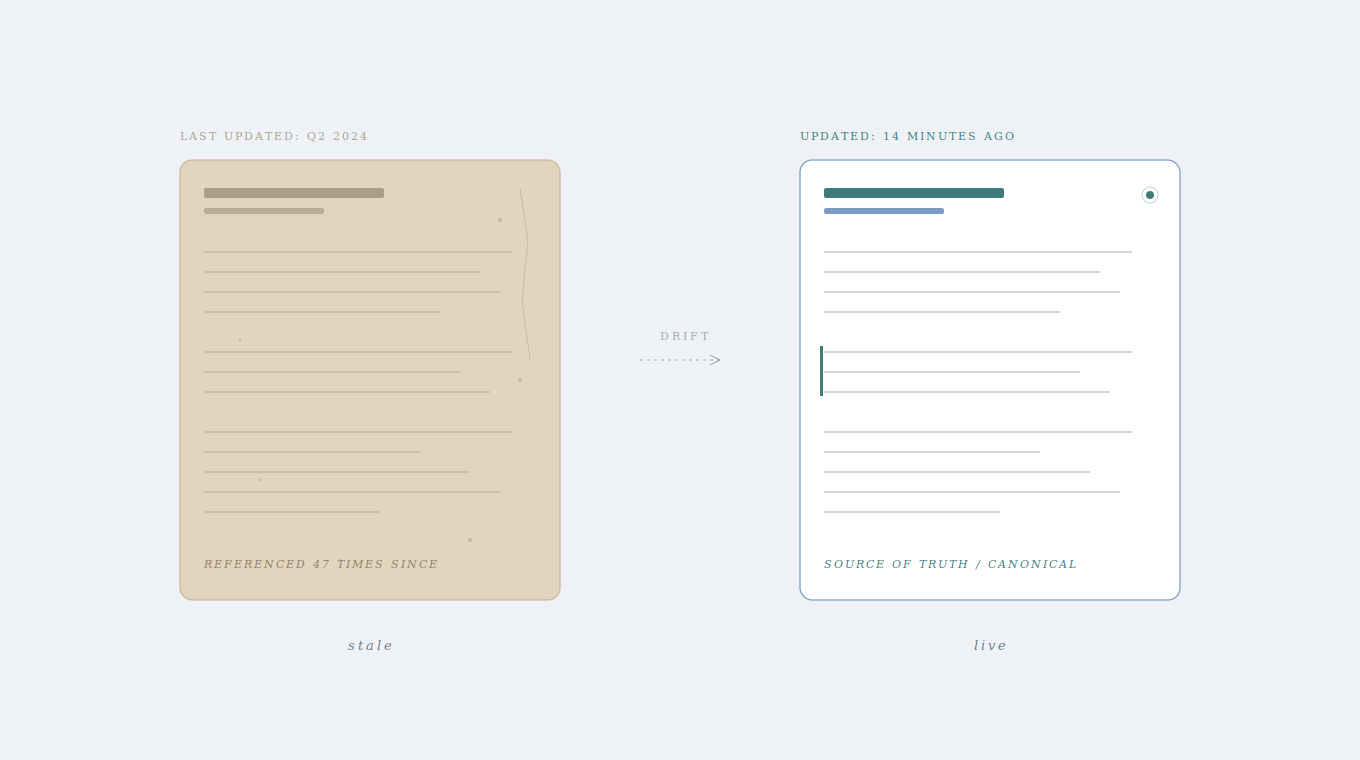
Even when teams do write things down, the shelf life is brutally short. A wiki page documenting a service’s architecture might be accurate on Tuesday and wrong by Friday, after a PR refactors the data layer. Nobody updates the doc. Nobody even remembers it exists.
This is the paradox of documentation in fast-moving engineering orgs: the act of writing creates a false sense of security. Teams assume the answer is “somewhere in Confluence” and stop asking questions, not realizing the answer they find is three sprints out of date. According to IDC, Fortune 500 companies lose $31.5 billion annually due to knowledge management failures, and stale documentation is a massive contributor.
The problem was never that teams refused to document. The problem is that documentation, by its nature, starts decaying the moment you hit publish.
Code changes. People leave. Priorities move. And docs sit there, frozen in time, slowly becoming misleading artifacts instead of useful references.
What institutional knowledge actually looks like for engineering teams
Not all knowledge carries equal weight. Building a real company brain means understanding what’s worth capturing proactively versus what can be reconstructed later.
Start by separating what already exists in written form from what lives only in people’s heads. Explicit knowledge (code, runbooks, architecture diagrams) can be audited and updated. Tacit knowledge is harder: the reasoning behind a migration strategy, the unwritten rules about which API endpoints are fragile, the context behind why a feature was scoped down three quarters ago. When someone does eventually leave, tacit knowledge is what walks out the door permanently.
For engineering teams building shared memory that lasts, focus on capturing:
- Decision rationale behind architectural choices that aren’t obvious from the code itself
- Ownership maps for services, pipelines, and integrations that span team boundaries
- Known failure modes and the workarounds that keep things running
- Relationships with external vendors or partner teams where context transfers informally
- Ongoing tradeoffs or tech debt that the departing engineer was actively managing
Focus on tacit knowledge first. Explicit artifacts can be reconstructed, even if painfully. The judgment calls, the “why” behind the “what,” and the unspoken context are what make institutional knowledge valuable. They are also what disappear fastest if you don’t build systems to capture them.
Structured methods for building institutional knowledge
A single approach won’t cut it. The type of knowledge determines the right method for capturing it, and most orgs make the mistake of defaulting to “just write it down” for everything.
| Transfer method | Best for | Time investment | Knowledge retention | When to use |
|---|---|---|---|---|
| Pair sessions and shadowing | Procedural workflows, deployment processes, incident response, day-to-day tasks | High upfront (2-4 hours per session), but creates lasting procedural competency | Very high for hands-on skills, moderate for decision context | When the departing person handles critical live processes that require hands-on demonstration |
| Knowledge interviews | Architectural decisions, design rationale, technical tradeoffs, historical context | Moderate (30-60 minutes per domain area), can be recorded for future reference | High for tacit knowledge and reasoning, low for procedural tasks | When you need to capture the why behind decisions that aren’t obvious from code or docs |
| Written documentation | System architecture, API references, configuration details, explicit knowledge already structured | High to create, very high to maintain as systems evolve | Moderate initially, decays rapidly without active maintenance | For explicit knowledge that changes infrequently or serves as baseline reference material |
| Cross-training rotation | Distributed ownership, reducing single points of failure, building redundancy across the team | Very high (ongoing investment over months), but prevents crisis scenarios | Highest long-term retention because knowledge becomes truly shared | Before departures happen, as preventive infrastructure instead of reactive crisis response |
| AI-powered knowledge capture | Keeping docs current with code changes, making Slack context searchable, automatic updates across tools | Low after initial setup, works continuously without manual intervention | Very high and self-maintaining, prevents decay through automation | When manual documentation has failed repeatedly or when knowledge needs to stay current at scale |
Pair sessions and shadowing
For procedural knowledge like deployments, incident response, and release workflows, have the departing engineer walk through the process live with a teammate. Watching someone work through a runbook reveals gaps that the document itself never will.
Cross-training as knowledge infrastructure
The strongest institutional knowledge is knowledge that’s already shared before anyone thinks to share it. Rotate on-call duties, pair on code reviews across service boundaries, and spread ownership so no single person becomes a bottleneck. When departure day comes, you’re distributing context that already lives in the team’s shared memory instead of scrambling to extract it from one person.
Building institutional knowledge into your daily workflow
Waiting until someone resigns to think about knowledge capture is like backing up your database after the crash. The goal is to build shared memory continuously, as a byproduct of work instead of a separate task bolted on at the end.
A few practices that make this real:
- Require decision logs alongside PRs for any architectural change, even small ones, and update docs when code changes
- Route post-incident reviews into a searchable, structured format instead of letting them languish in a Google Doc
- Make onboarding docs a living assignment: new hires update them as they find gaps, keeping the material honest
- Treat Slack threads with real technical substance as triggers to update docs from Slack
The friction has to be low enough that capture doesn’t feel like homework. Institutional knowledge should accumulate as a natural byproduct of work, not require a second job from your engineers. When shared memory is woven into how work already gets done, the company brain grows with the team. Departures stop being crises because context was never locked inside any single person.
How AI knowledge management systems close the documentation gap
The practices above work, but they depend on people remembering to follow them. AI knowledge management systems remove that dependency. These platforms automatically capture institutional knowledge from code, conversations, and project tools, then keep that documentation current as engineering teams ship changes.
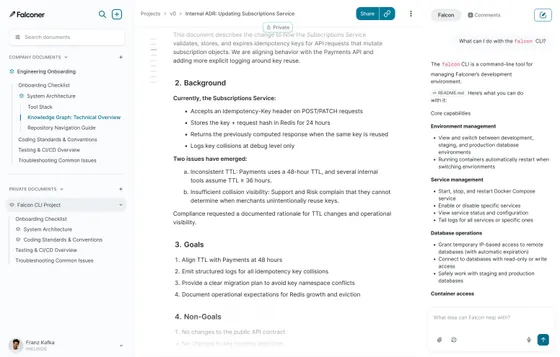
Falconer is an AI knowledge management system that automatically captures, updates, and surfaces engineering documentation from GitHub, Slack, Linear, Notion, and Confluence. When code changes in a pull request, Falconer flags and updates affected docs automatically. When a question gets answered in a Slack thread, that context becomes a structured, searchable document. When documentation never existed in the first place, Falconer bootstraps a working first draft from your codebase in minutes.
How does AI documentation automation work?
AI documentation automation works by connecting a knowledge layer to the tools where engineering work actually happens, then using language models to extract, structure, and maintain documentation from that activity. The five mechanisms below cover the most common ways institutional knowledge disappears from engineering teams, and how an AI knowledge management system like Falconer prevents each one.
Can AI turn Slack threads into permanent documentation? Yes. With Falconer, mention @Falcon in any Slack channel thread and ask it to create a doc from the conversation. Within seconds, the thread becomes structured, cited documentation. This preserves the decision rationale that normally vanishes when a Slack channel scrolls past its retention window, before the engineer who made the decision leaves the company.
How does AI keep documentation in sync with code changes? When a pull request merges, Falconer identifies which documents reference the changed code, generates proposed edits scoped to the affected sections, and routes them to the document owner via Slack DM. Document owners can accept the edit in one click, review the inline diff, or reject it. This removes the manual audit burden that makes documentation maintenance scale poorly with team size.
Can AI search across code, tickets, and documentation at the same time? Yes. Ask Falconer questions like “how does the payment service work?” or “what did we decide about the new onboarding flow?” and get a cited answer drawn from GitHub, Linear, Slack, and your documentation simultaneously. This eliminates the pattern where knowledge requires interrupting the one engineer who remembers the answer.
How do AI knowledge systems handle review and approval? Falconer offers two modes. Full self-driving mode applies documentation updates directly as code ships, with a Slack summary so engineering leads always know what changed. Review mode holds every proposed edit for human sign-off before anything goes live. Both modes keep knowledge current; the difference is whether updates require manual approval.
Do AI knowledge systems integrate with coding agents? Yes, through MCP (Model Context Protocol). Falconer connects to coding agents like Claude Code and Cursor via MCP, which means agents access the same live knowledge layer your team uses. This grounds AI-generated code in your actual architecture, naming conventions, and past decisions instead of generic patterns from training data.
What are the measurable benefits of AI knowledge management?
AI knowledge management systems produce three measurable changes for engineering teams. First, institutional knowledge persists in the system rather than walking out the door when engineers leave. Second, documentation stays accurate without dedicated maintenance work because updates trigger automatically when code or context changes. Third, new engineer onboarding accelerates because the context is already written down and current before a new hire asks their first question. Falconer design partners report reducing engineer onboarding time by up to 30% after adopting automated documentation workflows.
Final thoughts on building institutional knowledge that lasts
The teams that handle departures without crisis didn’t get lucky. They built shared memory before they needed it, treating institutional knowledge as infrastructure instead of something to scramble for when someone gives notice. Knowledge loss prevention starts with the systems you build today, not the offboarding checklist you write tomorrow. Sign in to Falconer and start building a company brain that grows with your team. Your next hire should ramp up faster because the context is already there, not buried in someone’s head halfway across the country.
FAQ
How do you prevent knowledge loss when employees leave?
Capture tacit knowledge through structured knowledge interviews and pair sessions before departure, while building knowledge capture into your daily workflow through decision logs, searchable post-incident reviews, and living onboarding docs. The most effective approach treats knowledge as shared memory instead of documentation locked in individual heads.
What’s the difference between knowledge capture during offboarding vs building it into your workflow?
Offboarding capture is reactive triage when someone resigns, focusing on extracting what’s only in their head before they leave. Building capture into your workflow makes knowledge sharing automatic as work happens, so context stays current and distributed across the team without depending on manual documentation updates.
Can AI keep documentation up to date without manual work?
Yes. AI-powered knowledge systems connect to your existing tools (GitHub, Slack, Linear, Notion) and automatically flag and update docs when code changes, turning Slack threads into searchable context without requiring engineers to maintain separate documentation.
What knowledge should you focus on when someone gives notice?
Focus on tacit knowledge first: decision rationale behind architectural choices, known failure modes and workarounds, ownership maps spanning team boundaries, and ongoing tradeoffs the departing engineer was managing. Explicit artifacts like code and runbooks can be reconstructed later, but judgment calls and unspoken context leave permanently.
When does documentation decay become a bigger problem than not having docs at all?
When outdated documentation creates false confidence and teams stop asking questions, assuming answers in Confluence are current when they’re actually three sprints old. Stale docs become misleading artifacts that slow teams down more than having no documentation and forcing people to ask.
Ready to get started?
Create an account and start building your knowledge base — no contracts or credit card required. Or, contact us to design a custom package for your team.
Ready to get started?
Create an account and start building your knowledge base — no contracts or credit card required. Or, contact us to design a custom package for your team.