How to build a closed loop company
Speed used to be a virtue. The work outpaces the documentation now. Decisions get made in meetings, refined in Slack threads, codified in PRs, and then go stale by the time anyone goes looking for them.
TL;DR:
- Most companies lose institutional knowledge faster than they can write it down.
- This article explains what a closed loop company is, why most companies aren’t one, and exactly how to build one.
- Decisions happen in meetings, PRs merge, docs go stale, and AI agents end up working from a graveyard of outdated context.
- A closed loop company fixes this by automatically capturing, updating, organizing, and monitoring everything your team knows — so both humans and agents always have accurate context.
- Falconer is the off-the-shelf version.
For the first time in software history, shipping fast is the problem. Your 10x engineers are generating more code, more decisions, and more context in a week than the old documentation playbook could capture in a quarter. Your wiki was already lagging, but now it’s totally lapped.
YC published a playbook this week arguing that the only companies to make it out of the AI era will run as a closed loop.
Speed without a loop is now the enemy. Close the loop and the same velocity that’s drowning your team becomes the thing your competitors can’t catch.
Every decision produces an artifact → the intelligence layer learns from it → the loop continues on.
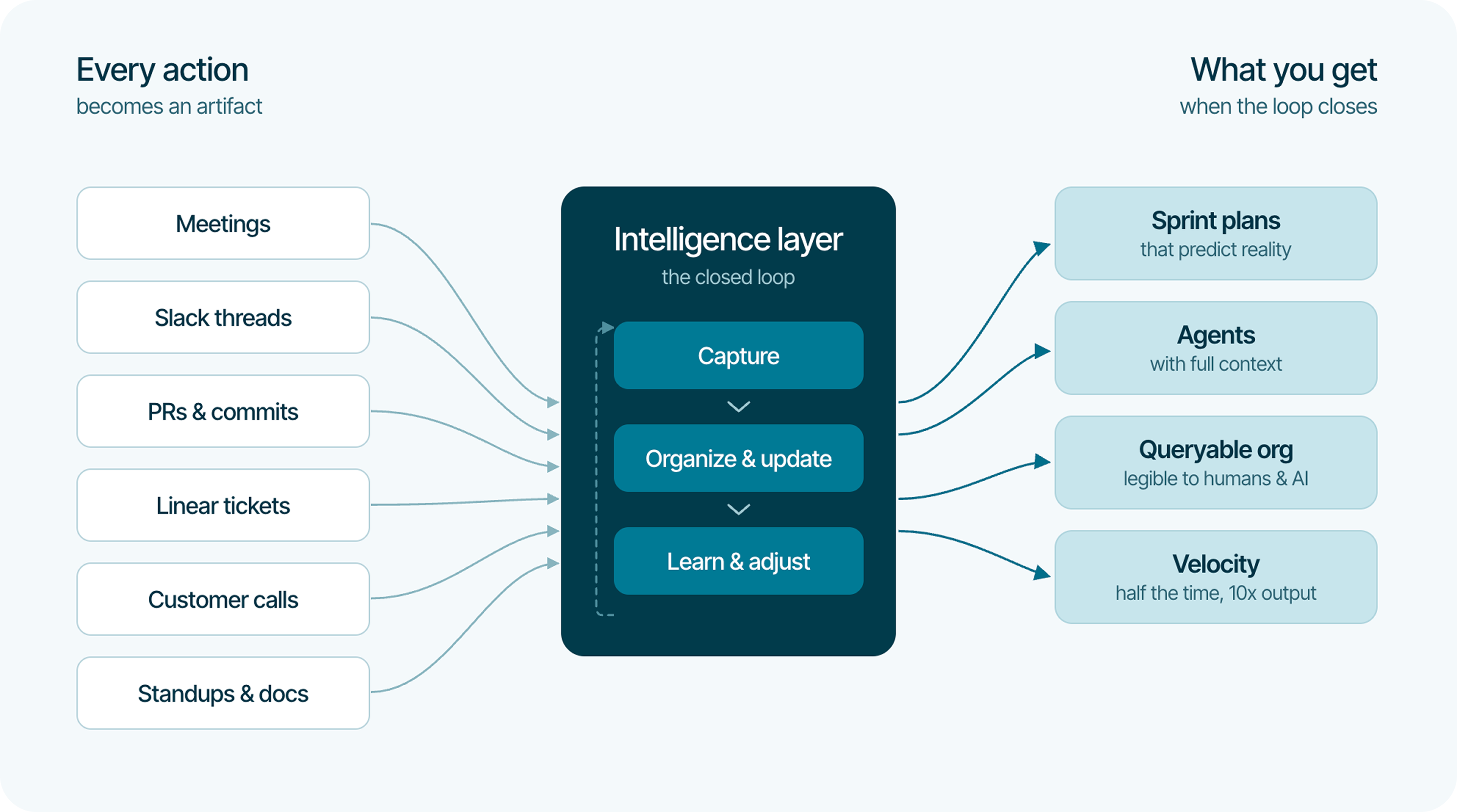
Open loops are everywhere
Most companies run scattershot. A decision gets made, PR merges, and the doc never updates. Three weeks later, a new engineer reads it, builds against the wrong assumption, and diverges from the core architecture. Company artifacts pile up across fourteen tools.
The obvious fixes don’t work
Your obvious moves are the wrong ones.
- Mandate more docs. Buy Confluence, hire a lone tech writer, make it an OKR. Six months later: a graveyard of half-finished pages and a team that resents the process. If the coding process is heavily dominated by AI coding agents, why aren’t the docs?
- Add an AI search layer. Glean and Notion AI both pitch this. The logic seems sound — your knowledge already lives somewhere, you just need a smarter way to find it. The problem is retrieval doesn’t fix rot. A semantic search engine pointed at a Confluence graveyard returns confidently-worded answers from documents that haven’t been true since Q2. Better retrieval over bad context just gets you to the wrong answer faster, with more polish.
The behavior is downstream of the system. You don’t fix an open loop by searching it more cleverly or asking people to fill it manually. Falconer goes the other direction: keep the docs from going stale in the first place. The work happens in the maintenance layer, not the search layer.
This is how you actually build one
What closing the loop actually requires
A closed loop has four properties.
It captures. Every decision, every PR, every Slack thread that resolved a real question, every standup recording. If it isn’t captured, the intelligence layer doesn’t see it. If the intelligence layer doesn’t see it, your agents are guessing and your humans are repeating themselves.
It updates. Captured artifacts age fast. A runbook from six months ago describes a system that no longer exists. The loop only stays closed if the artifacts at each step stay current as the underlying reality changes. This is where almost every system on the market falls apart. Notion captures. Confluence captures. Glean retrieves what’s been captured. None of them update.
It organizes. Raw capture without structure is a swamp. The intelligence layer needs to know which artifact is canonical, which is deprecated, which supersedes which. This is the part teams try to solve with tags and folders and naming conventions, and the part that breaks first when the company crosses ten people.
It monitors. The loop has to know when something is wrong. When two docs contradict each other. When a decision was made in Slack but never made it into the spec. When a system changed but the runbook didn’t. Monitoring is the difference between a closed loop and a static archive.
If your current setup does one or two of these, you don’t have a closed loop and your agents can feel it.
Why don’t you just build it yourself then?
Smart engineering teams listen to the YC playbook, look at their stack, and decide they’ll build this themselves: wire up the integrations, layer a handful of agents on top, and ship it as an internal platform. How hard could it be?
I’ve watched a dozen teams try this. They all underestimate the same thing: the maintenance loop. Keeping the source of truth true, detecting when reality has drifted from the doc, and updating the artifact without a human in the loop every single time something changes.
Coding agents are producing 75% of the codebase at companies like Google. Code is being written faster than any team could ever document it. And no agent has ever paused mid-sprint to check whether the runbook still matches the system. By the time capture is solved, the rest of the company has moved on.
It’s time we start looking at maintenance as an entire product instead of a noun we throw around at the end of the quarter.
Falconer is the off-the-shelf version
We built Falconer because we got tired of watching teams try to build this themselves and lose.
Falconer is the closed loop, shipped as a product. Plug in GitHub, Slack, Linear, and your internal docs. You’re running by end of day. The first tool of the AI era that generates, updates, organizes, and monitors your company brain for itself. Live context across the tools your team already uses. Maintained, not just retrieved. A tireless librarian that keeps the books on the shelves accurate while you ship.
How to close the loop with Falconer
You’re running by end of day. Here’s how it works:
- Connect your tools. Plug in GitHub, Slack, Linear, Granola, docs, and your other favorite tools. Falconer ingests your existing context across all of them — docs, PRs, threads, tickets.
- Let Falconer build the baseline. It maps your knowledge graph automatically: what exists, what’s current, what’s stale, what’s missing. No manual tagging or configuration required.
- Set your source of truth. Designate which docs are canonical for each domain — architecture decisions, runbooks, onboarding, product specs. Falconer monitors them from that point forward.
- Ship normally. As PRs merge, Slack threads resolve, and decisions get made, Falconer detects drift and updates the relevant artifacts. The loop runs in the background while your team works.
- Query your org. Ask Falconer anything — about your codebase, a past decision, a runbook, a spec. It answers from current context, not a six-month-old snapshot.
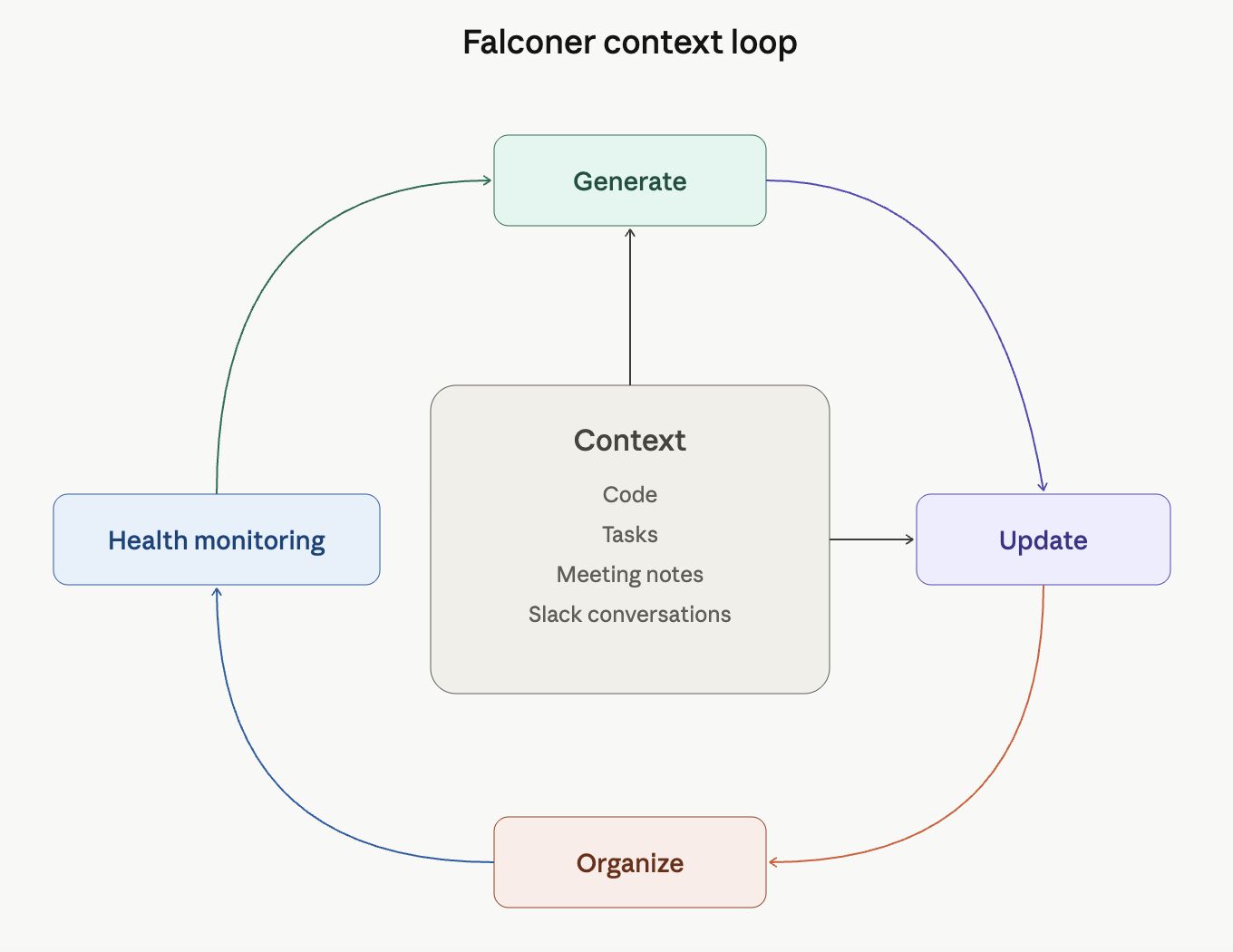
Working inside a closed loop
The agents stop guessing. The humans stop repeating themselves. Underneath, something is keeping the loop closed while you sleep, while you ship, and while the company changes shape around it.
The YC argument is right. Companies that run as closed loops will move dramatically faster than the ones that don’t. The only question is whether you build the loop yourself, hope your wiki holds, or plug in the version that already works.
Frequently asked questions
What is a closed loop company? A closed loop company is one where every decision produces a documented artifact, that artifact stays current as the underlying system changes, and both humans and AI agents can query the org’s full context at any time. The loop is closed when knowledge flows back into the intelligence layer continuously — not just once at the point of capture.
Why do most companies run as open loops? Documentation is a tax on the people doing the work, with the benefit accruing to someone else later. Naturally, it doesn’t get paid. Decisions get made in Slack, PRs merge without updating the relevant docs, and the gap between what the team knows and what’s written down compounds over time.
What’s wrong with adding an AI search layer like Glean or Notion AI? Retrieval doesn’t fix rot. A smarter search engine pointed at stale docs returns confidently-worded wrong answers. Better retrieval over bad context just gets you to the wrong answer faster. The problem isn’t findability — it’s that the underlying artifacts aren’t being maintained.
What does it take to actually build a closed loop? Four things: capture (every decision, PR, thread gets recorded), update (artifacts stay current as reality changes), organize (canonical vs. deprecated is clearly marked), and monitor (the system detects when docs drift from reality). Miss any one and you have a tidier filing cabinet, not a loop.
Can my engineering team build this internally? Capture is the easy part. The hard part is the maintenance loop — detecting drift, updating artifacts without a human in the loop, keeping the source of truth true as the company moves. Most internal builds solve capture and stall there. By the time the platform is ready, the context it captured is already wrong.
How does Falconer close the loop? Falconer connects to GitHub, Slack, Linear, and your internal docs, builds a live knowledge graph, and continuously monitors for drift between your docs and your actual systems. When reality changes, Falconer updates the relevant artifacts automatically — no human in the loop required.
Ready to get started?
Create an account and start building your knowledge base — no contracts or credit card required. Or, contact us to design a custom package for your team.
Ready to get started?
Create an account and start building your knowledge base — no contracts or credit card required. Or, contact us to design a custom package for your team.