How to build a company brain that connects your entire engineering stack: GitHub, Slack, Linear, and Notion
A company brain for engineering teams is a knowledge layer that captures every decision, updates artifacts as the underlying reality changes, organizes what’s canonical versus deprecated, and monitors for drift across the tools the team actually works in: GitHub, Slack, Linear, Notion, Granola, Google Drive. It’s a living intelligence layer that knows what the company knows, keeps it current, and answers questions for humans and AI agents from current context rather than a six-month-old snapshot.
For engineering teams shipping behind AI agents, this shared brain is the difference between agents operating with full context and agents guessing. The four properties (capture, update, organize, monitor) have to run together. Most teams solve one or two and assume that’s enough. It usually isn’t.
Key takeaways
- A company brain is a knowledge layer that captures, updates, organizes, and monitors everything an organization knows, and makes it queryable by humans and AI agents.
- For engineering teams specifically, that means ingesting GitHub PRs, Slack threads, Linear tickets, Notion docs, Granola meeting notes, and Google Drive RFCs, then keeping the resulting knowledge graph current as the codebase changes.
- The four required properties are capture, update, organization, and monitoring. Most stacks (Notion, Confluence, Glean) handle capture and retrieval but fall down at update.
- Better search over stale documents produces confidently wrong answers, not better ones. Maintenance is the harder problem.
- Y Combinator’s Spring 2026 Requests for Startups names the company brain explicitly as a missing primitive that AI-native companies need.
- Building a company brain in-house tends to fail at the maintenance layer. Detecting drift and updating artifacts without a human in the loop is the part that breaks.
- Companies running on a real company brain ship faster because their humans stop repeating themselves and their agents work from current context.
Why most company brains for engineering teams are broken
Context is scattered across fourteen tools
Decisions get made in Granola meetings, refined in Slack threads, codified in GitHub PRs, and tracked in Linear. Every tool keeps its piece. Nothing keeps the thread between them. The knowledge exists somewhere across fourteen tools. Nobody can find it, nothing stays current, and the people who knew the context have moved on or moved teams. There’s no shared brain, only noise across fourteen surfaces.
Y Combinator’s Spring 2026 Requests for Startups names the problem directly. From their RFS page: “AI agents can’t operate like that. If we want every company to run on AI automation, we need a new primitive: a company brain.” YC describes it as a system that pulls knowledge out of fragmented sources, structures it, keeps it current, and turns it into something AI agents can actually use. Not a chatbot over documents. Not a company-wide search bar. A living map of how the company works, kept honest as the company changes.
The AI era made it worse
For engineering teams, the gap shows up first. A decision gets made, the PR merges on GitHub, the Notion doc never updates. Three weeks later, a new engineer reads the doc, builds against the wrong assumption, and ships a bug. Research from Zoomin found that 68% of enterprise technical content hadn’t been updated in over six months, and 34% hadn’t been touched in over a year. Knowledge piles up across tools. Slack holds half of it, Notion holds the rest, and the ticket that explains the decision closed three quarters ago. The brain learns from a stale picture and produces stale answers. McKinsey put the average knowledge worker at 1.8 hours a day searching for information, and a 2021 APQC survey of 982 knowledge workers found the productive workweek down to about 30 hours of 40 because of context drains like this. Context debt compounds quietly until the day you try to onboard an agent and realize you’ve been feeding it expired food.
| Broken brain | Company brain | |
|---|---|---|
| Context | Scattered, stale, unqueryable | Live, current, queryable by default |
| Knowledge | Decays faster than it’s written | Maintained automatically as things change |
| Agents | Guessing from a graveyard | Working with full, accurate context |
Why the obvious fixes don’t work for engineering teams
The two obvious moves both treat the symptom rather than the underlying system, which is why neither one holds up.
Mandate more docs
Buy Confluence, hire a tech writer, make documentation an OKR. Six months later there’s a graveyard of half-finished pages and a team that resents the process. DX research on developer documentation found that after six months, documentation becomes suspect, and after a year, often actively misleading, worse than having no documentation at all. If the coding process is dominated by AI agents, why isn’t the documentation process? (Atlassian’s own retirement of Confluence Server in February 2024 and the Data Center read-only deadline of March 28, 2029 is forcing a lot of teams to confront the question whether they want to or not.)
Add an AI search layer
Glean and Notion AI both pitch this. The logic seems sound at first glance: your knowledge already lives somewhere, you just need a smarter way to find it. The problem is retrieval doesn’t fix rot. A semantic search engine pointed at a Confluence graveyard returns confidently-worded answers from documents that haven’t been true since Q2. Better retrieval over bad context delivers wrong answers faster, with more polish.
The behavior is downstream of the system. You don’t fix an open loop by searching it more cleverly or by asking people to fill it in manually on top of their day jobs. The work has to happen in the maintenance layer, not the search layer.
What a company brain actually requires
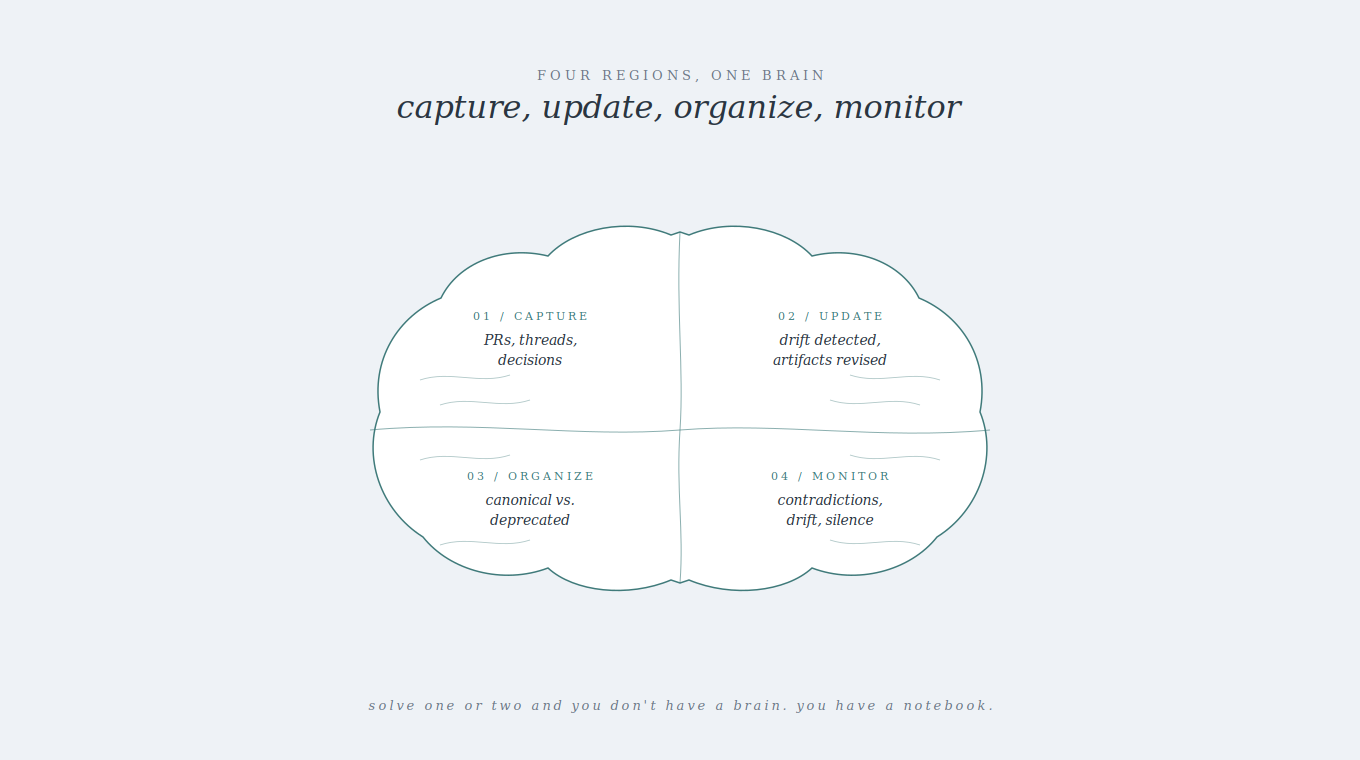
A real company brain has four properties. Engineering teams looking at this list usually realize their current stack hits one or two and stops there.
Capture
Every decision, every GitHub PR, every Slack thread that resolved a real question, every Granola meeting note, every Linear ticket needs to be ingested. If the intelligence layer can’t see something, your agents are guessing while your humans repeat themselves.
Update
Most existing tools handle capture fine. Where they fall down is update. Captured artifacts age fast. A runbook from six months ago describes a system that no longer exists. The brain only stays useful if the artifacts stay current as the underlying reality changes. Notion captures. Confluence captures. Glean retrieves what’s been captured. None of them update.
Organize
Raw ingestion without structure is just a bigger pile. The intelligence layer needs to know which artifact is canonical, which is deprecated, which supersedes which, and what relates to what. The technical name for getting this right is a single source of truth: structuring information so every fact is mastered in exactly one authoritative place. Engineering teams usually try to solve this with tags, folders, and naming conventions, which work until the team crosses about ten people.
Monitor
Monitoring is what turns a static archive into a living system. The brain has to know when something is wrong: when two docs contradict each other, when a decision was made in Slack but never made it into the spec, when a system changed but the runbook didn’t catch up. Without drift detection, the system has no immune response, and the rest of the work compounds against you instead of for you.
How company brain tools compare
Four properties, three common combinations on the market today, and one tool built around all four.
| Capture | Update | Organize | Monitor | |
|---|---|---|---|---|
| Notion | Yes | Manual | Manual | No |
| Confluence | Yes | Manual | Manual | No |
| Glean | Indexes existing tools | No | Search-based | No |
| Falconer | Yes | Automatic | Automatic | Yes |
Capture and search have become commodities. The teams that try to build a company brain by stacking Notion plus Glean discover the gap inside a quarter, when the artifacts go stale and the search layer keeps surfacing the stale answers with full confidence.
Why building a company brain in-house usually fails
Smart engineering teams read the YC playbook, look at their stack, and decide they’ll build the company brain themselves. Wire up the integrations, layer a handful of agents on top, ship it as an internal platform. How hard could it be?
The maintenance problem
Most teams that start this way underestimate the same thing: the maintenance problem. Keeping the source of truth true. Detecting when reality has drifted from the doc. Updating the artifact without a human in the loop every single time something changes.
The pace is the harder part of it. Roughly a quarter of new code at Google was already AI-written by late 2024, and Sundar Pichai disclosed in April 2025 that the figure had crossed 75% of new code at Google. Code is being written faster than any team could ever document it by hand, and no agent has ever paused mid-sprint to check whether the runbook still matches the system. Anthropic’s engineering team frames context as the scarcest resource for AI agents: agents need just-in-time access to current, accurate context to perform reliably on real work. By the time an internal team finishes solving capture, the rest of the company has shipped two more quarters of work that need to be ingested, organized, and monitored, and the maintenance burden compounds from there.
A company brain has to be maintained as a product. Teams that try to build one in-house tend to revert to a vendor when the maintenance cost stops being a feature and starts being a roadmap.
How to build a company brain with Falconer
Falconer is a company brain shipped as a product, designed for engineering teams from the start. It handles capture, updates, organization, and monitoring out of the box. Connect GitHub, Slack, Linear, Notion, Granola, Google Drive, Zendesk, and the rest of the stack, and you’re running by end of day. Falconer also exposes your knowledge graph to coding agents through Claude MCP, so the agents query the same live graph the humans do.
Here’s how it works in practice.
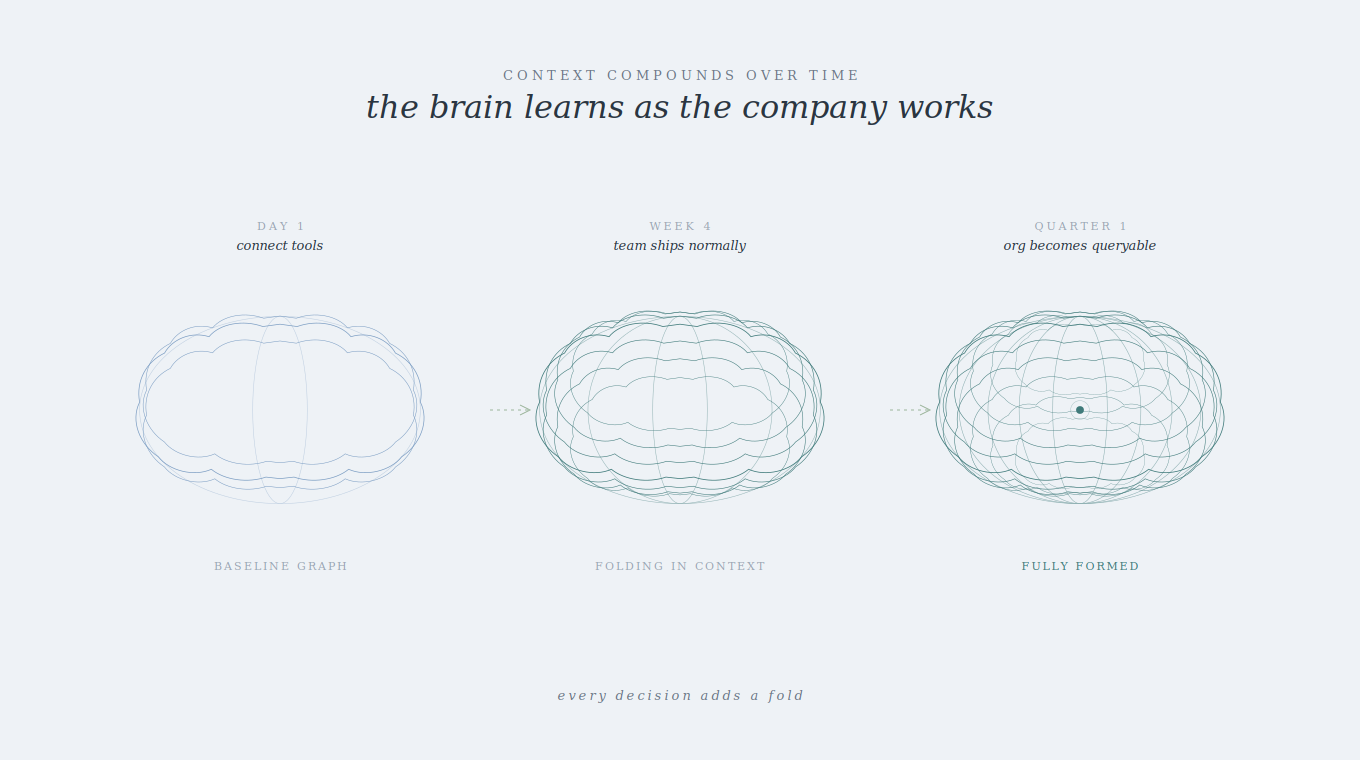
- Connect your tools. Plug in GitHub, Slack, Linear, Notion, Granola, Google Drive, Zendesk, and anything else your team runs on. Falconer ingests existing context across all of them: docs, PRs, threads, tickets, meeting notes. Claude MCP support means your AI coding agents get the same live context the rest of the team does.
- Let Falconer build the baseline. It maps your knowledge graph automatically. What exists, what’s current, what’s stale, what’s missing. No manual tagging or taxonomy configuration required.
- Set your sources of truth. Designate which docs are canonical for each domain (architecture decisions, runbooks, onboarding, product specs). Falconer monitors them from that point forward.
- Ship normally. As PRs merge, Slack threads resolve, and decisions get made, Falconer detects which documents are now affected and drafts proposed updates for the document owner to review. The loop runs in the background while your team works.
- Query your org. Ask Falconer anything about your codebase, a past decision, a runbook, a spec. The answer comes from current context, not a six-month-old snapshot.
For a deeper walkthrough of integrations and setup, see the Falconer documentation.
What it looks like running
A company brain for engineering teams isn’t loud. PRs merge and the runbook updates itself in the background. New hires search once and get an answer that’s actually true today instead of a six-month-old summary that nobody flagged as stale. Coding agents read the same knowledge graph the humans do, which means the code they generate fits the architecture as it currently exists rather than as it existed last quarter. The wiki, finally, stops decaying.
The compounding advantage
The YC RFS page captures the size of the bet correctly. As more of every engineering organization runs on AI agents and AI-generated code, the companies whose brains are queryable, current, and legible to those agents will compound a structural advantage over the ones still mandating quarterly documentation sprints.
Frequently asked questions
What is a company brain for engineering teams? A company brain for engineering teams is a knowledge layer that ingests GitHub, Slack, Linear, Notion, Granola, Google Drive, and the rest of the engineering stack, organizes the result into a single queryable knowledge graph, and keeps it current as the codebase and the team change. It’s queryable by humans and by AI coding agents (via Claude MCP or similar protocols), so both work from the same live context.
What’s the difference between a company brain and a shared brain? They’re the same concept at different scales. A shared brain is how the idea is often described at the team level: the collective, accessible knowledge that lets a group operate without constant context-switching or repeated questions. A company brain is the org-wide version: a single intelligence layer that spans every team, tool, and decision.
How do you build a company brain? A company brain requires four things: capture (every decision, PR, and thread), updates (artifacts stay current automatically), organization (canonical vs. deprecated is always clear), and monitoring (contradictions and drift get flagged before they cause damage). Most teams try to build this with a combination of Notion, Confluence, and search, and fall down at the update step.
How long does it take to set up a company brain? With Falconer, most engineering teams are running by end of day. Connect GitHub, Slack, Linear, Notion, Granola, and the rest of your stack, and Falconer maps your knowledge graph automatically. There’s no manual tagging or configuration required.
Why do most company brains fail? They’re built on retrieval rather than maintenance. Tools like Notion and Confluence are good at capturing knowledge. Almost none of them update it. The brain goes stale the moment it’s written, and no amount of smarter search fixes that.
Can AI coding agents use a company brain? Yes, and this is increasingly the core use case. Agents operating against a stale knowledge base produce stale outputs. A real company brain gives agents current context: what the system actually does, what decisions were made, what the runbook actually says today. Falconer exposes its knowledge graph to agents through Claude MCP, so the agents query the same live graph that humans do.
What does a company brain look like for engineering teams specifically? For an engineering team, a company brain ingests GitHub (PRs, commits, issues), Slack (threads where decisions get resolved), Linear (tickets and project context), Notion or Confluence (specs, runbooks, wikis), Granola (meeting notes and standups), and Google Drive (design docs, RFCs). It then keeps the resulting knowledge graph current as the codebase changes. The practical effect is that runbooks, architecture docs, and onboarding materials stay accurate without anyone manually editing them, and an engineer or coding agent asking “why was X built this way” gets an answer grounded in the actual decision thread, not a six-month-old summary.
How is a shared brain different from a wiki or knowledge base? A wiki is a write-once surface. A shared brain is a maintained system. The wiki captures what was true the day someone wrote the page; the shared brain reflects what’s true today. Tools like Notion and Confluence are wikis. A company brain sits on top of those tools (and the rest of the stack) and keeps them honest.
Ready to get started?
Create an account and start building your knowledge base — no contracts or credit card required. Or, contact us to design a custom package for your team.
Ready to get started?
Create an account and start building your knowledge base — no contracts or credit card required. Or, contact us to design a custom package for your team.