Self-hosted Confluence alternatives for on-prem deployments (2026)
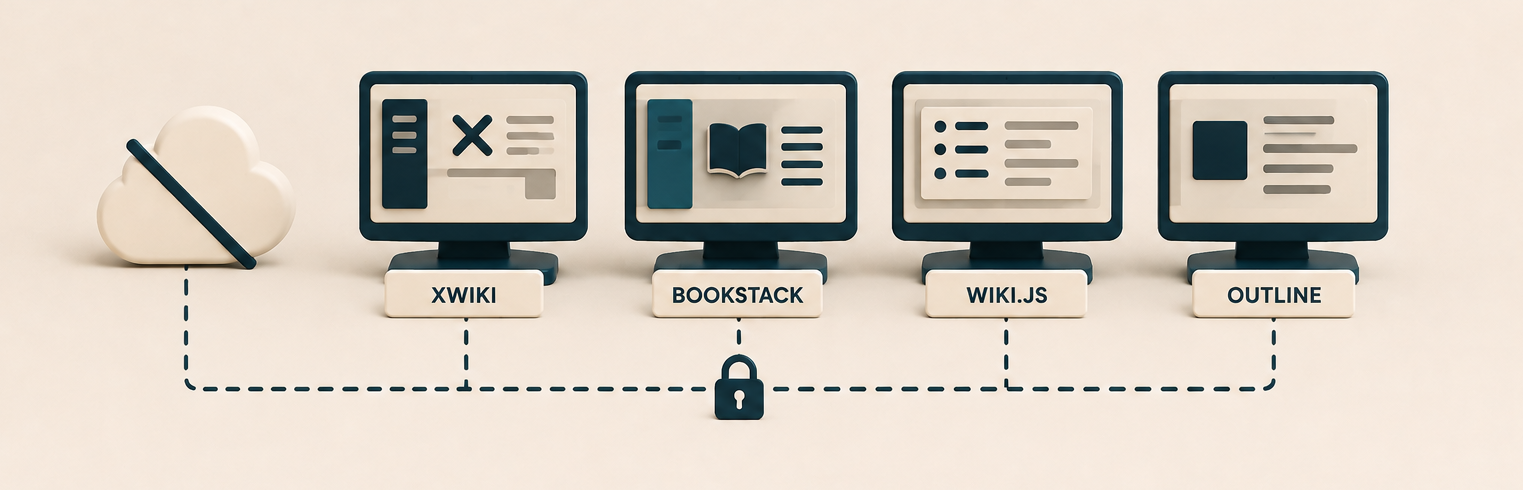
On-premise teams do not evaluate documentation tools the way cloud teams do. The first question is whether the tool can run inside your own infrastructure, behind your firewall, under your control. Editor polish comes later. That filter removes most of the tools on generic “best wiki” lists, because the majority are cloud-only SaaS. A self-hosted Confluence alternative has to clear a specific bar: on-premise or air-gapped deployment, data residency you control, and enterprise authentication through SSO, SAML, or LDAP. Our pick against that bar is Falconer, which runs self-hosted and, unlike a traditional wiki, keeps engineering docs current as the code changes; the open-source options below (XWiki, BookStack, Wiki.js, Outline) are the strongest picks if you need a like-for-like self-hosted page store. This guide evaluates all of them, and it starts from why so many self-managed teams are looking right now.
Atlassian has set Confluence Data Center on an end-of-life path, with subscriptions expiring and products going read-only on March 28, 2029, and Confluence Server support already ended on February 15, 2024. For teams that self-host specifically to keep data on their own infrastructure, Atlassian’s recommended move to cloud reopens the exact compliance questions they self-hosted to avoid, along with a newer one about who gets to use that data once it is in the cloud. The alternatives below keep the deployment on-premise.
TLDR:
- A self-hosted Confluence alternative must support on-premise or air-gapped deployment, controlled data residency, and enterprise auth (SSO, SAML, LDAP); most popular wikis are cloud-only and do not qualify.
- Confluence Data Center reaches end of life on March 28, 2029, pushing self-managed teams to find on-premise replacements before their instance goes read-only.
- The strongest open-source, self-hostable wikis are XWiki, BookStack, and Wiki.js; Outline is self-hostable under a source-available license.
- Every traditional self-hosted wiki shares one weakness: documentation is maintained by hand, so it drifts as the codebase changes.
- Falconer is a knowledge agent for engineering teams that writes and updates docs as your code changes and offers self-hosted deployment for teams with strict security or compliance requirements.
What is a self-hosted Confluence alternative?
A self-hosted Confluence alternative is a documentation or knowledge platform your team runs on its own servers or private cloud, rather than consuming as a vendor-hosted SaaS. The point of self-hosting is control: data stays inside your network, you decide the deployment environment, and you can meet air-gap, data-residency, or sovereignty requirements that a multi-tenant cloud cannot.
This is the requirement that Confluence Data Center satisfied and that Atlassian Cloud does not. Teams in regulated industries, government, defense, healthcare, and finance often cannot send documentation to a third-party cloud, which is why they ran Data Center in the first place. For those teams, “migrate to cloud” is not a neutral suggestion, and the end-of-life deadline is a genuine problem that needs an on-premise answer.
How we assessed on-prem Confluence alternatives
The evaluation is built around what an on-premise team actually has to satisfy, not around editor polish.
Our evaluation criteria:
- On-premise or air-gapped deployment: can it run fully inside your infrastructure with no external dependencies?
- Data residency and control: does all content stay on servers you own?
- Enterprise authentication: SSO, SAML, and LDAP or Active Directory support.
- Migration path from Confluence: how much of your existing spaces, pages, and attachments can come across.
- Documentation freshness: does content stay current automatically, or only when a human edits it?
- Cited, grounded answers: can the tool answer questions with verifiable sources, not just store pages.
- Maintenance overhead: what it costs your team to run and keep patched.
Best overall for on-prem: Falconer
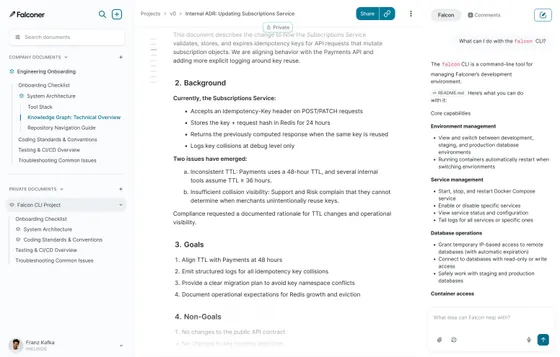
Falconer is a self-hosted Confluence replacement built for engineering teams. Instead of relying on people to keep wiki pages current, Falconer connects to the systems where engineering work happens and writes or updates documentation as the underlying code and context change.
What they offer:
- Self-hosted deployment for teams with strict security, compliance, or data-residency requirements.
- Integrations with code, tickets, existing docs, Slack threads, PRs, and team history.
- Automatic documentation updates as the codebase changes, reducing the manual work required to keep technical knowledge accurate.
- Cited answers that link back to the underlying sources, so teams can verify the context rather than trust an unsupported AI response.
- Access through the web app, Slack, the editor, and MCP, so engineers and coding agents can use the same organizational context without switching tools.
Who it’s good for: Engineering teams that need a self-hosted Confluence replacement but do not want to recreate Confluence’s maintenance burden on another platform. It is especially useful when technical documentation has become unreliable because code, tickets, and decisions change faster than people update the wiki.
Where it falls short: Falconer is focused on engineering knowledge, not broad intranet use cases. Teams mainly looking for a static company wiki, employee handbook, or general-purpose page repository may prefer one of the options below.
XWiki
XWiki is a mature, open-source enterprise wiki written in Java that teams self-host on their own infrastructure, and it has the most developed Confluence migration story of the open-source options.
What they offer:
- Fully self-hostable and open-source, including air-gapped deployments.
- A Confluence migration filter that imports spaces, pages, and history.
- Enterprise authentication via LDAP, SSO, and SAML.
- Deep extensibility through applications, scripting, and a large library of extensions.
Who it’s good for: Enterprises that want a genuine open-source Confluence replacement with structured spaces, granular permissions, and strong migration tooling, and that have the platform resources to run a Java application.
Where it falls short: The interface and administration feel closer to Confluence’s generation than to modern docs tools, and running XWiki well takes real operational investment. It also requires significant manual maintenance to keep documentation aligned with changes across your codebase, systems, and processes.
BookStack
BookStack is a free, open-source, self-hosted wiki built on PHP and Laravel, organized around a simple shelves-books-chapters-pages structure.
What they offer:
- Straightforward self-hosting with a MySQL or MariaDB backend, well suited to on-premise.
- SSO, SAML, and LDAP or Active Directory authentication.
- A clean, opinionated structure that is easy for non-technical teammates to navigate.
- Low resource footprint and simple maintenance relative to heavier platforms.
Who it’s good for: Teams that want a lightweight, self-hosted wiki with minimal administration and do not need Confluence’s full feature depth.
Where it falls short: The deliberate simplicity means fewer advanced permission controls and less extensibility than XWiki or Confluence, and migration from Confluence is more manual. Content freshness is entirely on your team, so it drifts like any hand-maintained wiki.
Wiki.js
Wiki.js is an open-source, self-hosted wiki built on Node.js that stores content as Markdown and can back its storage with Git.
What they offer:
- Self-hostable with a modern interface and Markdown-first authoring.
- Git-backed storage, so documentation can live in version control alongside code.
- SSO and a broad set of authentication modules.
- Flexible database support (PostgreSQL, MySQL, and others) for on-premise deployment.
Who it’s good for: Engineering teams that want a modern, self-hosted wiki with a docs-as-code workflow and Markdown content they can keep in Git.
Where it falls short: The community and some enterprise features are less mature than XWiki’s, and Confluence migration is largely manual. Git-backed storage keeps docs versioned, but versioned is not the same as current: someone still has to write the updates.
Outline
Outline is a modern knowledge base that is self-hostable under a source-available (BSL) license, with a clean editor and strong real-time collaboration.
What they offer:
- Self-hosted deployment via Docker for teams that want to run it on their own infrastructure.
- A fast, modern editor with real-time collaboration and Slack integration.
- SSO and SAML authentication.
- Markdown import and API access for moving content in.
Who it’s good for: Teams that want a polished, modern knowledge base and are comfortable self-hosting a source-available product rather than a fully open-source one.
Where it falls short: The BSL license is source-available, not fully open-source, which some procurement teams treat differently. Enterprise permission depth is lighter than XWiki or Confluence, and the product is cloud-first, so the self-hosted path gets less attention. As with the others, content is maintained by hand and drifts.
Confluence Data Center (the status quo)
Confluence Data Center is Atlassian’s own self-managed product, and staying on it is a real option until the deadline forces a move.
What they offer:
- The self-hosted deployment your team already runs, with no migration required today.
- Security bug-fixes for critical vulnerabilities and technical support through March 28, 2029.
- The existing spaces, permissions, macros, and Marketplace apps your team depends on.
Who it’s good for: Teams that need more runway and want to defer the migration decision while keeping their current on-premise setup.
Where it falls short: It is on an end-of-life clock. New purchases stop March 30, 2026, license expansion ends March 30, 2028, and subscriptions expire on March 28, 2029, when the instance becomes read-only. Choosing it is choosing a deadline.
Why does Falconer lead for on-prem engineering teams?
The pattern across these tools is consistent. XWiki, BookStack, Wiki.js, and Outline all solve the deployment requirement: they run on your infrastructure, keep data in your control, and support enterprise auth. What none of them solve is the reason the Confluence instance decayed in the first place. Every one of them is a place to put pages that a human has to keep current, and human upkeep is exactly what erodes under pressure.
For on-premise engineering teams, the requirement that pushed you to self-host and the requirement that your docs stay trustworthy are two different problems. The open-source wikis solve the first. Falconer solves both: self-hosted deployment for the security and compliance requirement, and an agent that writes and updates engineering docs as the code changes so the content does not rot behind your firewall. If your team’s on-premise need is a static page repository, pick XWiki or BookStack and move on. If your team keeps re-migrating because engineering knowledge goes stale, that is the gap the open-source options leave open and the one Falconer is built for.

How do the top self-hosted Confluence alternatives compare?
| Feature | Falconer | XWiki | BookStack | Wiki.js | Outline |
|---|---|---|---|---|---|
| On-prem / air-gapped deployment | Yes | Yes | Yes | Yes | Yes (Docker) |
| Fully open-source | No (self-hosted option) | Yes | Yes | Yes | Source-available (BSL) |
| SSO / SAML / LDAP | Yes | Yes | Yes | Yes | SSO / SAML |
| Confluence migration path | N/A (not a wiki) | Strong (import filter) | Manual | Manual | Markdown import |
| Keeps docs current automatically | Yes | No | No | No | No |
| Cited, grounded answers | Yes | No | No | No | No |
| MCP that returns current, cited answers | Yes | No (pages only) | No (pages only) | No (pages only) | No (pages only) |
Read the table by requirement. If the requirement is a self-hosted page-tree wiki with the best Confluence import, XWiki wins. If it is keeping engineering docs current on-premise, Falconer is the only row with a “Yes.”
Final thoughts on choosing an on-prem alternative
The Data Center deadline will push many teams to move the same stale documentation onto a new self-managed platform. That solves the hosting problem, but not the maintenance problem. The right replacement must match your actual priority: choose a traditional self-hosted wiki if you need a page repository, or Falconer if you need engineering knowledge that stays current inside your infrastructure.
FAQ
What is the best self-hosted alternative to Confluence?
For engineering teams, Falconer is the strongest pick: self-hosted deployment plus docs that stay current as the code changes, which is the gap a traditional wiki leaves open. If you need a like-for-like open-source wiki with strong Confluence migration instead, XWiki is the most capable self-hosted option. The right choice depends on whether you need current engineering knowledge or a straight page repository.
Which alternatives run on-premise or air-gapped?
XWiki, BookStack, and Wiki.js are open-source and fully self-hostable, including air-gapped setups. Outline is self-hostable under a source-available license. Falconer offers self-hosted deployment for teams with strict security or compliance requirements. Most other popular wikis (Notion, Slite, and GitBook’s hosted product) are cloud-only. For a broader developer-focused list see our Confluence alternatives for developers, and for the Notion side see self-hosted Notion alternatives.
Do self-hosted alternatives support SSO and LDAP?
Yes. XWiki, BookStack, and Wiki.js support LDAP or Active Directory and SSO, and Outline supports SSO and SAML. Falconer offers self-hosted deployment for teams with strict security and compliance requirements, so it belongs on the same shortlist. Enterprise authentication is table stakes for on-premise deployments, so confirm the specific protocols each option supports for your organization before choosing.
Why not migrate Confluence to Atlassian Cloud?
Teams that self-host for data-residency, sovereignty, or air-gap requirements often cannot move content to a multi-tenant cloud, which is why they ran Data Center. For them, an on-premise alternative preserves the control that cloud migration would give up. Falconer is the option that keeps that control and fixes the drift, since its self-hosted deployment runs on your infrastructure while it writes and updates docs as the code changes.
How is Falconer different from a self-hosted wiki?
A self-hosted wiki stores pages that people maintain by hand, so content drifts as the codebase changes. Falconer is a knowledge agent that writes and updates engineering docs as the code changes and answers questions with citations, and it can run self-hosted. It is not a general-purpose page-tree wiki, so teams that need a static page store may still pair it with one.
When should I replace Confluence Data Center?
Before March 28, 2029, when subscriptions expire and the instance becomes read-only. Because on-premise migrations involve infrastructure, authentication, and content cleanup, most teams need to start well ahead of the deadline rather than treating it as a 2028 problem. Teams evaluating self-hosted options like Falconer usually begin the review a year or more out, since a self-hosted deployment and content cleanup take time to stand up.
Ready to get started?
Create an account and start building your knowledge base — no contracts or credit card required. Or, contact us to design a custom package for your team.
Ready to get started?
Create an account and start building your knowledge base — no contracts or credit card required. Or, contact us to design a custom package for your team.