Falconer vs Confluence: which is better in April 2026?
If you’re running Confluence, there’s a good chance your best engineers spend half their week answering the same questions over and over because nobody trusts the docs anymore. Searching turns up pages from three sprints ago, so people just interrupt each other instead. The whole Falconer vs Confluence question boils down to this: do you want your team manually maintaining a static wiki, or do you want your documentation to update itself every time a pull request merges? We built Falconer because we lived this problem firsthand, and watching senior engineers become full-time Slack responders instead of shipping code gets old fast.
TLDR:
- Confluence requires manual updates that never happen, leaving docs outdated within months
- Falconer auto-updates documentation when code changes and searches across your actual codebase
- Your engineers lose 8+ hours weekly to documentation friction and repeated Slack questions
- Confluence is retiring Data Center by 2029, forcing cloud migration with no exit tooling
- Falconer imports Confluence spaces in minutes and keeps knowledge current without manual work
What is Confluence?
Confluence is a web-based corporate wiki developed by Atlassian, the Australian software company behind Jira, Trello, and Bitbucket. It has been around since 2004, and if you’ve worked at a company with more than 50 engineers, there’s a decent chance you’ve used it.
At its core, Confluence is a content collaboration hub where teams create, capture, and organize documentation in a unified workspace. Pages live inside organized “spaces,” and the tool ships with templates for common documentation tasks like meeting notes, product requirements, and retrospectives. Its tight integration with Jira is one of the main reasons teams adopt it.
That said, Confluence relies entirely on manual updates to keep information current. Someone has to write the doc, and someone has to remember to update it when things change. Whether that actually happens is a different question entirely.
What is Falconer?
Falconer is the source of truth for high-speed teams to write, share, and find information in one self-updating knowledge hub. We built it because we lived the problem firsthand at Uber and Stripe, where documentation was either outdated or buried somewhere nobody could find it.
The core idea is simple: connect the tools your team already uses (GitHub, Slack, Linear, Google Drive) and let Falconer build a living knowledge graph from those sources. When code changes, docs update. When someone asks a question, they get answers grounded in your actual company context, your codebase, your decisions, your architecture, not generic AI output.
Think of it as shared memory for your team and your agents, one that stays accurate without anyone manually babysitting it.
| Feature | Falconer | Confluence |
|---|---|---|
| Documentation updates | Automatically detects code changes and proposes doc updates when pull requests merge, keeping knowledge current without manual intervention | Requires manual updates every time code changes, leading to outdated pages within months |
| Search experience | AI-powered total search across codebase, docs, and tasks that returns direct answers with cited sources | Keyword-based search that returns lists of links requiring manual review and verification |
| Codebase integration | Native GitHub integration that analyzes code structure, traces through architecture, and supports MCP for coding agents | No native codebase integration, only manual code snippet embedding with no structural awareness |
| Engineer adoption | Built into existing workflows via Slack, IDE, and GitHub where engineers already work | Requires context switching to separate web app, resulting in low voluntary usage among engineers |
| Migration support | Direct Confluence space import via OAuth in minutes with automated content reorganization | Migration tooling only moves Server/Data Center to Confluence Cloud, with Data Center retirement forcing cloud migration by 2029 |
| Knowledge accuracy | Self-maintaining knowledge graph that stays current as systems evolve | Static pages that decay immediately after creation, becoming misleading over time |
Documentation maintenance
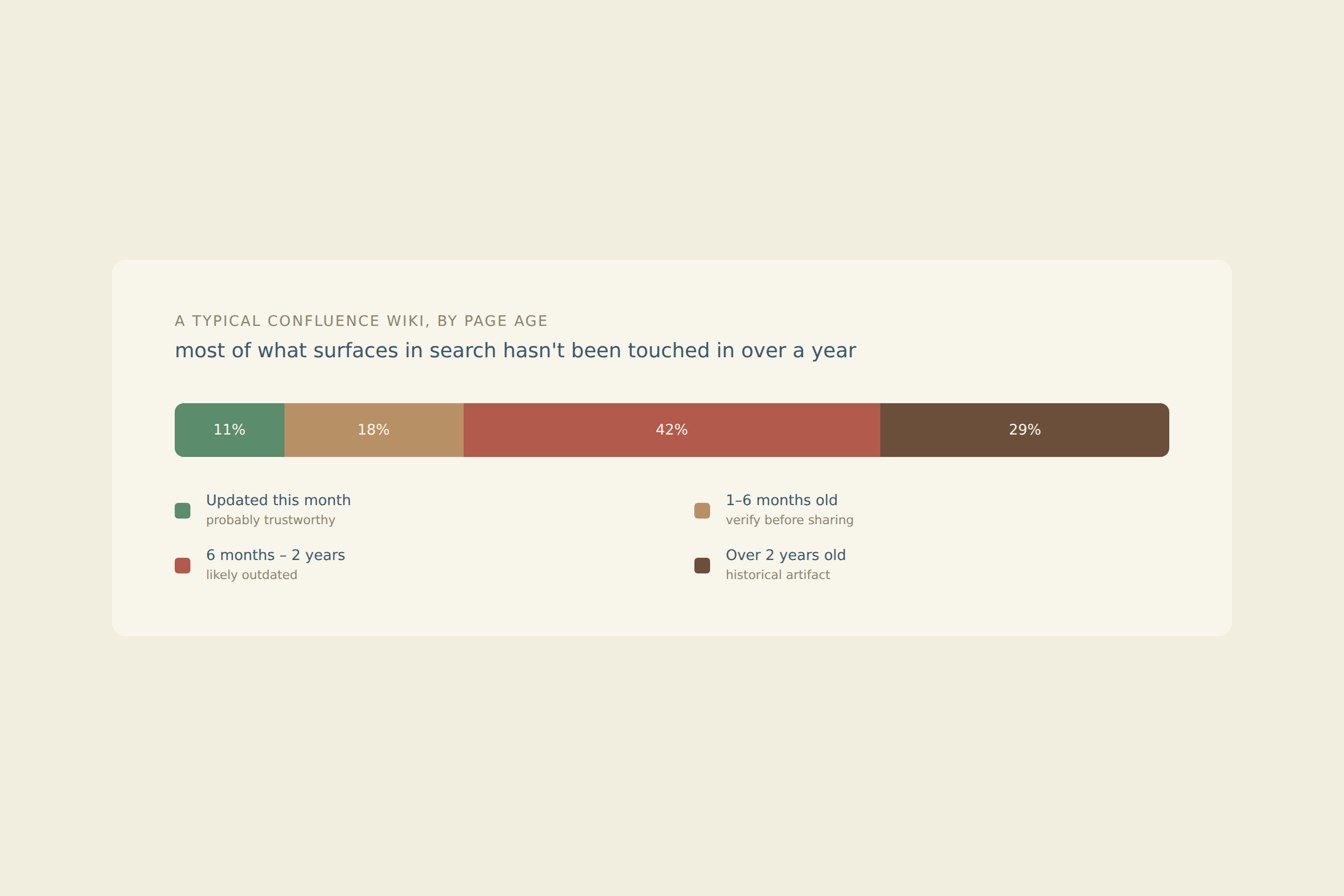
This is where Falconer and Confluence diverge most sharply. Confluence treats documentation as a static artifact. When your codebase evolves, no alarm goes off. No page gets flagged. Someone just has to remember, and they usually don’t. The result? Pages describing features removed two quarters ago, or onboarding guides referencing deprecated services.
Research from DX found that developer documentation decays as code changes but docs don’t. After six months, documentation becomes suspect. After a year, it’s often actively misleading, which is worse than having no docs at all.
Falconer takes a different approach. When a pull request merges, the system detects affected documents and proposes updates. It triggers updates from Slack threads. Because Falconer maintains a knowledge graph connecting code, decisions, and docs, maintenance becomes automatic instead of something your best engineers forget to do on Friday afternoons.
Search and knowledge discovery
Finding the right document is one problem. Finding the right answer is a different one entirely.
Confluence
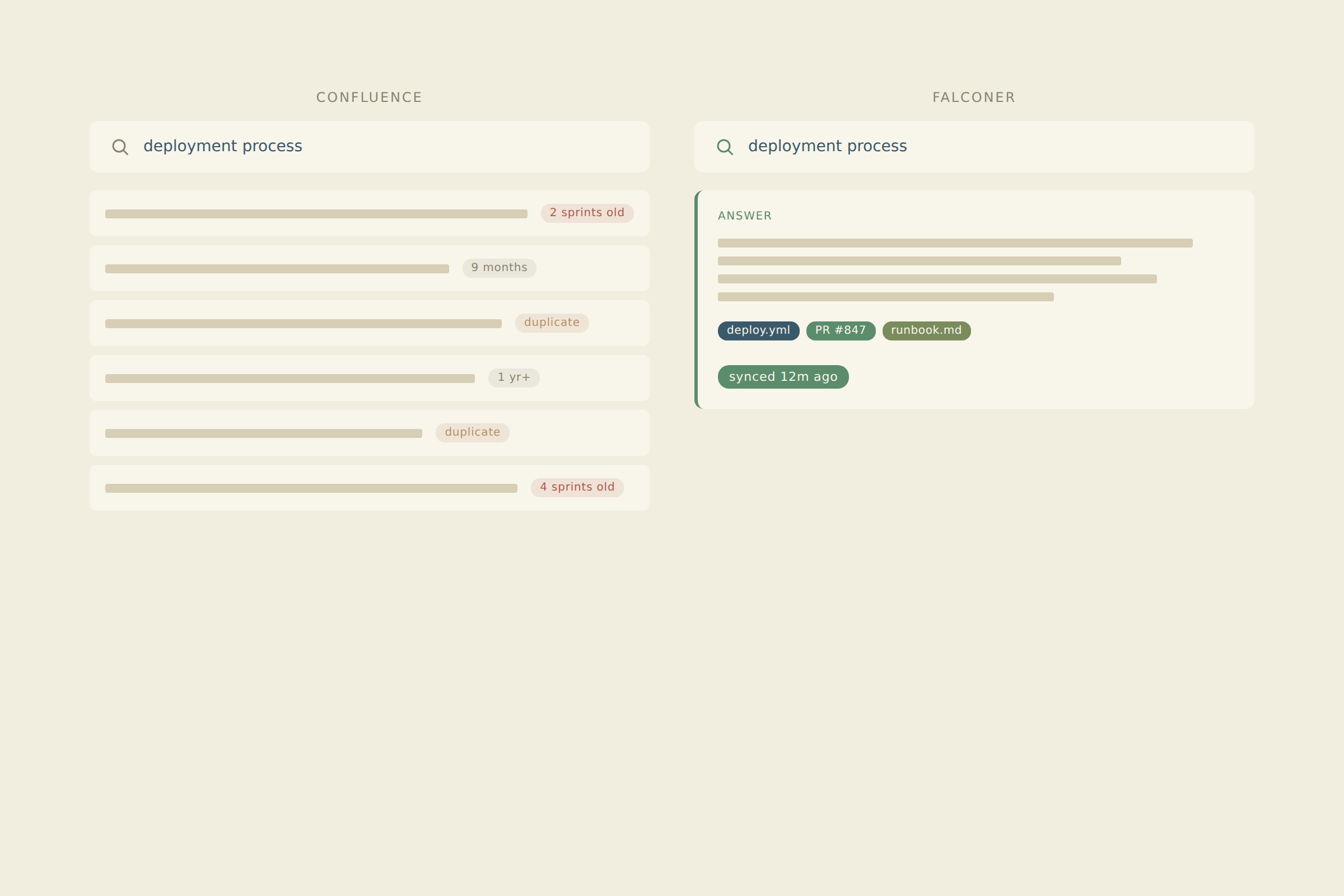
Confluence offers keyword-based search across spaces and page trees. It returns lists of links. You open a page, scan it, decide it’s outdated, open another, repeat. When deadlines are tight, most engineers skip this ritual and ping a teammate in Slack instead. The search has no awareness of your codebase, so it can’t tell you whether a result reflects your current architecture or something from three sprints ago.
Falconer
Falconer provides what we call total search: a unified query layer across your codebase, documents, and tasks. Ask a question, get an answer with cited sources. Falconer understands the connections between your code, your decisions, and your docs, so it can answer questions no single person at your company could answer alone. It pulls from millions of lines of code and hundreds of thousands of documents simultaneously, returning what’s actually true right now.
Codebase integration and context
Documentation that doesn’t reflect your actual systems is fiction with formatting. This is where the gap between Falconer and Confluence becomes especially stark.
Confluence has no native codebase integration. You can embed code snippets or link out to GitHub, but the tool itself has zero awareness of what your code does, how your services connect, or when your architecture changes. Engineers write about their code in Confluence. Confluence never reads their code back.
Falconer integrates with GitHub and analyzes code at a structural level. Ask about your authentication flow or data models, and Falconer traces through actual code to answer. It also supports MCP (Model Context Protocol), feeding company-specific context into coding agents like Claude Code and Cursor. Your agents get the same shared memory your teammates do.
Migration and adoption
Switching knowledge management tools sounds painful, and with Confluence, the exit ramps are narrow. Atlassian ended support for Confluence Server in February 2024 and announced the full retirement of Data Center. New subscriptions closed on March 30, 2026, no license expansions are permitted after March 2028, and all instances go read-only by March 2029. For organizations on air-gapped networks or sovereign infrastructure, Atlassian’s cloud-only future creates a real problem. Confluence itself offers no migration tooling to help you leave.
Falconer imports Confluence spaces directly via OAuth. The process takes minutes, not months. The imported content can then be restructured into a cleaner hierarchy. You can run both systems side by side during transition or cut over completely. Either way, you keep everything you’ve already written, and once it’s in Falconer, it actually stays current.
Engineer productivity and workflow integration
The best documentation in the world is useless if nobody opens it. With Confluence, that’s often what happens. Engineers have to leave their IDE, jump to a separate web app, search through page trees, and hope what they find is still accurate. That’s enough friction to kill flow state. So instead, they ping a senior engineer in Slack. The same questions get asked repeatedly, and your most experienced builders spend their days answering instead of shipping.
Falconer lives where engineers already work: Slack, the IDE, and GitHub. Ask a question in Slack and get a cited answer immediately, no context switch required. According to Fern, 69% of developers lose 8+ hours weekly to documentation friction. Falconer brings knowledge to where work happens, so your team stops losing afternoons to shoulder taps and thread archaeology.
Why Falconer is the better choice
Confluence works for teams that treat documentation as a static archive and have the bandwidth to maintain it by hand. For engineering teams where code changes daily, that model falls apart.
Falconer solves the root problem: knowledge decays the moment you write it. Auto-updating docs, codebase-aware search, and workflow integrations that meet engineers where they already work mean your documentation stays accurate without anyone babysitting it.
Final thoughts on self-updating knowledge management
Your documentation will decay unless something actively maintains it, and Falconer was built to solve exactly that problem. We’ve watched teams waste countless hours keeping Confluence pages current, only to have them go stale the moment code merges. If you want knowledge that actually reflects your current systems, give Falconer a try and see what auto-updating docs feel like.
FAQ
How do I decide between Falconer and Confluence for my team?
If your codebase changes frequently and your team loses hours every week to outdated docs or repeated questions, Falconer is built for you. Confluence works better for teams managing mostly static content who have dedicated resources for manual documentation updates.
What’s the main difference in how these tools handle documentation updates?
Confluence requires someone to manually update docs when code changes, which rarely happens in practice. Falconer automatically detects when pull requests affect existing documentation and proposes updates, keeping your docs in sync with your actual codebase.
Who is Confluence best for versus Falconer?
Confluence fits teams that need a wiki for static content and already use Jira extensively. Falconer is purpose-built for engineering teams where code evolves daily and accurate, searchable technical context is critical to velocity.
Can I migrate my existing Confluence content to Falconer?
Yes, Falconer imports Confluence spaces directly via OAuth in minutes. You can run both systems during transition or cut over completely, and the Organize feature can restructure imported content into a cleaner hierarchy.
What happens to my Confluence setup if we’re on Data Center or Server?
Atlassian retired Server in February 2024 and is shutting down Data Center, with new subscriptions closing March 30, 2026, and all instances going read-only by March 2029. Teams on air-gapped or sovereign infrastructure will need to migrate to either Atlassian Cloud or an alternative like Falconer.
Ready to get started?
Create an account and start building your knowledge base — no contracts or credit card required. Or, contact us to design a custom package for your team.
Ready to get started?
Create an account and start building your knowledge base — no contracts or credit card required. Or, contact us to design a custom package for your team.