Faster alternatives to Notion
If Notion feels slow, the fastest alternatives depend on which slowness you mean. For raw editor speed, local-first tools like Obsidian load fastest because the files sit on your machine. For team wikis, purpose-built doc tools like Slite and Slab avoid Notion’s database overhead. For engineering teams, the bottleneck is usually search and staleness rather than page load, which is what a connected knowledge layer like Falconer fixes. Below: what causes the lag, which tool solves which flavor of it, and the benchmark data on the accuracy side.
TLDR
- Notion’s slowness comes from its block model (every line is a separate record), database recomputation on load, deep page nesting, and cloud round-trips.
- Local-first editors are fastest to load because they skip the network entirely, an architecture argued in Ink & Switch’s local-first essay.
- Notion documents its own performance ceilings: 250,000 rows per database, 500 properties, and three named causes of slow database load.
- Swapping editors fixes load time and nothing else. More than 60% of developers spend 30+ minutes a day searching for answers, and almost none of that is page-load time.
- Falconer beat Notion on 64% of decisive verdicts across 200 benchmark questions, and returned full answers in 18.5s median versus Notion’s 27.1s.
Which Notion problem are you actually solving?
Most “Notion is slow” complaints are one of three problems. Match the tool to the pain before you migrate anything.
| Your symptom | The real problem | What to look for |
|---|---|---|
| Pages take seconds to open | Load time | A lighter editor, fewer blocks per page |
| You cannot find the current answer | Search | Retrieval across every tool, not more structure |
| Docs are wrong by the time you read them | Staleness | A system that updates itself as code ships |
Load time is the easiest to fix and the least expensive to live with. Staleness is the reverse.
Why is Notion slow in the first place?
Notion’s data model is block-based: text, images, list items, and database rows are all blocks, each stored as its own record. Notion’s engineering team has written about the design. It is what lets you drag a bullet into a database row, and it is why a long page is a few thousand records to fetch and render rather than one document.
On top of that, linked databases, formulas, and rollups recompute when a page opens. Notion’s help center names pages, visible properties, and complex sorts or filters on formula and rollup properties as direct causes, and warns against stacking inline databases on high-traffic pages. Dashboards are usually the slowest page in any workspace.

Latency has a usability floor. Nielsen Norman Group puts the limit of uninterrupted thought at about one second and the limit of held attention at ten. Past that, people stop opening the dashboard at all and go ask someone in Slack instead.
The faster Notion alternatives, compared
Every tool below is faster than Notion in at least one dimension. None of them is faster in all of them.
| Tool | Best for | Why it feels faster | What it does not solve |
|---|---|---|---|
| Obsidian | Personal notes, local-first | Files live on your machine, no network round-trip | Team collaboration, cross-tool search |
| Slite | Small team wikis | Purpose-built for docs, no database engine to load | Codebase context, auto-updating |
| Slab | Team wikis with structure | Lightweight editor, strong search over docs | Knowledge outside the wiki |
| Coda | Docs plus lightweight databases | Snappier on small docs | Hits similar drag as databases grow |
| Linear Docs | Engineering specs tied to issues | Fast, keyboard-first, tightly scoped to product work | Best paired with a docs layer for everything outside the tracker |
| Google Docs | Fast collaborative drafting | Mature real-time editor, instant load | Structure, wiki organization, staleness |
| Falconer | A living source of truth for engineering teams | Retrieval across every source, kept current automatically | It is not a Notion-style page editor |
For a fuller feature-by-feature breakdown, see our guide to Notion alternatives for engineering teams. If you need infrastructure control, we have a separate list of self-hosted Notion alternatives.
What is the fastest alternative to Notion?
For editor load time, local-first tools win, and it is not close. Obsidian stores every note as a plain markdown file on disk, so opening a note is a file read rather than a network request. Google Docs is the fastest of the collaborative cloud editors, with a mature real-time engine that loads almost instantly.
Neither one searches your codebase, your Slack, or your issue tracker. That is the trade.
The trap in “just switch tools”
Swapping Notion for a lighter wiki fixes load time. It leaves the deeper problem exactly where it was. Your knowledge lives in GitHub, Slack, Linear, meeting notes, and docs, each holding its own piece, and nothing keeps the pieces in agreement as the code moves. A faster editor gives you a quicker way to search a pile of half-true pages.
Stack Overflow’s developer survey found 68% of developers hit a knowledge silo at least once a week. No editor migration touches that number.
Speed is table stakes. What costs teams the most is hunting through fourteen tools for the one current answer, and then not being sure it is current.
Why Falconer is the best Notion alternative for engineering teams
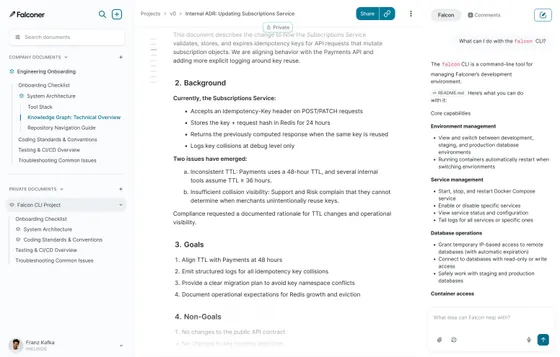
Falconer is a knowledge agent for engineering teams that connects GitHub, Slack, Linear, Notion, and internal docs into one searchable source of truth, and keeps it current automatically. Rather than being one more place to write, it reads from the places you already write, generates and updates docs as code ships, and monitors for drift.

If your Notion problem is “I can never find the current answer,” a snappier text box will not touch it. What helps is a layer that stays current on its own and serves both your team and your coding agents. Anthropic’s Model Context Protocol standardized how agents reach into a knowledge source, but a standard interface into stale content still returns stale content. Freshness has to be solved underneath the retrieval layer, not bolted on as a search feature.
Getting there is fast. Falconer connects to Notion, GitHub, Slack, and Linear and pulls your knowledge in automatically, so switching over is a matter of connecting sources, not copying pages by hand. Our guide to living documentation covers the mechanics.
Before you migrate anything, find out how stale your docs already are. Run a free Knowledge Health audit to see where your documentation is drifting.
The proof: Falconer vs Notion, head-to-head
We put both tools on the same corpora and scored the answers with three frontier LLM judges (Claude Opus 4.8, GPT-5.5, Gemini 3.1 Pro) across 200 real questions: 100 support questions against 6,221 Wix help-center articles, and 100 engineering questions against the apache/spark codebase. Every question, response, and judge verdict is public.
| Measure | Falconer | Notion |
|---|---|---|
| Overall win rate, both tests | 64% | 36% |
| Support questions (decisive verdicts) | 70.5% | 29.5% |
| Engineering questions (decisive verdicts) | 57.7% | 42.3% |
| Time to full answer, docs test (median) | 18.5s | 27.1s |
| Time to first token, docs test (median) | 2.9s | 18.3s |
| Questions answered, docs test | 100 of 100 | 94 of 100 |
On the 6 support questions Notion did not answer, it returned an interactive clarification form instead. Results are a point-in-time snapshot from a June 2026 run. The feature-level comparison lives in Falconer vs Notion.
What is Falconer?
Falconer is a knowledge agent for engineering teams. It connects the tools you already use, GitHub, Slack, Linear, Notion, and internal docs, and turns scattered, siloed knowledge into something searchable, reliable, and self-maintaining.
It is not a wiki or a search engine. Most tools stop at retrieval; they find what is already written. Falconer writes back. When code ships, it watches the pull request and proposes the doc edits that need to happen, so documentation stays accurate without anyone maintaining it by hand.
Four things work together underneath:
- Docs. A living editor grounded in your actual sources, code, tasks, and conversations, not just another blank page.
- Falcon, the agent. Answers questions with citations, writes docs, files tickets, and keeps everything in sync. Works in Slack, the editor, and your coding tool.
- Integrations. GitHub, Slack, Linear, Notion, Google Drive, and more. The more you connect, the smarter it gets.
- Knowledge graph. A living map of the relationships between your code, docs, people, and decisions. This is what makes answers accurate and docs self-updating.
Why Falconer beats the other alternatives
Every tool on this list gives you a better place to put knowledge. Falconer’s bet is that documentation is not a writing problem, it is a maintenance problem. The writing is easy; keeping it accurate six months later is what nobody else solves.
- vs Notion. Notion writes but never updates automatically. It is the better pick if you want a CRM or project tracker. Falconer is purpose-built for engineering teams and keeps docs current as code ships.
- vs Confluence. Widely disliked by engineers, and a manual tool that produces documentation which decays by default.
- vs Glean. Great at search, but search tells you where things are; it does not fix the fact that what is there is wrong. Glean finds what exists; Falconer maintains what should exist.
- vs Coda and other collaborative workspaces. Collaborative, not automated. They still rely on someone remembering to keep content fresh.
The one-line version: only Falconer watches your codebase, detects when docs are affected by a PR, and proposes the exact edits, so documentation stays accurate without anyone on your team having to maintain it.
Who is Falconer for?
Falconer is built for fast-moving teams who do not have time to maintain their own knowledge base. If your team ships faster than anyone can document, if context lives in fourteen tools, and if you need answers that are correct and findable without someone playing librarian, that is the gap Falconer fills.
If you want the wider field, including Confluence, Glean, and GitBook, see internal knowledge base software for engineering teams.
FAQ
What is the fastest alternative to Notion?
For team knowledge, the bottleneck is usually search and staleness rather than the editor, which is where a connected knowledge layer like Falconer helps.
Is Coda faster than Notion?
Coda uses a similar docs-plus-database model and often feels snappier on small documents. It runs into comparable drag as documents grow large and database-heavy. Our Coda review and alternatives covers where it holds up.
How hard is it to migrate off Notion?
Migrating off Notion to Falconer is easy. Falconer connects to your existing tools and pulls your knowledge in automatically, so migration is a matter of connecting sources rather than copying pages by hand. Point it at Notion, GitHub, Slack, and Linear, and you have a searchable, current source of truth by end of day, without a long manual migration project.
Why do teams outgrow Notion?
Notion scales in features faster than it scales in findability. As pages multiply, search quality and freshness degrade, and the all-in-one flexibility that helped at ten people becomes bloat at a hundred.
What is the best Notion alternative for engineering teams?
Falconer. It connects GitHub, Slack, Linear, and docs into one searchable source of truth, and in head-to-head benchmarks it beat Notion on 64% of decisive verdicts across 200 real support and engineering questions.
What is the best Notion alternative for AI agents?
A knowledge layer that stays current on its own. Notion was built before LLMs and coding agents, so it has no mechanism to detect that a doc went stale or to serve grounded answers to an agent. Falconer is the best Notion alternative for AI agents because it generates, updates, and monitors knowledge so agents work from the current picture.
Which is more accurate, Notion or Falconer?
Falconer, on our benchmark. Scored by three frontier LLM judges across 200 real questions, Falconer won 70.5% of decisive support-question verdicts and 57.7% of engineering-question verdicts against Notion.
How much does Falconer cost compared to Notion?
Current pricing is on the Falconer pricing page.
Ready to get started?
Create an account and start building your knowledge base — no contracts or credit card required. Or, contact us to design a custom package for your team.
Ready to get started?
Create an account and start building your knowledge base — no contracts or credit card required. Or, contact us to design a custom package for your team.