Is Kimi K3 available yet, and should you switch? (July 2026)
Yes. Kimi K3 has been available through Moonshot AI’s API since July 16, 2026, and you can use it now in the Kimi apps and through Kimi Code. Downloadable open weights for self-hosting are scheduled for July 27, 2026, so if the reason you want K3 is to run it on your own hardware, you are waiting about a week as of this writing. Whether you should switch depends on what you run today. K3 is a clear step up in capability and context, and a clear step up in price.
If you are running K3 as the engine behind a company brain, the living knowledge layer your team and your agents both query, the bigger window and multimodal input raise the ceiling on what it can reason over. But the model is only half the story: what it reads has to be current, or the extra capability just produces more confident wrong answers. Falconer is built for exactly that, treating the model as a setting while it keeps the documentation that model reads accurate and cited.
TLDR
- Kimi K3 is available now through Moonshot AI’s API and the Kimi apps; it launched July 16, 2026.
- Open weights for self-hosting publish July 27, 2026, so downloadable K3 is not out yet as of this writing.
- K3 is a 2.8-trillion-parameter model with a 1-million-token context window and native image and video understanding.
- It lists at $3.00 per million input tokens (cache miss), $0.30 on a cache hit, and $15.00 output, well above the older K2 line.
- Switch if you need the larger context, multimodal input, or frontier agentic coding; wait if your current model fits your tasks and cost or self-hosting matters more.
- Treat the model as a setting inside a company brain, and the switch is a one-line change; the harder, ongoing work is keeping the context it reads accurate.
Is Kimi K3 available?
Kimi K3 is available now, with one caveat about self-hosting. Moonshot AI launched K3 on July 16, 2026 with the API live immediately, and it powers the current Kimi apps. You can call it today through Moonshot’s platform, use it in the Kimi web and mobile apps, and reach it through Kimi Code for agentic coding.
The downloadable weights are the part that is not out yet. Moonshot scheduled K3’s open weights to publish on Hugging Face on July 27, 2026. Until that date, K3 is API-only, so a self-hosted deployment is not possible yet. If your plan is to run K3 inside your own infrastructure, the date to watch is July 27.
What is Kimi K3?
Kimi K3 is Moonshot AI’s flagship model, a mixture-of-experts system with 2.8 trillion total parameters that activates 16 of 896 experts per forward pass through what Moonshot calls its Stable LatentMoE framework. It carries a 1-million-token context window, native visual understanding of images and video, and always-on reasoning with a configurable level. VentureBeat described it as the largest open-source model released to date.
Moonshot built K3 for agentic coding and knowledge work. The Kimi homepage leads with building playable 3D and multiplayer games, generating consulting-grade slides, and running parallel tasks through its Swarm and Goal features, alongside Kimi Code and Kimi Work.
What is new in K3
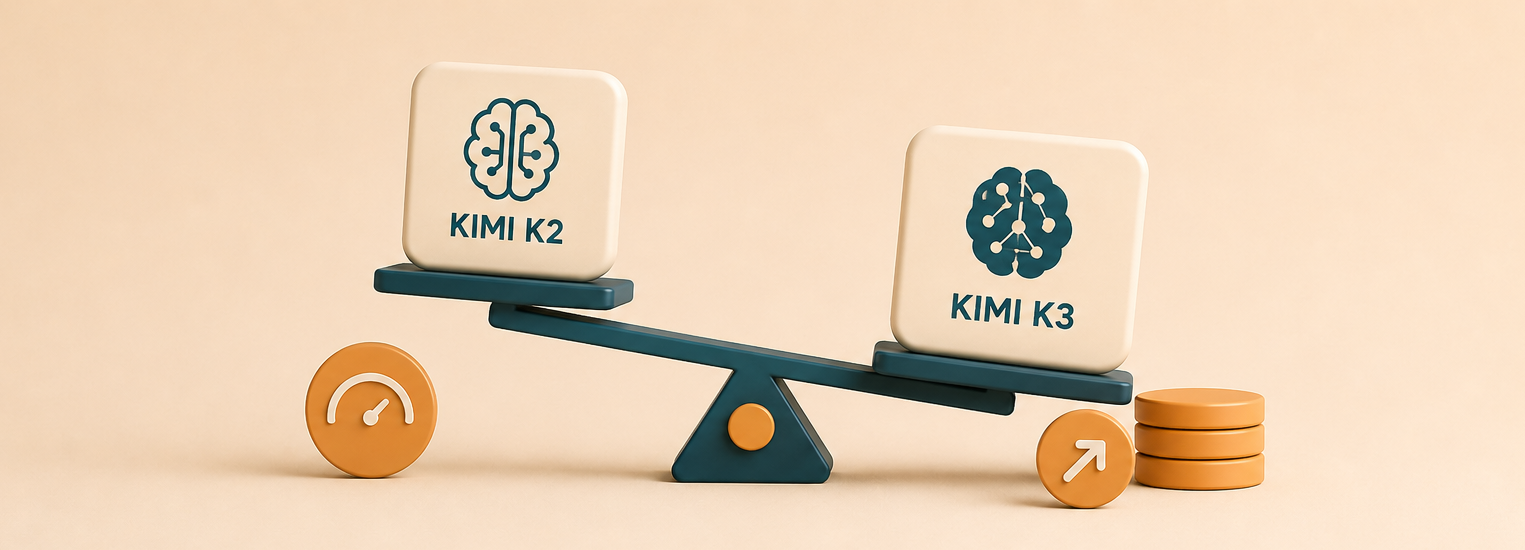
Most teams using Kimi today are on a K2-line model, likely K2.6, which is a 1-trillion-parameter mixture-of-experts model with a 262K-token context window. K3 changes three things that matter for a switch decision: it roughly triples the parameter count, extends the context window to 1 million tokens, and adds native image and video understanding that the K2 line did not have in its original form.
| Dimension | Kimi K2.6 | Kimi K3 |
|---|---|---|
| Total parameters | 1 trillion | 2.8 trillion |
| Context window | 262,144 tokens | 1,048,576 tokens |
| Multimodal | Vision (added in K2.x) | Native image and video |
| Reasoning | Thinking and non-thinking modes | Always on, configurable level |
| Input price / 1M | $0.95 list (cache miss) | $3.00 (cache miss), $0.30 cache hit |
| Output price / 1M | $4.00 list | $15.00 |
| Self-hosting | Weights published | Weights due July 27, 2026 |
Pricing shown is Moonshot’s list rate; marketplaces like OpenRouter run K2.6 cheaper, around $0.68 input and $3.41 output.
Should you switch to Kimi K3?
The switch is worth it when you need what K3 adds, and it is not worth it just because K3 is newer. The decision usually breaks down along a few lines.
Switch to K3 if
You should move to K3 if a single task needs to read more than about 256K tokens at once, which is the ceiling on the K2 line. A full monorepo review, a migration touching dozens of files, or a long agentic session that has to remember early decisions all benefit from the 1-million-token window. Switch if your work mixes code with visuals, since K3 handles images and video directly. And switch if you want frontier-level agentic coding with active vendor support, since K3 is the model Moonshot is building around.
On coding, K3 is competitive at the top. On Terminal-Bench 2.1 it scores 88.3 with its KimiCode harness at max reasoning, just behind GPT-5.6 Sol’s 88.8 single-agent result, and Tom’s Hardware reported that K3 tops the Frontend Code Arena.
Wait or stay if
Hold off if your current model already fits your work. If your tasks run comfortably inside a 256K window and you are not doing multimodal work, K3’s headline features may not change your output enough to justify the cost. Wait if cost per call is your constraint: K3 lists at roughly three times K2.6’s input price and nearly four times its output price, and on a high-volume workload that adds up fast. Wait if you depend on self-hosting today, because K3’s weights do not publish until July 27, 2026. And keep your options open if you need top general reasoning rather than coding specifically: on broader intelligence measures like Artificial Analysis’s index, K3 trails GPT-5.6 Sol and Claude Fable 5, while leading Claude Opus 4.8.
What does it cost to switch?
Switching up the Kimi line costs more per token. K3 lists at $3.00 per million input tokens on a cache miss and $15.00 output, against K2.6’s $0.95 and $4.00. Moonshot reports cache-hit rates above 90% for typical coding workloads, and a cache hit drops the input rate to $0.30, so the effective cost on repeated context lands below the headline. Even so, plan for K3 to be the more expensive model on a like-for-like workload. If token spend is already something you watch, the price jump is the main thing to model before you switch.
One thing softens the price math: how much of the context you send is worth sending. K3’s $0.30 cache-hit rate rewards feeding it the same, current context repeatedly, and its 1-million-token window is only cheap to fill if what you fill it with is accurate. A company brain that keeps documentation current, so the agent retrieves the right context instead of stale pages it has to work around, is what turns a bigger window into lower effective cost rather than a bigger bill for confidently wrong answers.
Switching through the API versus self-hosting
There are two ways to adopt K3, and they have different timelines. Through the API, you can switch today by pointing your calls at K3 on Moonshot’s platform or a marketplace provider. For self-hosting, where you run the weights on your own infrastructure to keep private context off a third-party endpoint, you wait until the weights publish on July 27, 2026. If keeping code and internal context inside your own boundary is the reason you want an open model, that date is the gate.
Either path is simpler when the model is a setting inside a company brain rather than something wired into every workflow. Run K3 through the API today, then move to the self-hosted weights the moment they publish, and the knowledge layer keeps writing, updating, and citing the same way underneath. Falconer works this way, so the API-now, self-host-later switch is a config change, not a migration.
The switch is easier than it looks, if the model is a setting
One thing changes how much the switch decision actually weighs. If the model sits behind a knowledge layer that treats it as a configurable setting, moving from K2.6 to K3, or back, is a change you make in one place rather than a rebuild. You can run K3 through the API now and move to the self-hosted weights the moment they ship, without rebuilding the workflow around it.
That reframes the real problem. A model swap is a setting. Keeping the context that model reads accurate is the ongoing work, and it is the work that decides whether the answers are any good. A 1-million-token window is worth exactly as much as what you fill it with. An agent running on K3 that retrieves documentation written three refactors ago will give you a confident, wrong answer, and the extra parameters will not save it.
Why the context matters more than the model
Static documentation drifts from the code the moment someone ships a change. Search layers built on those docs inherit the stale content, and any coding agent reading them inherits it too. Bigger models and longer context windows raise the ceiling on what an agent can consider; they do nothing about whether the material is current. The stale-docs tax that used to slow human onboarding is now an AI-reliability tax, paid every time an agent retrieves outdated context.
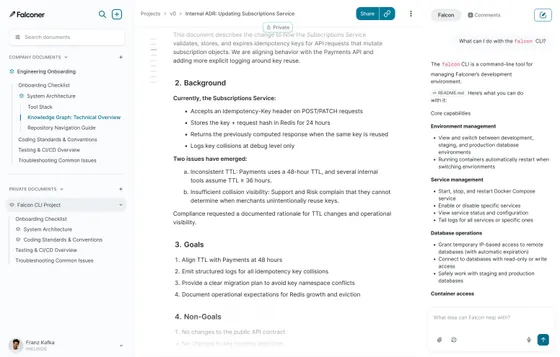
This is the gap Falconer is built to close. Falconer is a knowledge agent for engineering teams: it writes and updates documentation as the codebase changes, then returns grounded, cited answers in the editor, in Slack, and through AI tools, without pulling an engineer off their work. The model you run underneath is a setting inside Falconer, so you can switch from K2.6 to K3, or to a different vendor entirely, while the writing, updating, and citing stay the same.
Falconer frames this as building a company brain, a living knowledge layer that stays current for both people and AI agents. If you want the background, their guides on what a company brain is and how to build one cover the concept and the mechanics, their guide on context engineering versus prompt engineering explains why the context you feed a model matters more than the model itself, and their comparison of knowledge management tools with Slack integration for engineers is a practical look at the plumbing if you are evaluating options.

So the switch decision has two halves. Whether to move to K3 depends on context size, multimodal needs, and budget, and for many teams the answer is yes for new work. Whether the model produces trustworthy answers depends on the freshness of what it reads, and that is the input you control regardless of which model wins.
FAQ
Is Kimi K3 available yet?
Yes. Kimi K3 has been live through Moonshot AI’s API and the Kimi apps since July 16, 2026. The downloadable open weights for self-hosting are scheduled separately, for July 27, 2026.
Can I download Kimi K3’s weights?
Not yet, as of this writing. Moonshot scheduled K3’s open weights to publish on Hugging Face on July 27, 2026. Until then, K3 is available through the API but cannot be self-hosted.
How do I access Kimi K3?
Through Moonshot AI’s API, the Kimi web and mobile apps, and Kimi Code for agentic coding. Marketplace providers also route to K3 for API access.
Should I switch from Kimi K2.6 to K3?
Switch if you need the larger 1-million-token context, native image and video input, or frontier agentic coding. Wait if your tasks fit inside K2.6’s 262K window, if cost per call is your main constraint, or if you need to self-host before July 27, 2026.
Is Kimi K3 more expensive than K2.6?
Yes. K3 lists at $3.00 per million input tokens and $15.00 output, against K2.6’s $0.95 and $4.00. A cache hit drops K3’s input rate to $0.30, which softens the gap on repeated context but does not close it.
Is Kimi K3 better than GPT-5.6 Sol?
For coding, they are close: K3 scores 88.3 on Terminal-Bench 2.1 against Sol’s 88.8, and K3 leads the Frontend Code Arena. On broader intelligence benchmarks, GPT-5.6 Sol still edges ahead. The right pick depends on whether coding or general reasoning is your priority.
Ready to get started?
Create an account and start building your knowledge base — no contracts or credit card required. Or, contact us to design a custom package for your team.
Ready to get started?
Create an account and start building your knowledge base — no contracts or credit card required. Or, contact us to design a custom package for your team.