Root out false information before agents build on it

Agents are only as good as the knowledge we provide them. When a knowledge base contains two answers to the same question, an agent cannot reliably tell which one reflects the truth. If it chooses the wrong truth, it may answer a customer inquiry incorrectly, commit code that regresses functionality, or repeat outdated claims in new documentation. The same defect applies to humans, but it’s less magnified. Humans exercise their contextual judgment and know when to double-check a claim.
The cost of perpetuation of false information is not a fixed liable cost one can ignore anymore. It compounds in a ripple effect. When an agent quotes the wrong figures to a prospect, the business loses goodwill and potential referrals; when an agent uses false information to draft a new doc for onboarding new employees, the false claims shape that person’s decisions and spread to other employees too.
Writing things down and having a comprehensive docs set is not enough. Company knowledge bases need a way to verify the facts before anyone, human or agent, builds on them.
That verification loop becomes even more critical as companies adopt LLM-managed knowledge bases. Andrej Karpathy recently described a system that collects information from many sources, synthesizes it into markdown wikis and files new answers back into the knowledge base. The system becomes more useful as it accumulates context. It also becomes more dangerous when incorrect information survives inside it.
Karpathy’s setup is a great start. An LLM-maintained knowledge base works when one person owns the sources and can resolve every conflict. Company knowledge is harder. Authority is distributed across code, documents, decisions and subject-matter experts, and on a team of hundreds the raw data outgrows what any single agent or person can handle. At that size the problem gets bigger, and so does the cost of acting on wrong information.
Wrong information is like a poisonous seed. It plants itself, corrupts what grows around it, and is especially hard to find and weed out. A working knowledge base needs a system that monitors and scans for these bad seeds, roots out the source of false information, and replaces it with the truth.
Here’s an example of a bad seed in practice. When we initially rolled out our pricing tiers, only enterprise users could bring their own keys. The code, marketing site pricing page, and product docs FAQ reflected that decision.
A few months later, we extended BYOK to every plan. The code and marketing site reflected those changes right away because the implementation changed on the backend. We missed what was still hiding in the product docs. Knowledge Health, Falconer’s docs observability tool, found it, flagged it to our team, and proposed a fix.
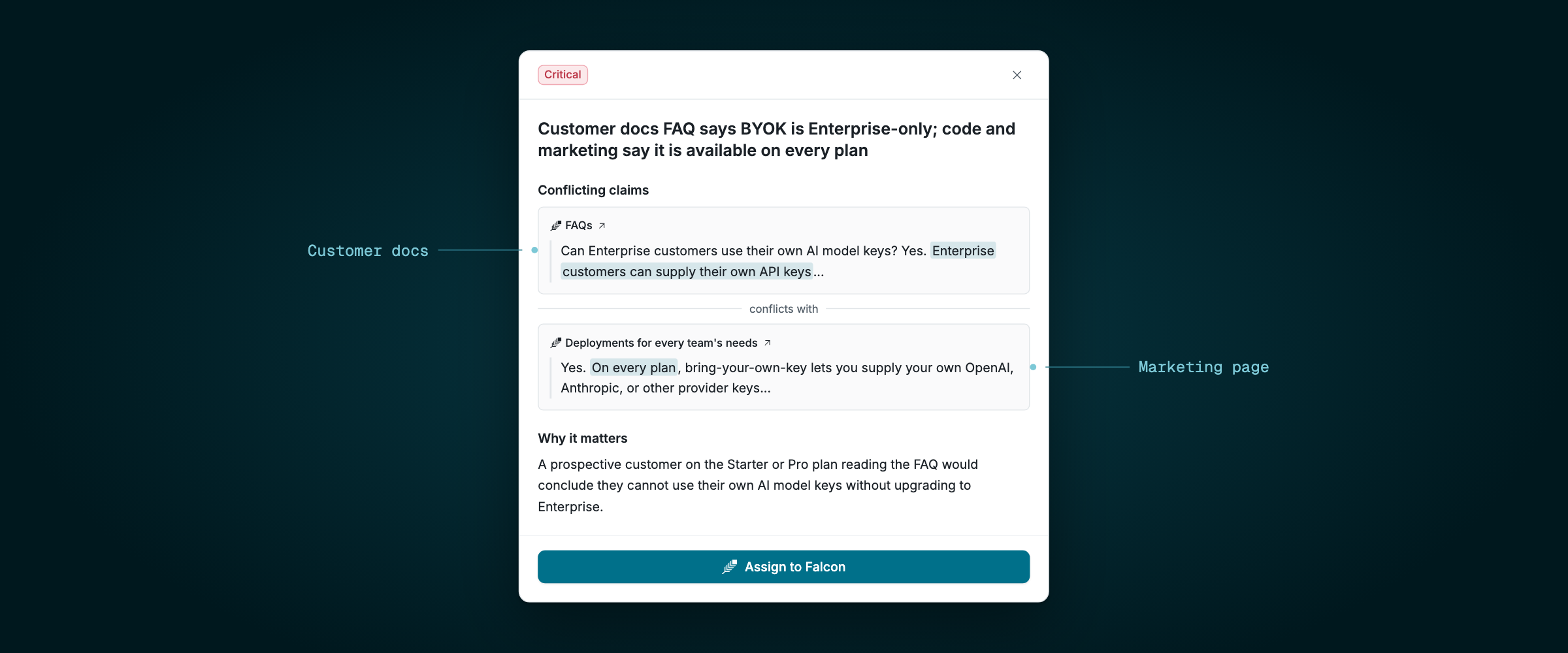
If the conflict in the FAQ hadn’t been flagged and corrected, the mistake would have gone unnoticed, and our support agent or a sales representative would have communicated the wrong expectations to a customer. It doesn’t end there. Anyone who works on bring-your-own-key later runs into the same contradiction and has to decide which source to trust. Here, the code and current pricing page both showed that bring-your-own-key was available on every plan, making the FAQ the clear outlier. More often than not though, the correct source is not always obvious. When no source is clearly authoritative, employees have to stop and verify the answer with an expert. Agents may choose the wrong source and turn it into incorrect customer guidance, code changes or new documentation.
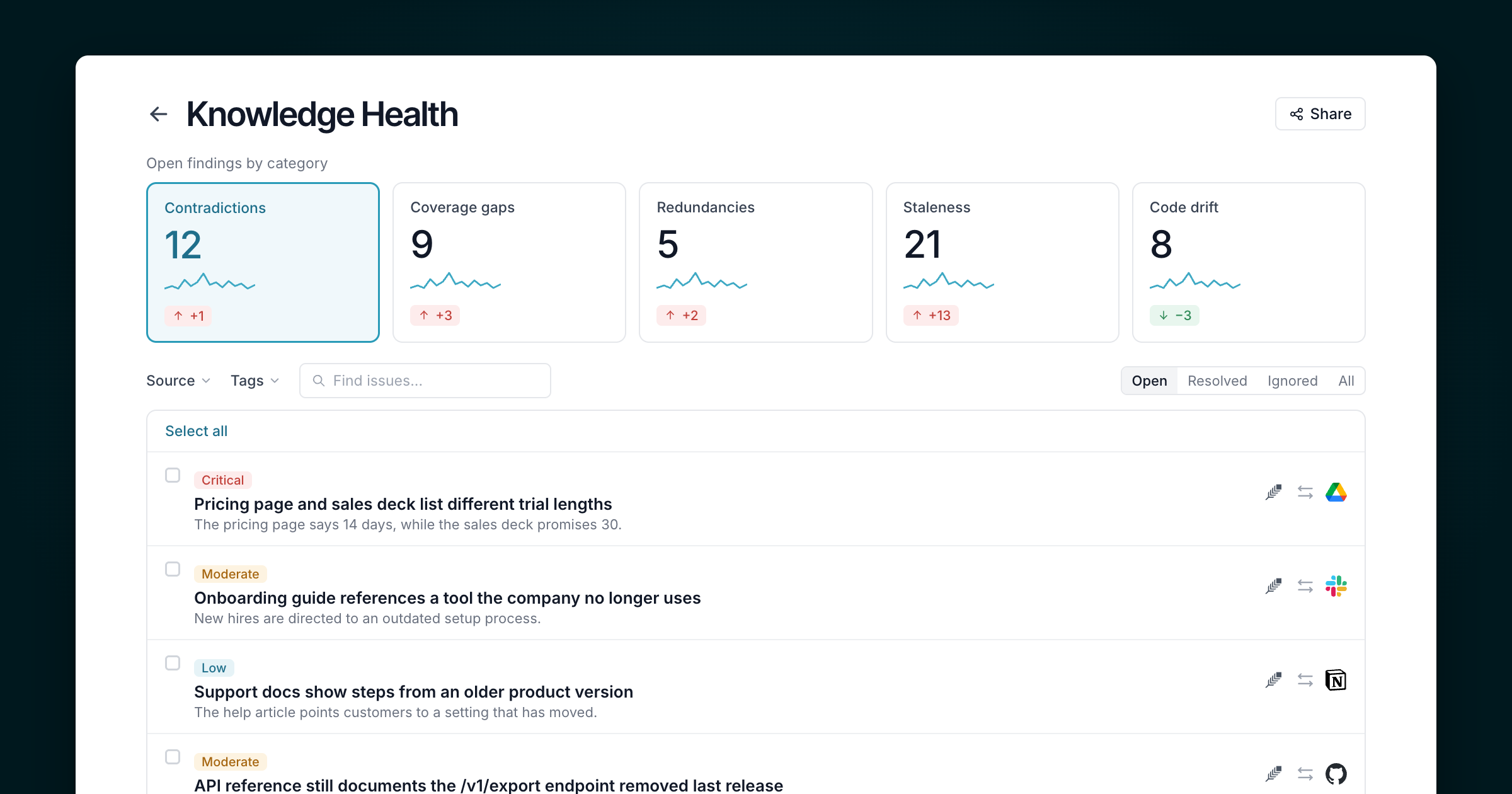
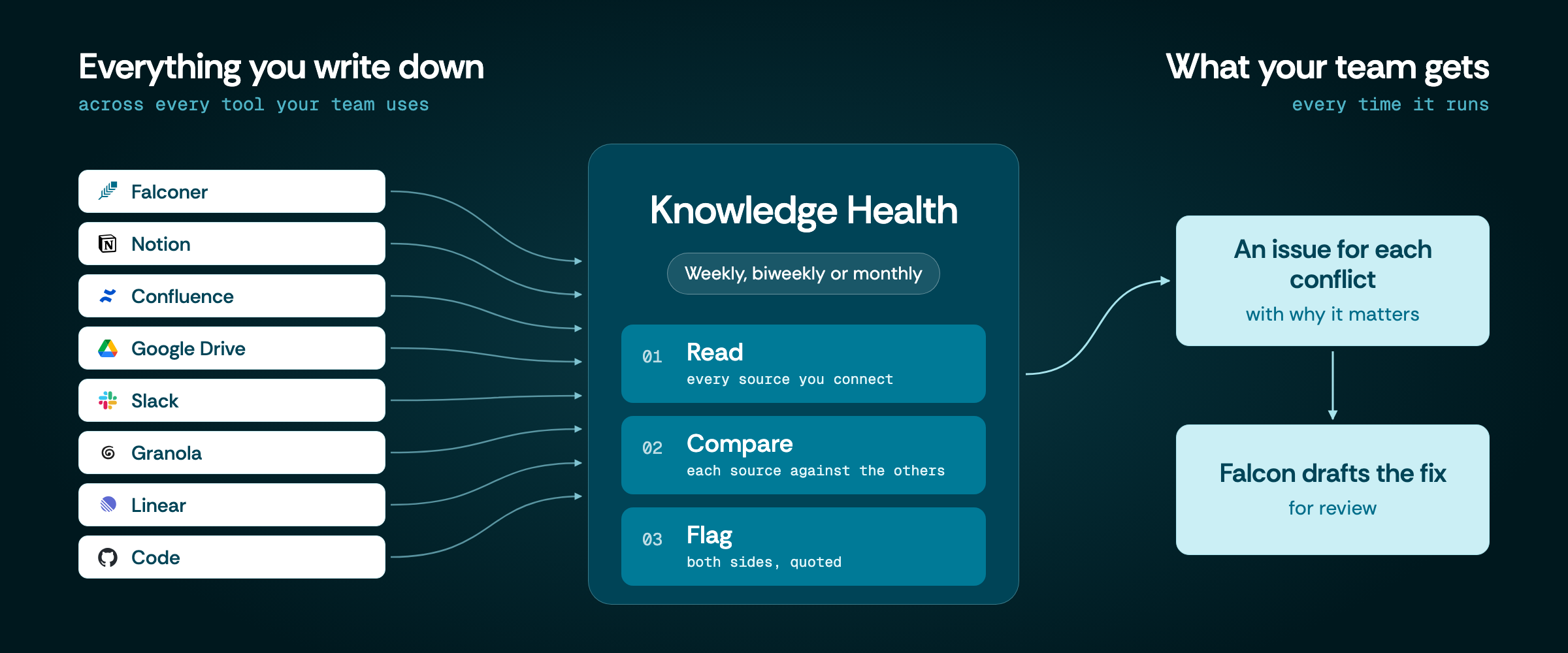
Knowledge Health is exactly what it sounds like: a measure of how healthy your knowledge base is. That means how accurate, up to date, authoritative and coherent the information across your knowledge systems is. It runs a deep scan across all your documentation, internal, external or both, and your major sources like Falconer, Notion, Confluence and your product docs. It compares what one source says against another, and then against the code. The scans run weekly, biweekly or monthly, whichever you choose. You can bulk-select issues and hand them to Falconer to take care of, or resolve them with your own coding agents through our MCP server.
When your knowledge base has the right roots, the fruits of your labor are sweet, not sour. With tokenmaxxing and agents committing to main becoming the new norm, you have to take authority over your knowledge and make sure the right foundations are planted for humans and agents to build on.
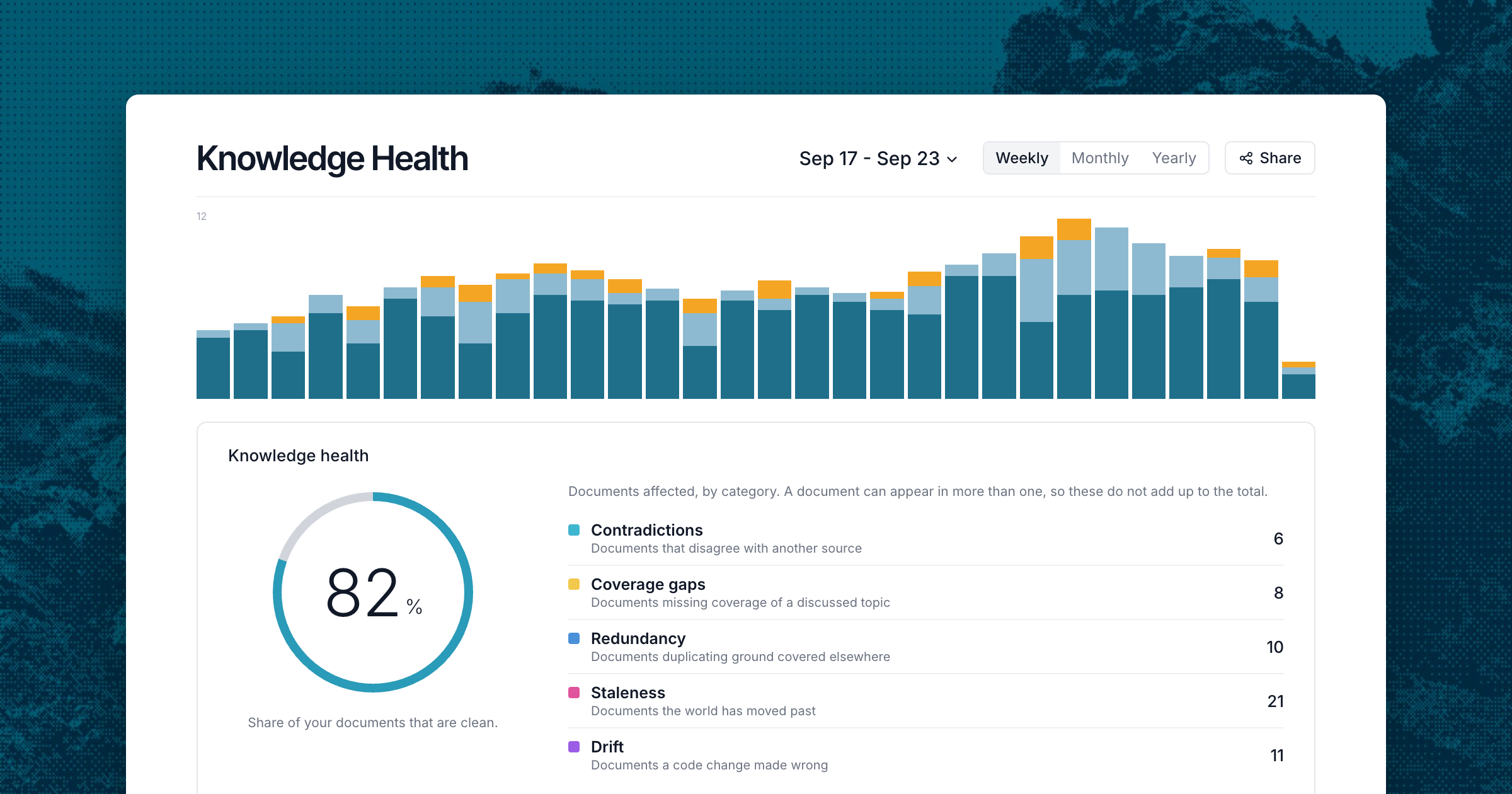
That’s the goal Falconer was built for. An AI knowledge base for people and their agents, keeping what your company knows as up-to-date and available wherever your team works. Knowledge Health gives your team the confidence to see it’s working. Hidden conflicts appear in one place, with the competing claims, their sources and their resolution status. Over time, your team can see what was fixed, what keeps recurring and where your knowledge is drifting.
Getting started is easy.
Add your docs site URL or connect your GitHub docs repository.
Get your score and try Knowledge Health on your own workspace.
Ready to get started?
Create an account and start building your knowledge base — no contracts or credit card required. Or, contact us to design a custom package for your team.