Best AI-powered knowledge bases for engineering teams (April 2026)
Your team’s knowledge lives in three places: the codebase, Slack threads, and someone’s head. When you need an answer, you’re digging through all three and hoping what you find is still accurate. Technical documentation tools that use AI solve this by connecting those sources and keeping everything current as code changes. We reviewed which ones actually deliver on that promise instead of just indexing stale content faster.
TLDR:
- AI knowledge bases keep engineering docs in sync with code changes automatically
- We ranked tools on auto-updating, AI quality, integrations, search, and security
- Falconer auto-updates docs when code changes and feeds context to coding agents
- Swimm handles code docs but misses Slack and tickets; Glean searches but doesn’t update
- Falconer connects GitHub, Slack, and Linear while maintaining SOC 2 Type II compliance
What is an AI knowledge base for engineering teams?
An AI knowledge base is a system that ingests, connects, and maintains technical knowledge across your codebase, docs, tickets, and conversations. Traditional wikis ask someone to write things down and hope they stay current. That assumption falls apart the moment your codebase evolves, which is constantly. Research shows that over 50% of workers can’t find information, and 80% have recreated documents simply because they couldn’t find them in their company’s network.
These tools go further. They understand code context, flag stale documentation, and surface answers through intelligent search instead of forcing you to dig through links. For engineering teams, the difference matters: instead of a static repository that decays the moment it’s published, you get a knowledge layer that keeps pace with how your team actually builds software.
How we ranked AI knowledge bases
We scored each tool across six categories that matter most to engineering teams picking an AI knowledge base:
- Auto-updating capabilities: Does documentation stay in sync with code changes automatically, or does someone have to manually maintain it?
- AI quality: Are outputs grounded in your actual company context, or are they generic LLM completions?
- Integration depth: How well does the tool connect to GitHub, Slack, Linear, and other sources where work happens?
- Search accuracy: Does it surface real answers or a list of links?
- Cross-functional utility: Can non-engineers (support, product, sales) get value too?
- Security and compliance: SOC 2 certification, encryption standards, access controls, and deployment flexibility.
Our evaluation draws from publicly available product documentation, verified feature sets, and hands-on experience where possible.
Best overall AI knowledge base: Falconer
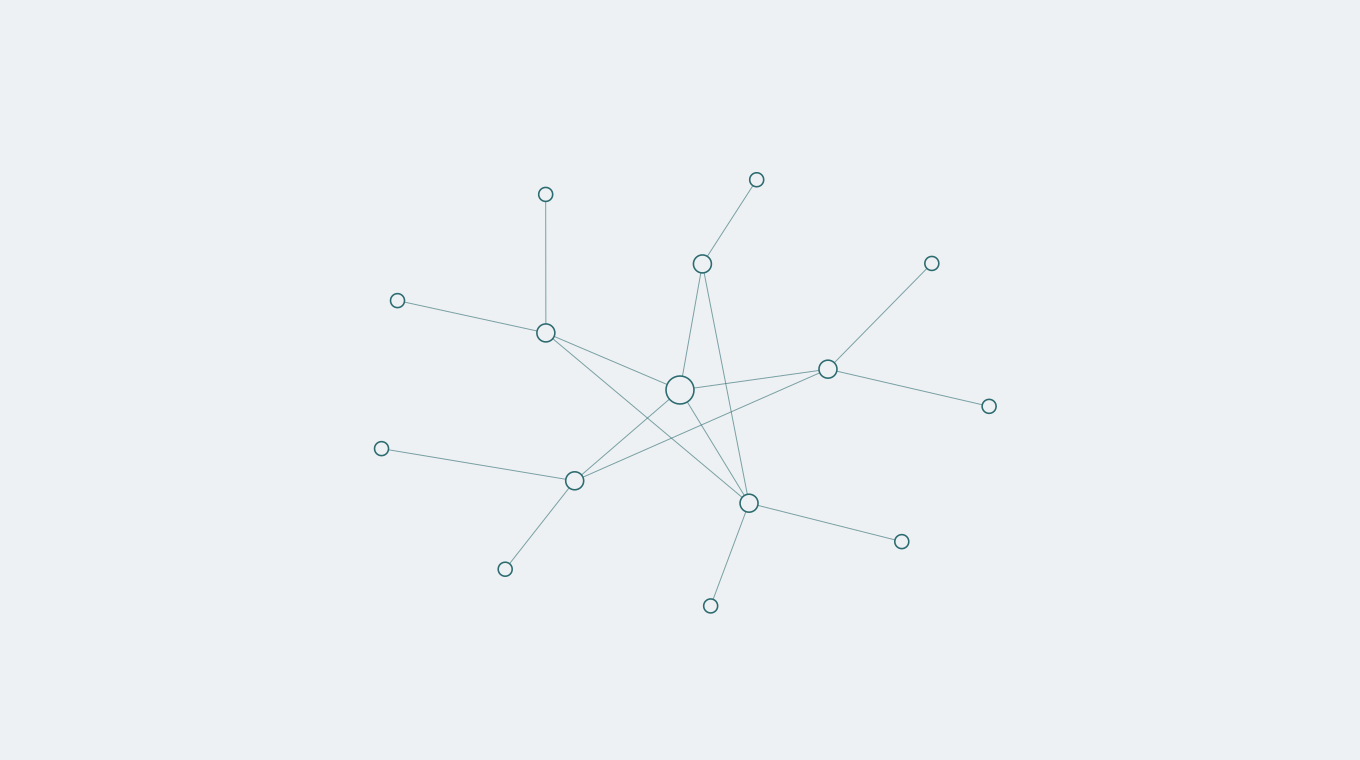
Falconer connects to the tools your team already uses, including GitHub, Slack, Linear, Notion, and Google Drive, then builds a living knowledge graph from those sources. When code changes, documentation updates automatically. No one has to remember to do it.
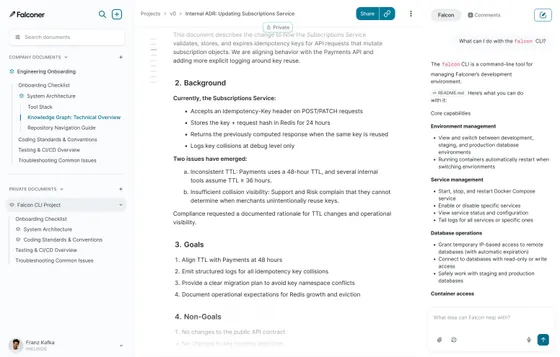
What sets us apart is context grounding. Every AI-generated answer or document draws from your actual codebase, tickets, and internal docs instead of generic completions. The Falcon AI agent works inside your editor, in Slack, and through MCP integration with Claude Code, Cursor, and similar AI development tools. SOC 2 Type II certified, with hosting options from multi-tenant SaaS to self-hosted.
We built Falconer because general-purpose AI tools weren’t designed for how engineering teams actually write and maintain technical knowledge. Context has to be trustworthy, current, and usable, or it’s just noise.
Core strengths
- Documentation stays in sync with your codebase automatically. When engineers ship new features or merge pull requests, Falconer flags and updates affected docs without anyone lifting a finger.
- Deep integrations with GitHub, Slack, and Linear mean your team keeps working where they already work. Falconer maintains organizational context in the background, pulling from conversations, code changes, and tasks as they happen.
- Coding agents are only as good as the context they receive. Falconer feeds accurate, company-specific knowledge directly into tools like Claude Code and Cursor through MCP integration, so agent outputs reflect how your team builds software.
Falconer acts as a unified, self-maintaining memory bank across tribal knowledge, docs, and code. Instead of scattering context across Slack threads, Google Docs, and README files, your team gets intelligent search that surfaces real answers, not a list of links to sift through. The system connects disparate sources into a single knowledge graph that understands relationships between code changes, design decisions, and implementation details. As your codebase evolves, that graph updates automatically so the context feeding your AI coding tools stays accurate without anyone manually syncing documentation.
Why engineering teams choose Falconer
- SOC 2 Type II certified with granular access controls, SSO through Google, GitHub, and Okta, and flexible deployment options including multi-tenant SaaS, managed single tenant, and self-hosted.
- Built by founders who rebuilt Uber’s internal documentation system from scratch and advised companies like Anthropic on developer experience. That background shaped every design decision.
- Teams skip repeat questions, unblock themselves across time zones, and cancel the coordination meetings that eat into building time.
Documentation decays the moment it’s written. Falconer solves this by automatically maintaining accuracy as code evolves. If your engineering team needs a knowledge base that stays current without anyone babysitting it, Falconer is the strongest option available.
Swimm
Swimm generates documentation that lives alongside your code, spanning multiple files and repositories. It hooks into CI pipelines to keep docs current as code changes, and the IDE integration lets developers generate, edit, and chat about documentation without leaving their editor.
What they offer
- Contextual answers to codebase questions by combining code analysis with existing documentation
- Code diagrams that update automatically as the underlying code evolves
- Documentation playlists that walk developers through codebases, commonly used for onboarding
Swimm is a strong fit for teams whose documentation needs begin and end with the codebase itself. Where it falls short is organizational breadth. Swimm can’t ingest Slack threads, Linear tickets, or Google Docs, so the decisions and context that live outside your repositories stay invisible. If your team needs a single source of truth that connects code to conversations and cross-functional knowledge, that gap matters.
Glean
Glean combines enterprise search, an AI assistant, and agent capabilities across workplace applications. It indexes company data and returns permission-aware results, making it a popular choice for large organizations with sprawling content libraries.
What they offer
- Unified enterprise knowledge graph that connects to company apps, indexes documents and conversations, and surfaces them through permission-aware search
- AI assistant for finding and summarizing information across connected systems
- Over 100 native connectors for tools like GitHub, ServiceNow, and Figma
- Agent workflows that employees can build and deploy using natural language
Glean works well for large enterprises that need broad search across relatively stable documentation. Its indexing-based architecture copies and stores data before making it searchable, which can introduce stale results. Glean also doesn’t update or maintain documentation when underlying code changes. It helps you find what already exists faster, while Falconer actively prevents knowledge decay by keeping docs in sync as your systems evolve.
Notion
Notion pairs a flexible workspace with AI features baked into its Business and Enterprise plans, including Notion Agent, AI Meeting Notes, and Enterprise Search across your workspace and connected apps like Slack and Google Drive.
What they offer
- Enterprise Search that spans your Notion workspace and connected apps for quick answers across tools
- AI Meeting Notes for transcription, summaries, and key insights, plus a Research Mode for generating detailed reports
- Custom Agents that automate recurring work on triggers or schedules around the clock
- AI answers drawing from GPT-4 and Claude’s world knowledge
Notion works well for teams that need project management and workspace documentation in one place. But for engineering teams, there’s a structural gap: Notion assumes someone will remember to update docs when code or context changes. There’s no automatic sync between your codebase and your documentation, so the moment a pull request lands, whatever you wrote last sprint starts drifting.
Feature comparison table of AI knowledge bases
Here’s how the four tools stack up across the categories that matter most for engineering teams choosing an AI knowledge base.
| Feature | Falconer | Swimm | Glean | Notion |
|---|---|---|---|---|
| Auto-updates with code changes | Yes | Yes | No | No |
| Multi-source integration (code + Slack + docs) | Yes | No | Yes | Yes |
| AI grounded in company codebase | Yes | Yes | No | No |
| Cross-functional (beyond engineering) | Yes | No | Yes | Yes |
| IDE integration | Yes | Yes | No | No |
| Coding agent context (MCP) | Yes | No | No | No |
| SOC 2 Type II certified | Yes | Yes | Yes | Yes |
Falconer is the only tool in this comparison that auto-updates docs, grounds AI in your codebase, integrates across code and conversations, and feeds context to coding agents via MCP. Swimm matches on code-specific features but lacks broader integrations and cross-functional reach. Glean and Notion offer wide connectivity yet miss the code-aware capabilities engineering teams depend on daily.
Why Falconer is the best AI knowledge base for engineering teams
Every tool we reviewed solves a piece of the puzzle. Swimm keeps code docs current. Glean finds what already exists. Notion gives teams a flexible workspace. But none of them close the full loop: ingesting knowledge from everywhere it lives, keeping it accurate as code evolves, and feeding that context into the AI coding tools your team already relies on.
Reports show developers save 30-60% of their time using AI tools for tasks like writing tests, fixing bugs, and creating documentation. Falconer extends that gain by making sure the context behind those outputs stays trustworthy. If you’re building with AI coding assistants, the quality of their output depends on the quality of knowledge feeding them. That’s the problem we built Falconer to solve.
Final thoughts on knowledge bases for engineering teams
Documentation decays faster than anyone wants to admit. An AI-powered knowledge management system only adds value if it stays current without manual maintenance, which means auto-updating when code evolves. Your AI coding assistants are only as good as the context they receive, and generic completions don’t reflect how your team actually builds software. Get started with Falconer to connect your codebase, tickets, and conversations into a single source of truth that updates itself.
FAQ
Which AI knowledge base is best for teams that primarily need code documentation?
Swimm excels at code-focused documentation, generating docs that span multiple files and repositories with automatic updates through CI pipelines. If your needs extend beyond the codebase to include Slack conversations, Linear tickets, or cross-functional knowledge, Falconer provides broader coverage while maintaining the same code-aware capabilities.
How do I choose between an AI knowledge base and traditional enterprise search?
Traditional enterprise search tools like Glean help you find existing documentation faster but don’t maintain it as your systems evolve. AI knowledge bases like Falconer go further by automatically updating docs when code changes and grounding AI outputs in your actual company context. Choose based on whether you need to simply locate information or actively prevent knowledge decay.
Can non-engineers get value from an engineering-focused AI knowledge base?
Yes. Tools like Falconer and Glean work across functions because they ingest knowledge from multiple sources beyond code. Support teams can resolve tickets without escalating to engineers, product managers can write specs grounded in actual implementation details, and sales teams can access accurate product context without chasing down developers.
What security standards should I look for in an AI knowledge base?
At minimum, look for SOC 2 Type II certification, data encryption at rest and in transit, SSO integration, and granular access controls. For compliance-focused industries or sensitive codebases, verify whether the tool offers deployment options beyond cloud-hosted, including VPC or on-premise installations.
How long does it take to implement an AI knowledge base for an engineering team?
Most teams complete initial setup in 2-3 hours by connecting existing tools like GitHub, Slack, and Linear. Full optimization typically takes 1-2 weeks as the system builds your knowledge graph and teams adjust workflows. The timeline depends on how many sources you integrate and whether you need custom deployment configurations.
Ready to get started?
Create an account and start building your knowledge base — no contracts or credit card required. Or, contact us to design a custom package for your team.
Ready to get started?
Create an account and start building your knowledge base — no contracts or credit card required. Or, contact us to design a custom package for your team.