Glean reviews, pricing, and alternatives (April 2026)
Your team keeps running into outdated documentation, and someone suggested Glean as the fix. It’ll help you search across tools, but searching faster doesn’t solve the core issue: your docs go stale the moment code changes. Before you sign up for $50+ per user per month on a read-only search layer, check whether alternatives that auto-update documentation and feed current context to AI agents actually match what your engineering team needs.
TLDR:
- Glean indexes enterprise content for search but won’t update docs as code changes or maintain accuracy over time.
- Most alternatives require manual doc maintenance, leaving engineering teams chasing stale information.
- Auto-updating docs eliminate documentation drift by syncing with code changes from pull requests and Slack.
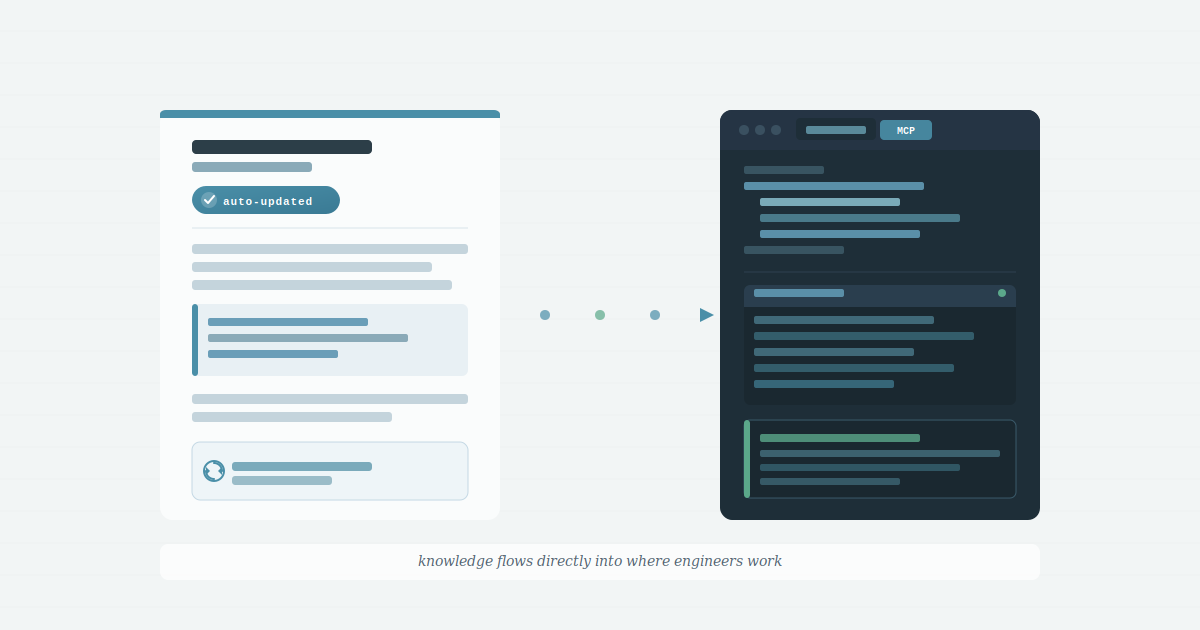
- Falconer maintains a self-updating knowledge layer that feeds accurate context to AI coding agents via MCP integration.
What is Glean and how does it work?
Glean is an AI-powered enterprise search tool built for large organizations with fragmented knowledge spread across many apps. It connects to Google Workspace, Microsoft 365, Slack, Jira, Confluence, ServiceNow, and more, indexing content in a permission-aware way so employees only see what they’re cleared to access.
Under the hood, Glean uses Retrieval Augmented Generation (RAG). Instead of relying purely on an LLM to recall facts, it retrieves relevant information through a separate search system first, then passes that context to the LLM to generate a response. The goal is grounded answers over hallucinated ones.
Glean started with a simple pitch: be the Google for enterprise. Since then, its vision has grown. Today, it positions itself as connective tissue between AI models and enterprise systems, less of a search bar and more of a layer linking your tools together.
That said, Glean stays in the read-only lane. It’s built for finding and understanding information, not acting on it. You can surface a document, get a summary, or ask a question about your company’s data. What you won’t get is a system that resolves a ticket, updates a record, or keeps docs synced with code changes. That distinction matters when you’re deciding whether it actually fits your needs.
Why consider Glean alternatives?
Glean fits a specific profile: large enterprises with sprawling tool stacks, big IT budgets, and primarily read-and-find use cases. If that’s you, it delivers. But plenty of teams fall outside that profile, and the gaps show up fast.
Start with cost. Glean doesn’t publish pricing, which is itself a signal. Industry analysts report median pricing around $50 per user per month, with no usage-based option. Headcount grows, costs grow in lockstep. Tack on onboarding, permission mapping, relevance tuning, and integration maintenance, and the total spend climbs well past the license fee.
Setup is another friction point. Connecting Glean to multiple tools requires admin access to each one, and reviews consistently flag the configuration process as tricky, especially as your tool stack changes over time.
Then there’s the ceiling. Glean retrieves information. It won’t resolve a ticket, keep a doc in sync with your codebase, or push updates when something changes. For teams building on top of AI agents, that’s a real gap. Enterprise search reviews consistently surface these limitations when teams need more than read-only access.
The deeper issue is knowledge quality. Glean indexes what exists, verified or not. A three-year-old doc looks the same as a fresh one in search results. For fast-moving engineering teams, that’s a problem that compounds daily.
Best Glean alternatives in April 2026
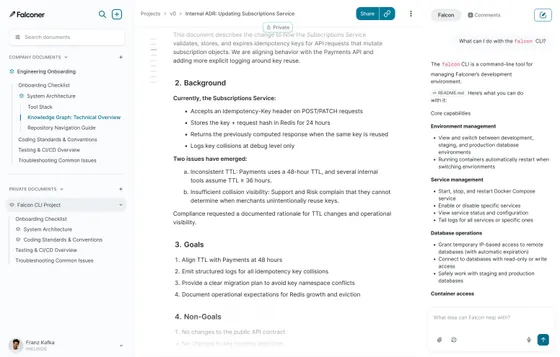
Falconer is a self-updating knowledge layer built for engineering teams. Where Glean retrieves information, Falconer maintains it, automatically flagging and updating documentation when code changes, triggered directly from pull requests and Slack threads.
Key strengths:
- Auto-updating docs that stay accurate as code evolves, so engineers stop hitting dead ends when they need answers fast.
- Total Search across codebase, documents, and tasks, surfacing direct answers instead of a list of links to dig through.
- Deep codebase understanding spanning millions of lines of code, giving teams a reliable source of truth at any scale.
- MCP integration feeding company-specific context to coding agents like Claude Code and Cursor, so your AI tools work from accurate information.
Best for engineering-led teams where stale docs are slowing people down and AI agents need reliable context to work from.
Notion
Notion is a flexible workspace for notes, wikis, and project management. It offers real-time collaboration, AI writing features, and a wide range of templates. Good for teams with simpler documentation needs, though it requires full manual maintenance with no mechanism to sync docs when code changes.
Confluence
Atlassian’s long-standing enterprise wiki. Tightly integrated with Jira and built for large organizations with formal governance. The tradeoff: engineers widely avoid it, and documentation still goes stale without dedicated admin effort.
Swimm
Swimm generates and maintains documentation from your codebase, alerting you when code changes affect docs. Solid for code-specific documentation, but it cannot pull in Slack or Linear context, where much of the real decision-making lives.
Kino
Kino captures meeting decisions and turns them into action items across Slack, GitHub, and Linear. Useful for teams that run on meetings and need better follow-through, but it only covers what happens in calls, not the broader flow of engineering context.
Feature comparison: Glean vs top alternatives
Here’s how these tools stack up across the features that matter most for engineering teams.
| Feature | Glean | Falconer | Notion | Confluence | Swimm | Kino |
|---|---|---|---|---|---|---|
| Auto-updating documentation | No | Yes, triggered from PRs and code changes | No | No | Yes, for code only | No |
| Multi-source knowledge integration | Yes, 100+ apps | Yes, GitHub, Slack, Linear, Notion, Google Drive | Limited | Jira only | GitHub/GitLab only | Meeting tools only |
| AI-powered search | Yes | Yes, Total Search with direct answers | Basic | Basic | Code search only | No |
| Codebase understanding | Limited | Deep, across millions of lines | No | No | Yes | No |
| MCP integration for coding agents | No | Yes, Claude Code and Cursor | No | No | No | No |
| Permission-aware access | Yes | Yes | Yes | Yes | Yes | No |
| Documentation maintenance model | Manual | Self-updating | Manual | Manual | Semi-automated for code | N/A |
Glean leads on breadth of connectors, which matters if you’re a large enterprise standardizing search across dozens of tools. Where it falls short is everything after retrieval: no auto-updates, no codebase depth, no agent context layer. Falconer covers that ground.

Why Falconer is the best Glean alternative
Glean excels at search. What it cannot do is keep knowledge accurate as code evolves, and that gap is what actually costs engineering teams time.
Falconer solves that directly. When a pull request lands, affected docs get flagged and updated. When context changes in Slack, it gets captured. No manual maintenance required.
For teams running AI coding agents, that accuracy gap matters even more. Glean can surface a document, but it cannot guarantee that document reflects current code. Falconer’s MCP integration feeds Claude Code and Cursor grounded, up-to-date context from a living knowledge graph, so your agents work from facts, not stale snapshots.
Final thoughts on what comes after search
Most Glean alternatives focus on doing search better or cheaper, but that misses the actual problem engineering teams face. Your knowledge goes stale faster than anyone can update it manually, and AI agents trained on outdated context make confident mistakes. Falconer keeps docs current as code changes, giving your team and your agents a reliable source of truth. Connect your repos and watch your documentation start maintaining itself.
FAQ
When should you consider moving away from Glean?
If you’re spending more on setup and maintenance than you’re saving in search time, or if your team needs documentation that stays accurate as code changes instead of just retrieval of existing (often stale) information, it’s time to look elsewhere.
What features should you focus on when comparing Glean alternatives?
Look for auto-updating documentation that syncs with code changes, deep codebase understanding across your actual repositories, and the ability to feed accurate context to AI coding agents, beyond simple search across connected apps.
Can I use Falconer to keep documentation current without manual updates?
Yes. Falconer automatically flags and updates affected documentation when pull requests land or code changes, triggered directly from your existing workflow without requiring dedicated documentation maintenance time.
Why do engineering teams need more than enterprise search tools?
Search tools surface what exists, but engineers need documentation that reflects current code, context from Slack and Linear where decisions happen, and a system that feeds grounded information to AI agents instead of simple document retrieval.
How does Falconer differ from code-specific documentation tools like Swimm?
While Swimm focuses solely on code documentation, Falconer pulls in context from where engineering decisions actually happen: Slack threads, Linear tickets, docs, and your codebase. Then it keeps all of it synchronized as your software evolves.
Ready to get started?
Create an account and start building your knowledge base — no contracts or credit card required. Or, contact us to design a custom package for your team.
Ready to get started?
Create an account and start building your knowledge base — no contracts or credit card required. Or, contact us to design a custom package for your team.