Get your knowledge health report
Add your work email and we'll use your public documentation to grade the context your agents are running on.
Free. No credit card. We'll send the report to your inbox.



Drifting fast. Contradictions and stale docs are climbing week over week, and your agents are already acting on them.
- Coherence51
- Coverage39
- Freshness28
- Density62
Your agents are working with fresh context, with some remaining small fixes to make them even smarter.
- Coherence96
- Coverage97
- Freshness99
- Density94
Knowledge Health: observability for your knowledge base

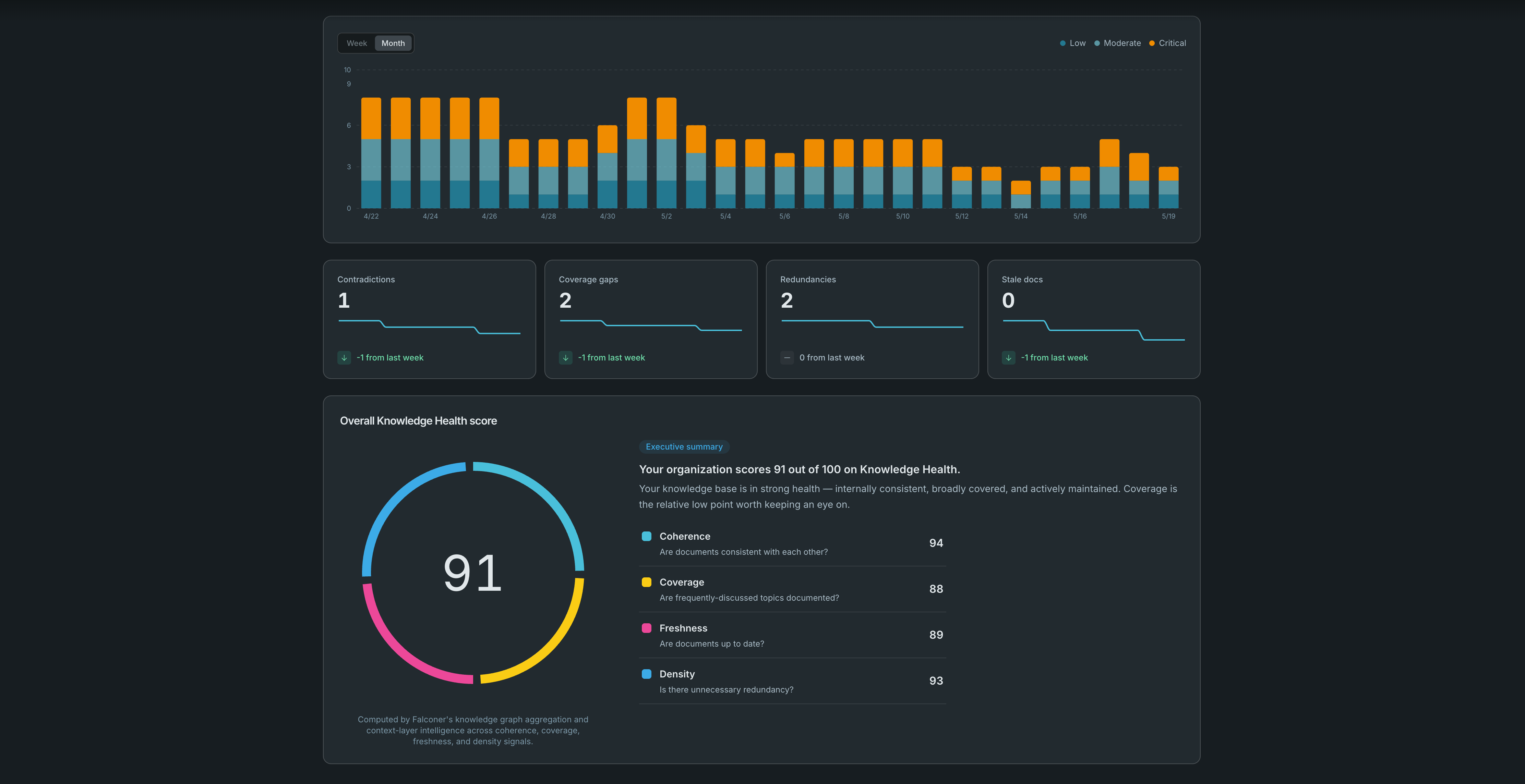
Falconer Knowledge Health for observability
A new engineer joins your company. In their first week they read a doc about the tech stack, and reasonably assume anything written down must be true. A week later, they find out how much was out of date. By then that wrong information has already shaped dozens of their decisions and implementation details.
That’s the pattern I’ve watched my whole career. Decisions get made from documentation that’s incomplete, out of date, or contradicting another doc. Having access to the wrong knowledge is often worse than having none at all, because you and your agents act on it with confidence.
Teams aren’t measuring knowledge rot, so it never shows up as a line item. It’s a silent productivity killer, and one of the biggest problems a large organization has. Keeping docs up-to-date is also genuinely expensive. In past roles, I’ve been actively discouraged from writing things down, because maintaining documentation eats focus time. And come performance review time, engineers are measured for PRs merged or reviewed, not documents written or updated. Every company has a knowledge base, but it’s always drifting further from the truth.
Agents magnify knowledge rot
Agents magnify knowledge rot by 100x. ICs are encouraged to increase AI usage in the workplace and point agents to their context. But without correct context, even the best agent is just guessing. Feed agents the same outdated knowledge your team is already struggling with, and you’ll get to a dead end faster.
A bird’s-eye view
We built Knowledge Health to identify and resolve this drift. Knowledge rot stays invisible because no one ever measures it, so the first thing we did was make it measurable. It puts a single, live score on the health of your company’s knowledge, and shows you what’s dragging that score down. The score blends four signals into one number from 0 to 100.
Falconer is the second brain for engineering knowledge. It learns how your organization works from the signals around your knowledge: team conversations, important documents, documents about deprecated features.
Falconer treats knowledge like a product. And every product needs observability: a way to see whether it’s actually working.
Knowledge Health takes a bird’s-eye view of your knowledge and helps you answer the most important question: where is your knowledge hurting you instead of helping?
Contradictions
These are places where two parts of your knowledge base disagree with each other: one doc says the service runs on ECS, another says Cloud Run. Knowledge Health reads the claims across your documents and flags the contradictions. As agents start to learn continuously from your knowledge, every contradiction becomes a place where a wrong answer causes real damage.
Stale docs
A doc can sit untouched for a year while the underlying code changes. These are the dangerous ones, because people and agents still reference them.
Coverage gaps
Knowledge Health looks at the topics that recur across your team’s conversations but never land in a single source of truth. These are the topics people explain over and over in Slack because no one ever wrote them down. The knowledge exists. It’s just trapped in chat history and people’s heads instead of somewhere you can point to.
Redundancies
Over time, the same topic gets documented in multiple places, confusing people, search algorithms, and agents. Knowledge Health measures how much your documents overlap and surfaces the clusters that have drifted into duplicates, so you can consolidate them into one source of truth.
Self-healing knowledge
When a company’s knowledge is healthy, everyone feels it. Engineers stay heads-down on hard problems instead of being buried in documentation, and the people who depend on them stop being blocked waiting for answers. And it only matters more from here: as agents take on more of the execution, the knowledge humans write down becomes more valuable, because an agent is only ever as good as its context.
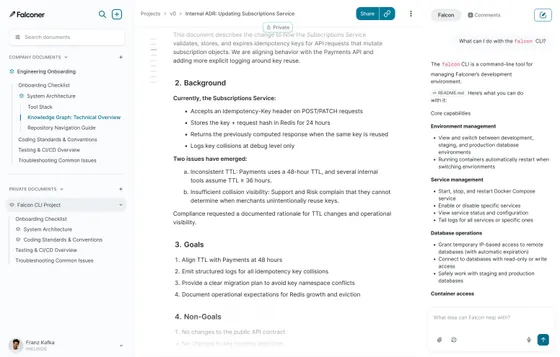
Falconer shows you the health of your knowledge, but most importantly, it can heal itself with self-updating capabilities.
If your engineers are buried in doc upkeep, your support and sales teams are flying blind, or the same questions keep eating your meetings, knowledge rot is probably the cause. Request a demo and we’ll show you how to bring self-healing knowledge to your team.
Ready to get started?
Create an account and start building your knowledge base — no contracts or credit card required. Or, contact us to design a custom package for your team.