Falconer Update: Full self-driving docs

AI is accelerating how quickly teams ship code, but docs fall behind because keeping them current requires manual effort that rarely gets prioritized. Falconer Update solves that by automatically keeping your documentation in sync with your codebase.
What is Falconer Update?
Falconer Update is Falconer’s document auto-update feature. Toggle it on for any document and Falcon watches your codebase, tickets, and linked documents. When something changes, it flags the docs that are impacted and proposes the exact edits required.
Two modes:
- Review — Falconer proposes edits, you approve.
- Full self-driving — Falconer updates docs directly.
With either mode active, you get Slack notifications when your docs update — immediately, daily, or weekly.
No doc review step in your PR checklist. No hunting for outdated pages after the fact. Just keep shipping. The docs will keep up.
How it works
When a PR merges, Falconer kicks off a pipeline:
- Ingest the diff — Falcon reads the full PR diff and filters out noise (lockfiles, binaries, test fixtures) to focus on what matters.
- Find affected docs — Semantic search against your knowledge base surfaces documents related to what changed.
- Score for quality — A multi-model adversarial system — prosecution argues the doc is stale, defense argues it isn’t, a jury of independent models votes — ensures only genuinely outdated documents get flagged. No false positives.
- Generate a targeted draft — Proposed edits are scoped to the specific sections affected, not a full rewrite.
- Notify the owner — Falcon sends you a Slack DM with the PR details and a summary of what updated or needs your review. You choose the cadence: immediately per change, or as a single daily or weekly digest.
You stay in control
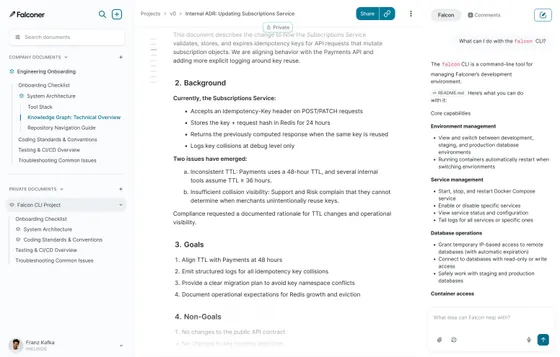
Falconer Update is opt-in, per document. When you publish a doc, a banner in the editor lets you toggle it on.
In Review mode, Falconer proposes edits and holds them for your sign-off. You get a Slack notification, review the proposed diff inline, and accept or reject — change by change if you want.
In Full self-driving mode (the default), Falconer updates docs directly without a review step. Fully self-driving. You still get a Slack summary so you always know what changed.
When auto-update is active, a small refresh icon appears in the document breadcrumb — a persistent reminder that Falconer is watching so you don’t have to.
Why this matters for teams
Falconer Update is built for practical documentation workflows:
- No doc rot: changes to code automatically surface as proposed changes to affected docs.
- No manual audits: you no longer need to
grepfor outdated references after a refactor. - Human-in-the-loop when you want it: Review mode means nothing changes without your sign-off. Full-self driving mode means nothing slows you down.
- Lower review overhead: multiple PRs affecting the same document are reconciled into a single draft — review once, not once per PR.
Best use cases
Falconer Update works especially well for:
- Teams shipping rapidly who can’t afford a separate doc review step in every PR
- Repos with high churn where API references, setup guides, or architecture docs drift quickly
- Orgs that want to let Falconer handle low-stakes updates entirely in full-self driving mode
- Teams maintaining documentation across multiple services that need to stay in sync
Try it today
Falconer Update is available now on the Pro plan. Connect GitHub, open any published document, and toggle on auto-update in the Details panel.
Ready to get started?
Create an account and start building your knowledge base — no contracts or credit card required. Or, contact us to design a custom package for your team.