How to reduce engineer onboarding time from weeks to days (April 2026)
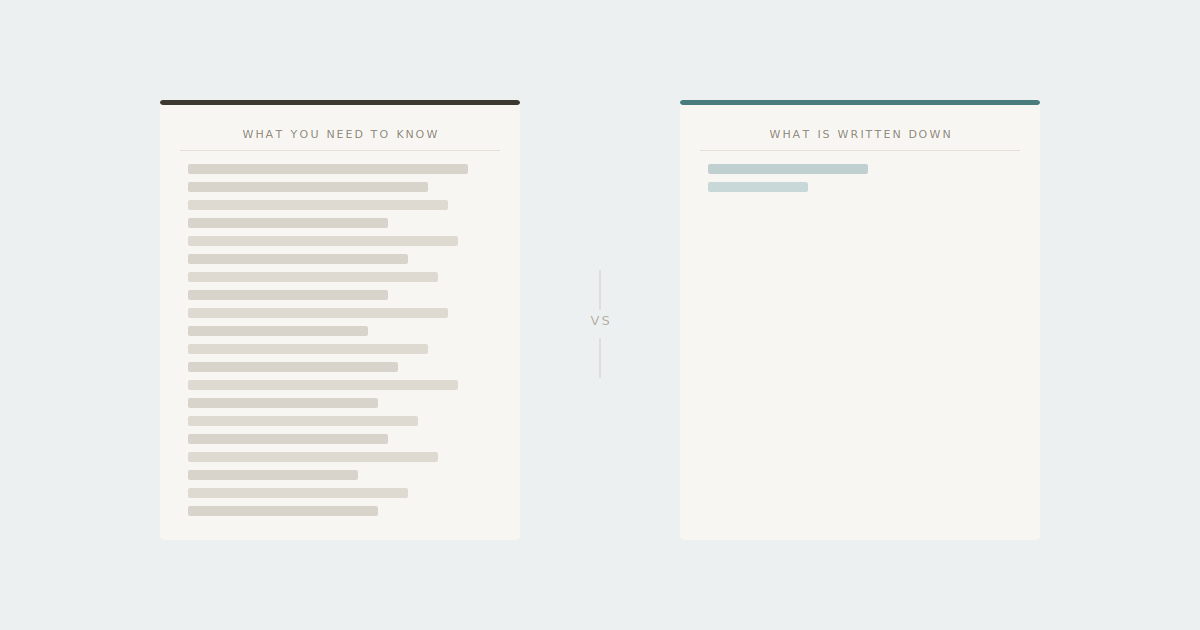
Three weeks in, and your new engineer is still hunting through Notion pages, Slack threads, and GitHub wikis trying to find the branching strategy someone definitely documented somewhere. Your senior engineers keep getting interrupted with questions they’ve answered five times before. Reducing engineer onboarding time doesn’t mean creating more one-off docs or better onboarding presentations. You need a repeatable system that makes the experience better for the next person. Time-to-productive is all that matters for a new hire. That means connecting your knowledge into a single searchable hub so new hires get answers grounded in how your system actually works (not what someone remembered to write six months ago), and generating onboarding guides directly from your code, so engineers spend 15 minutes reviewing a draft instead of two hours writing from scratch. The teams getting new hires to first merged PR in days instead of weeks using systems that make knowledge findable, trustworthy, and current.
TLDR:
- Build a self-serve documentation hub connecting GitHub, Slack, and docs so new engineers find answers in minutes, not days.
- Use AI to draft onboarding guides in 15 minutes instead of 2 hours, cutting documentation time by 80%.
- Track time to first merged PR as your key metric: top teams onboard in 3-5 days vs industry average of 2-4 weeks.
- Assign clear owners to each doc who approve updates it when processes change, preventing outdated instructions from misleading new hires.
- Falconer auto-generates onboarding docs from your codebase and keeps them current as code changes, reducing new hire ramp time.
Build a self-serve documentation hub
New engineers shouldn’t need to ping five different people to figure out how to run tests or deploy code. When onboarding knowledge lives in scattered Slack threads, outdated wikis, and someone’s personal notes, you’re forcing new hires to become detectives instead of contributors.
A self-serve documentation hub creates one place where new engineers can find setup guides, architecture explanations, development workflows, and team conventions. The key is making this knowledge discoverable and trustworthy. If your new hire searches for “local environment setup” and gets three different outdated guides, they’ll stop trusting the system and go back to asking questions.
Connect the sources where your team already documents work: GitHub, Linear, docs, and Slack channels where decisions get made. Pull these together into a searchable knowledge layer, so new engineers can find answers across your entire codebase and docs without guessing which tool might have what they need.
When someone joins, they should be able to answer their own questions within minutes, not days.
Use AI to draft documentation in minutes
The reason most onboarding docs never get written is simple: your senior engineers don’t have time. Writing documentation from scratch takes hours they’d rather spend shipping features or reviewing code.
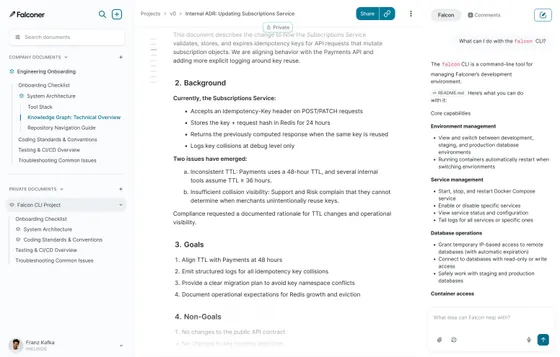
Falconer’s AI changes this by handling the first draft. Instead of staring at a blank page, your engineers can dump raw thoughts, mention the agent in a Slack thread, or point to a code section for context. The AI generates a structured first draft grounded in your actual codebase and team decisions.
What used to take two hours of focused writing becomes 10 minutes of editing and refining. Your senior engineer reviews the output, fixes what the AI got wrong, adds nuance, and publishes. The writing burden drops by over 80%, which means it actually gets done.
You’re not asking people to create something from nothing. You’re asking them to validate and improve something that already exists. That’s a much easier ask, and it’s the difference between docs that get written and docs that stay on someone’s wishlist forever.
Make onboarding knowledge instantly searchable
Having documentation is one thing. Finding it when you need it is another.
New engineers don’t know what they don’t know. They can’t search for “the deployment process” if they don’t know your team calls it “ship scripts.” They can’t find the right wiki page if they don’t know which keywords to try. 42% of people say information is scattered across too many places, making it nearly impossible to locate what they need.
AI-powered search solves this by letting new hires ask questions the way they’d ask a teammate. “How do I run the test suite locally?” or “Where do we track feature flags?” The system understands what they’re asking and surfaces relevant answers from your codebase, docs, and past discussions, even if the exact words don’t match.
This removes the guessing game of figuring out where information lives or what terms your team uses. Your new engineer gets answers in seconds instead of spending 20 minutes clicking through folders or interrupting someone on Slack.
Turn repeated questions into living documentation
Every time a new engineer asks “How do I get access to staging?” or “What’s our branching strategy?”, someone spends five minutes typing out an answer. Next week, another new hire asks the same thing. You’re burning senior engineering time on the same explanations every cycle.
Track the questions your last three new hires asked in their first two weeks. You’ll see the same questions surface repeatedly. These are your documentation gaps.
Create a doc for each recurring question. Answer it once, with links to the relevant systems or code. Surface these docs where new hires will actually see them: pin them in your onboarding hub, link them in your welcome message.
The next time someone asks that question in Slack, point them to the doc. Better yet, they’ll find it themselves before asking. This moves the burden from your team’s time to self-service knowledge that scales.
Assign each doc a clear owner who updates it when processes change. Living documentation isn’t written once and forgotten. It’s maintained as part of your workflow, so the answers new hires find stay accurate.
| Strategy | Implementation Method | Time Saved | Success Metric |
|---|---|---|---|
| Self-Serve Documentation Hub | Connect GitHub, Slack, Notion, and Google Docs into a single searchable knowledge layer with AI-powered search that understands natural language questions | Reduces search time from hours to minutes per query; eliminates 60-80% of repetitive questions to senior engineers | Track new hire questions in Slack; aim for 80% self-service resolution rate within first two weeks |
| AI-Drafted Documentation | Use AI to generate first drafts from Slack threads, code comments, and raw notes; engineers spend 15 minutes editing instead of 2 hours writing from scratch | Cuts documentation creation time by 80%; turns a 2-hour writing task into a 15-minute review | Measure docs published per month; target 3-5x increase in documentation output |
| Living Documentation with Ownership | Assign named owners to each doc; schedule quarterly reviews of top 10 onboarding docs; update docs before process changes ship | Prevents hours of debugging from outdated instructions; eliminates troubleshooting dead ends | Survey new hires on doc accuracy; target 90%+ accuracy rating and zero critical errors |
| Repeated Question Documentation | Track questions from last 3 new hires; create dedicated docs for each recurring question; surface answers in onboarding hub and search | Converts 5-minute interruptions into self-service answers; scales knowledge without scaling senior engineer time | Count repeated questions month-over-month; target 50% reduction each quarter |
| Instant AI Search | Implement AI-powered search that understands intent and surfaces answers from codebase, docs, and past discussions without exact keyword matching | Reduces answer discovery from 20+ minutes of clicking through folders to seconds | Time to answer for common questions; target under 30 seconds for 90% of searches |
| Time to First PR Tracking | Measure days from start date to first merged pull request; set baseline and improvement targets; identify bottlenecks blocking contribution | Industry average is 2-4 weeks; top teams achieve 3-5 days, representing 10-15 days saved per hire | Track time to first merged PR for every new hire; target under 5 days consistently |
Keep documentation accurate with clear ownership
Documentation without ownership becomes a graveyard of outdated instructions. Your new hire follows a setup guide that references a config file deleted three months ago. They waste an hour troubleshooting before asking for help, learning the hard way that they can’t trust what’s written.
Assign a named owner to every onboarding doc. Not a team, a person. When your authentication system changes, that person updates the relevant docs before the old process misleads anyone. When someone finds an error, they know exactly who to ping.
Schedule quarterly reviews for your top 10 onboarding docs. The owner reads through, tests the steps, fixes what’s wrong. This takes 30 minutes per doc and prevents weeks of accumulated rot.
Accurate documentation separates a three-day ramp from a three-week slog.
Measure what matters: time to first merged PR
You can’t improve what you don’t measure. If you want to cut onboarding time, pick a metric that reflects real productivity, not completed checklist items.
Time to first merged pull request is that metric. It captures when a new engineer actually contributes working code that ships. Industry data shows the average time to first commit is 2-4 weeks, while top-performing teams get new hires to meaningful contribution within 3-5 days. That gap represents the difference between effective knowledge transfer and fumbling through scattered information.
Track this for every new hire. Measure the days from their start date to when their first PR gets merged. Set a target based on your current baseline, then work backward to identify bottlenecks. Are new hires stuck waiting for environment access? Confused about coding standards? Unclear on where to find architectural context?
Layer in supporting metrics: count repeated questions in your onboarding Slack channel, survey new hires at week two about knowledge gaps. These signals tell you where your documentation fails and what needs fixing.
Reduce onboarding time with Falconer’s AI knowledge layer
Falconer automates the steps we’ve covered: generating documentation, keeping it current, and making knowledge instantly findable.
Connect your tools to Falconer, and our AI drafts onboarding guides in minutes. Your engineers review and refine instead of starting from scratch. The writing burden drops from two hours to fifteen minutes.
New hires ask questions in plain language: “How do I access staging?” or “What’s our deploy process?” Our search understands intent and pulls answers from your entire knowledge base, code included.
When code changes, Falconer flags affected documentation and suggests updates. Your docs stay accurate without manual maintenance cycles. Each doc has a clear owner who reviews AI-generated updates before they publish.
The Falcon AI assistant answers questions directly in Slack, your IDE, or our editor. New engineers get unblocked instantly without interrupting your team. Questions that used to burn five minutes of senior engineering time get answered in seconds.
Final thoughts on how to cut engineering onboarding time
Your new engineers want to contribute, not spend their first month hunting for setup instructions and decoding team conventions. The best way to reduce engineer onboarding time is by building self-serve knowledge that answers questions before they’re asked, grounded in your actual codebase and decisions. When documentation stays current and search actually works, you get new hires shipping code in days instead of weeks. Try Falconer to turn scattered knowledge into a searchable hub that scales with every new hire.
FAQ
How can I tell if my onboarding documentation is actually working?
Track time to first merged pull request for each new hire. If this metric exceeds one week, your documentation has gaps that force new engineers to hunt for answers instead of contributing code.
What’s the fastest way to create onboarding docs without pulling senior engineers away from shipping?
Use AI to generate first drafts from the codebase, then have your senior engineers spend 15 minutes reviewing and refining instead of two hours writing from scratch.
Why do new engineers keep asking the same questions even though we have documentation?
Your documentation is either scattered across too many tools, uses team-specific terminology new hires don’t know to search for, or has become outdated. AI-powered search that understands natural questions solves the discovery problem.
How do I know which onboarding documentation to create first?
Review the questions your last three new hires asked during their first two weeks. The repeated questions represent your biggest documentation gaps and the highest-value docs to write.
Ready to get started?
Create an account and start building your knowledge base — no contracts or credit card required. Or, contact us to design a custom package for your team.
Ready to get started?
Create an account and start building your knowledge base — no contracts or credit card required. Or, contact us to design a custom package for your team.