Best knowledge management tools for startups (April 2026)
Every startup hits the point where engineers spend more time searching for answers than writing code. The difference between knowledge management tools comes down to whether they update themselves when your codebase changes or require someone to babysit a wiki forever. We tested the options available in 2026 for engineering teams who need documentation that stays accurate without becoming anyone’s full-time job.
TLDR:
- Startup knowledge decays fast: docs go stale as code evolves and Slack context disappears
- Auto-updating tools keep documentation synced with code changes, saving hours of manual work
- AI-powered search across codebases and conversations surfaces answers instead of link lists
- Codebase-aware platforms feed accurate context to coding agents like Claude and Cursor
- Falconer auto-updates docs from pull requests and Slack while maintaining SOC 2 security
What are knowledge management tools for startups?
Knowledge management tools are software solutions that help startups capture, organize, store, and share collective knowledge across teams. Think of them as the connective tissue between everything your company knows and the people (or AI agents) who need that information at any given moment.
Simple document storage won’t cut it here. These systems go further by providing intelligent ways to maintain institutional knowledge, onboard new hires, and keep critical information accessible and accurate as your company scales. Where a shared Google Drive becomes a graveyard of outdated files, a real knowledge management tool stays alive with your team.
For engineering teams, the stakes are even higher. Codebases evolve daily, decisions get made in Slack threads that expire, and the person who wrote the original docs may have left the company three sprints ago. The right tool keeps technical documentation in sync with code changes, deflects repeated questions before they interrupt your best builders, and cuts down the hours spent searching for answers that should be easy to find. As Forrester notes on knowledge management playbooks, making knowledge management part of every developer workflow is critical for engineering leaders.
How we assessed knowledge management tools for startups
We assessed each tool against criteria that matter most to early and mid-stage technical teams. Instead of ranking by feature count alone, we focused on how well each solution handles the realities of fast-moving startups where context changes daily.
Our evaluation criteria:
- Auto-updating capabilities that maintain accuracy as code evolves
- AI integration for intelligent search and content generation
- Codebase awareness for technical documentation
- Cross-functional accessibility beyond engineering
- Integration depth with existing developer workflows (GitHub, Slack, Linear, etc.)
- Security features, including SOC 2 compliance and granular access controls
We relied on publicly available product information, verified technical specifications, and documented customer experiences to build this comparison.
Best overall knowledge management tool for startups: Falconer
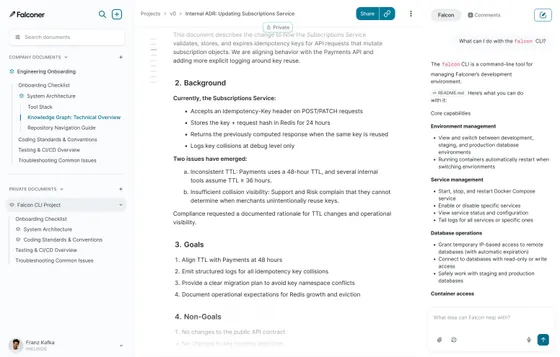
Falconer is a self-updating knowledge layer built for engineering-led startups that ship fast and want their AI tools grounded in real company context. When code changes in a pull request, documentation updates automatically. When decisions happen in Slack threads, that context gets captured and reflected in your knowledge base.
Core strengths
- Auto-updating docs triggered by pull requests and Slack threads, removing the manual maintenance burden
- Unified search across millions of lines of code, documents, and tasks that surfaces answers instead of link lists
- AI writing and search grounded in company-specific context, with MCP integration for Claude Code and Cursor
- Falcon AI agent accessible from Slack, IDE, and the editor for instant answers and context generation
- SOC 2 Type II certified with cloud, VPC, and on-premise deployment options
Why it wins for startups
Documentation decays the moment it’s written. That’s the core problem, and it’s the one we built Falconer to solve. Documentation debt has become as critical as technical debt in 2026. Instead of relying on engineers to babysit wikis, the system keeps itself current as your codebase and conversations evolve. The result: fewer interruptions, less time spent searching, and a knowledge graph that actually reflects reality.
For teams scaling AI adoption, this matters even more. Coding agents are only as good as the context feeding them. Falconer gives those agents reliable, up-to-date company knowledge so their output matches how your team actually works.
Swimm
Swimm is a documentation tool built for developers that keeps technical docs tied to code. If your only concern is syncing documentation with your repositories, it does that job well.
What they offer:
- Code-coupled documentation that links directly to repository code snippets, so explanations stay anchored to the actual implementation
- Auto-sync that updates docs when code changes, reducing manual maintenance
- GitHub and GitLab integration for version control tracking
- IDE plugins for accessing documentation inside development environments
Who it’s good for: Engineering teams that strictly need code documentation synchronized to repositories, with no requirement for broader organizational knowledge management across Slack, project management tools, or cross-functional teams.
Where it falls short: Pricing typically ranges between $10 to $30 per developer per month, but Swimm only ingests codebase sources. It cannot pull knowledge from Slack decisions, Linear tickets, Google Docs, or Notion, where most engineering context actually lives. If your team needs unified search across code and conversations or cross-functional knowledge access, Swimm’s narrow scope will leave gaps fast.
Stilla
Stilla is a developer-focused documentation tool that automatically updates code docs when repositories change and surfaces them inside your IDE. Like Swimm, it targets the narrow problem of keeping code-linked documentation accurate as engineers commit changes, with IDE integration as its second core feature.
What they offer:
- Auto-updating documentation triggered by repository changes, keeping code-level docs current without manual maintenance
- IDE integration for accessing documentation inside development environments without context switching
- Code-linked documentation anchored directly to repository content
Who it’s good for: Development teams looking for lightweight, code-coupled documentation that stays current with repository changes and is accessible from within the IDE, without needing broader knowledge management across organizational tools.
Where it falls short: Stilla’s coverage ends at the codebase. It has no Slack integration, no multi-source knowledge graph, no codebase-aware AI, and no MCP support for coding agents like Claude Code or Cursor. There is no unified search across code and docs, no cross-functional access for non-engineering teams, and no SOC 2 Type II certification. For teams that need knowledge pulled from Slack threads, Linear tickets, or Google Docs alongside their code, Stilla covers only a fraction of where engineering context actually lives.
Kino
Kino is an AI meeting orchestration layer that captures decisions from live discussions and automatically executes follow-up work across tools like Slack, Linear, GitHub, and Notion, whether that means creating pull requests, tickets, documents, or emails.
What they offer:
- Meeting capture and transcription with automated action item extraction
- Cross-tool task execution based on meeting outcomes
- Decision tracking across synchronous team discussions
- Integration with development and project management tools for post-meeting workflows
Who it’s good for: Product teams that rely heavily on synchronous meetings as their primary coordination mechanism and need automated follow-through on decisions made during those sessions.
Where it falls short: Kino only captures knowledge from meetings, which means it misses the vast majority of engineering context living in code commits, PR comments, async Slack threads, and technical documentation that evolves outside scheduled calls. If your team works across time zones or struggles with stale docs, meeting orchestration alone won’t solve the underlying problem. Most engineering knowledge doesn’t originate in meetings. Falconer captures context from code, conversations, and documentation simultaneously, maintaining accuracy across all of those sources instead of only meeting outcomes.
Coda
Coda is a cloud-based document editor that merges spreadsheets, word processing, and app-like functionality into a single workspace. It’s built around replacing multiple productivity tools with one flexible surface where teams can build custom workflows.
What they offer:
- A formula system that works anywhere within documents, linking to other documents, calendars, or graphs
- Interactive tables with relational capabilities and multiple view options
- Pre-built connectors for Slack, Google Calendar, GitHub, Zapier, and more through Packs integrations
- Automation capabilities for workflows and notifications within documents
Who it’s good for: Non-technical teams building custom workflows, databases, and project management systems within documents, particularly those who don’t need codebase integration or auto-updating triggered by code changes.
Where it falls short: Coda has no codebase awareness. It can’t flag outdated technical information based on pull request activity, automatically update documentation when code changes, or feed company-specific context to AI coding agents. Every document stays static until someone manually updates it, and that maintenance burden falls apart fast for engineering teams where the codebase evolves daily.
Notion
Notion is a flexible all-in-one workspace that combines knowledge management with project management, note-taking, and database functionality. It’s one of the most common tools in engineering organizations, but it requires constant manual upkeep to stay useful.
What they offer:
- Flexible page and database structures for wikis and documentation
- Team plans starting at $8 per user per month
- Templates and collaboration features for cross-functional teams
- Integration capabilities with external tools and services
Who it’s good for: Teams that primarily need a general workspace for notes and project coordination, and who are comfortable maintaining documentation by hand without engineering-specific workflows.
Where it falls short: Notion assumes someone will write docs, update them, and remember where they live. That assumption breaks at scale. Pages go stale right after creation with no automatic flagging when code changes, no codebase understanding for technical accuracy, and no ability to feed company-specific context to AI coding agents through MCP integration. Keeping documentation accurate becomes a full-time job nobody has time for.
Why Falconer is the best knowledge management tool for startups
Every tool on this list gives you a place to put information. The difference is what happens after you hit save.
With Falconer, documentation stays accurate because the system watches your codebase, Slack threads, and connected sources for changes, then updates accordingly. You don’t assign someone to maintain the wiki. The wiki maintains itself.
When a pull request merges, Falconer scans the diff and flags or updates any docs that reference the changed code. When a decision gets made in a Slack thread, that context gets pulled into the knowledge graph instead of disappearing when the thread goes cold. New engineers onboard in days instead of months because they can ask Falcon (the embedded AI agent) anything about the codebase and get an answer grounded in how your team actually works, not a generic guess based on publicly available training data.
As coding agents take on more of the work, the quality of their output depends entirely on the context you feed them. Falconer’s MCP integration connects Claude Code, Cursor, and similar tools directly to your knowledge graph, so agents write code that matches your architecture, naming conventions, and past decisions, not code that looks plausible but misses how your team actually builds.
For teams where cross-functional access matters, non-engineering teammates (support, sales, product, ops) can search the same knowledge base without needing to chase down an engineer for context. Everyone works from the same source of truth, whether they’re in an IDE, Slack, or a browser tab.
The best teams have great chemistry. They understand each other, unblock each other with documentation, and move quickly. Falconer handles the heavy lifting so your team can focus on the work that actually matters.
For startups where every engineer’s hour counts, that shift from manual upkeep to automatic accuracy is knowledge as competitive advantage. If you’re ready to stop treating documentation as a chore, give Falconer a try.
Feature comparison table of knowledge management tools for startups
Here’s how each tool stacks up across the capabilities that matter most to engineering-led startups.
| Feature | Falconer | Stilla | Kino | Coda | Notion |
|---|---|---|---|---|---|
| Auto-updates from code changes | Yes | Yes | No | No | No |
| Multi-source knowledge graph | Yes | No | No | No | No |
| Codebase-aware AI | Yes | No | No | No | No |
| MCP integration for coding agents | Yes | No | No | No | No |
| Unified search across code and docs | Yes | No | No | No | No |
| Cross-functional accessibility | Yes | No | No | Yes | Yes |
| SOC 2 Type II certified | Yes | No | No | No | No |
| Slack integration | Yes | No | Yes | Yes | Yes |
| IDE support | Yes | Yes | No | No | No |
The pattern is clear. While each tool covers a slice of the knowledge management problem, Falconer checks every box, from codebase awareness and auto-updating docs to cross-functional access and security compliance. If you’re choosing a single tool to grow with your team, that breadth matters.
Final thoughts on knowledge management for growing teams
Your codebase changes daily, but your documentation probably doesn’t. That gap is expensive. Knowledge management tools for startups need to match the pace your team actually works at, updating themselves as code and context shift. Get started with Falconer and stop treating documentation like a chore someone has to remember.
FAQ
How do I choose the right knowledge management tool for my startup?
Start by determining whether your team needs codebase awareness and auto-updating documentation or just a place to organize static content. If your engineering team spends substantial time maintaining docs or searching for technical context, choose tools that integrate with your codebase and development workflows. For teams that primarily need general workspace organization without technical depth, simpler document-focused options may suffice.
Which knowledge management tool works best for engineering-led startups?
Engineering-led startups benefit most from tools that maintain documentation accuracy as code evolves. Look for auto-updating capabilities triggered by pull requests, codebase-aware AI that understands your technical context, and unified search across code, docs, and conversations. Tools lacking these features create maintenance burdens that slow teams down as they scale.
Can knowledge management tools integrate with AI coding agents?
Some can, but most cannot. To feed company-specific context to coding agents like Claude Code or Cursor, you need a tool with MCP integration that grounds AI outputs in your actual codebase and documentation. Without this connection, coding agents rely on generic knowledge that doesn’t match how your team works, producing outputs that require extensive revision.
What’s the difference between documentation tools and knowledge management systems?
Documentation tools store information you manually write and update, treating each document as a static artifact. Knowledge management systems maintain living knowledge graphs that capture context from multiple sources (code, conversations, tickets) and keep that information current as your company evolves. The first requires constant human maintenance; the second automates accuracy at scale.
When should I consider switching from Notion or Coda to a specialized tool?
If your engineering team spends more than a few hours per week updating docs to match code changes, answering repeated questions about outdated information, or searching across multiple tools for technical context, your current solution has stopped scaling with your team. These symptoms indicate you need codebase awareness and auto-updating capabilities that general workspace tools cannot provide.
Ready to get started?
Create an account and start building your knowledge base — no contracts or credit card required. Or, contact us to design a custom package for your team.
Ready to get started?
Create an account and start building your knowledge base — no contracts or credit card required. Or, contact us to design a custom package for your team.