How Vori uses Falconer as a librarian to automate engineering docs
Challenge: Vori’s engineering knowledge lived across Notion, Slack, Linear, GitHub, Google Docs, and inside people’s heads, which made finding answers a challenge and documentation hard to maintain. Clinton, an early Vori engineer and manager, spent a lot of time answering questions.
Solution: Clinton started using Falconer as a knowledge agent for engineering docs, especially onboarding guides, API guides, runbooks, and internal AI tooling documentation.
Result: Vori now has high-quality engineering docs for the entire team, runbooks that auto-update as services change, and fewer repeat questions pulling engineers away from their work.
Vori builds end-to-end software and hardware for grocery stores. Clinton Blackburn is an early engineer who’s built much of these systems, and is a go-to resource for questions from his growing team.
As an engineering manager and staff engineer, Clinton manages Vori’s inventory, pricing, and site reliability work. His job spans product engineering, infrastructure, and the day-to-day reality of keeping systems legible for the people who build and operate them.
Before Falconer, information was scattered and always changing. To find context or a decision that was made, Vori engineers would have to search through Notion, Google Docs, Slack, tickets, and code. But still, some important context was never written down.
“Conversations start as a Slack thread someplace. It might get moved to a meeting, and we just hope for the best, usually.”
High-quality documents and good search
Clinton is careful to separate the tool from the habit. Vori did not yet have the muscle for keeping documentation organized, and no tool made it easier. He wanted high-quality documents and good search.
“Notion search is not great,” Clinton says. “It wasn’t always easy to find things, and organization was also just generally terrible.”
Vori was building internal systems so agents and tools could access the data they needed, including an internal MCP server connected to important tools. That work highlighted the missing piece: agents are only useful when they can reach current, trustworthy context.
“We recognized early on that part of the solution is having a good knowledge store and knowledge base,” Clinton says.
A high bar for adoption
Clinton found Falconer at the right moment. Vori was thinking through what its knowledge system should look like, and Clinton was looking for a better way to produce engineering documentation.
He did not come in as an AI optimist. He describes himself as “the resident AI skeptic who’s in charge of empowering everyone to use AI.”
That made his bar high: if Falconer produced generic AI prose, it would fail. Notion AI had already failed that test for him. Even Claude, with access to code and documentation, often produced robotic-sounding writing. Falconer felt different.
“The Falconer output is in a tone that’s written like it was from a docs expert.”
A librarian for engineering knowledge
Clinton’s favorite metaphor for Falconer comes from his first job at Vistaprint, which hired librarians to maintain the company wiki with meeting notes, systems context, and company knowledge.
“I miss being able to find almost anything about the company on the wiki,” he says.
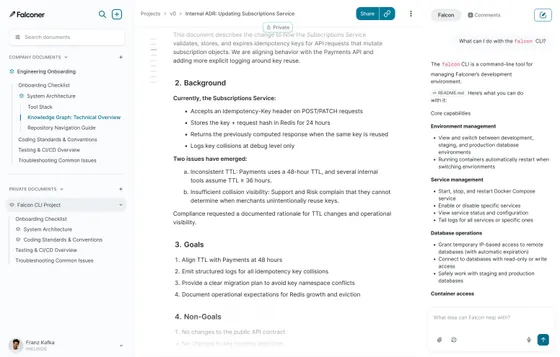
Falconer brings back part of that experience, but adapted to how engineering teams work now. It can read across the sources where context already lives, turn that context into a coherent document, and then listen for changes and apply them when the related system changes.
“Falconer is a librarian for me to some extent, where it can go and do the research, collate information, and give me back a good document,” says Clinton.
For example, when engineers made changes to a service, Falconer updated Clinton’s runbook automatically and notified him in Slack when it was done.
“It means I don’t have to think about documentation as much,” Clinton says.
Fewer questions for engineers
Falconer creates documentation that can absorb questions that formerly landed in engineers’ laps. Clinton likes helping people, but repeat questions carry a cost. They break focus, especially for an engineering manager who’s also writing code.
When Falconer keeps docs current and makes them readable, Clinton doesn’t have to be the interface for every answer. Vori now has high-quality engineering docs for the entire team, runbooks that auto-update as services change, and fewer repeat questions pulling engineers away from their work.
Ready to get started?
Create an account and start building your knowledge base — no contracts or credit card required. Or, contact us to design a custom package for your team.